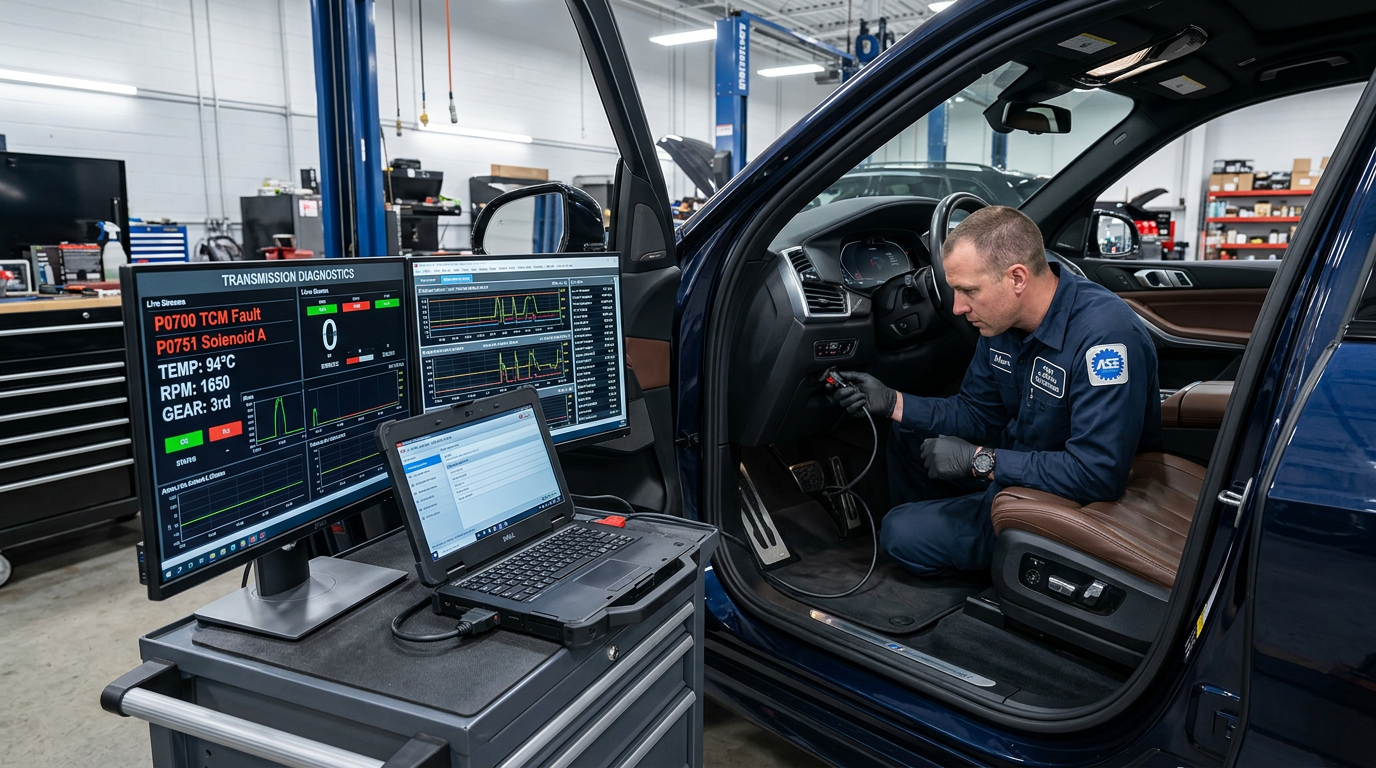
P0720 means your transmission's output speed sensor isn't delivering a reliable signal. Learn what causes this code, how it affects your speedometer, shifting, ABS, and cruise control, and what Chicag
What Does the P0720 Code Mean?
P0720 is a generic OBD-II powertrain diagnostic trouble code that stands for "Output Speed Sensor Circuit Malfunction." It is stored by the Powertrain Control Module (PCM) or Transmission Control Module (TCM) when the signal from the transmission's output shaft speed sensor - sometimes called the Vehicle Speed Sensor (VSS) - is missing, erratic, or does not match the expected value based on other system inputs. The PCM continuously compares the output speed sensor's reading against the input/turbine speed sensor, engine RPM, throttle position, and wheel-speed sensor data. When the output speed signal falls outside the calculated range or disappears entirely, the PCM flags P0720 and illuminates the Check Engine Light.
The output speed sensor is not just a transmission component - it is one of the most interconnected sensors on the entire vehicle. Its signal feeds the transmission controller for shift timing and torque-converter lockup, the instrument cluster for speedometer and odometer operation, the cruise-control module, the ABS and traction-control systems, and in some vehicles, the electronic power steering and fuel-injection strategies. When this single sensor fails, the ripple effect touches nearly every system that depends on knowing how fast the vehicle is moving.
If you are a Chicago-area driver who just had P0720 pulled at a shop on Archer Avenue, scanned at an auto-parts store in Orland Park, or read it yourself after your speedometer died on the Tri-State Tollway, this article will walk you through everything: what the sensor does, what went wrong, what it will cost to fix, and how to keep it from happening again.
The P0720 Code Family: P0721, P0722, P0723, and P0724
P0720 belongs to a family of codes that all address the output speed sensor circuit. Each code in the family narrows the diagnosis in a different direction.
P0720 is the general circuit-malfunction code. It tells the technician that the output speed sensor circuit has a problem but does not specify the exact failure mode. The signal could be absent, erratic, intermittent, or simply out of range. P0721 stands for Output Speed Sensor Circuit Range/Performance, meaning the sensor is producing a signal but that signal is behaving erratically - jumping between values, reading implausibly high or low, or failing to track smoothly with vehicle speed. This code often points to a sensor that is physically deteriorating, a reluctor gear with damaged or missing teeth, or electrical interference from nearby components. P0722 stands for Output Speed Sensor Circuit No Signal, which is the most definitive code in the family: the PCM is receiving absolutely nothing from the sensor. This almost always means the sensor has failed completely, a wire has been severed, or a connector has separated. P0723 indicates an intermittent fault - the signal appears and disappears unpredictably - and is frequently the earliest warning sign in the progression. P0724, where supported, indicates a high-input condition.
When P0720 appears by itself, the technician must test the sensor, wiring, and module to determine which specific failure mode is present. When it appears alongside P0722, the diagnosis points directly to a dead sensor or open circuit. When it appears with P0721 or P0723, the focus shifts to partially degraded components - a sensor losing its magnetic strength, a reluctor gear accumulating debris, or wiring with marginal resistance from corrosion. And when P0720 appears together with P0715 (Input Speed Sensor Circuit Malfunction), the root cause may be shared: contaminated fluid affecting both sensors, a common ground fault in the transmission harness, or an internal transmission problem that has compromised multiple components simultaneously.
How the Output Speed Sensor Works
The output speed sensor is mounted on the outside of the transmission case, positioned near the output shaft - the shaft that exits the transmission and connects to the driveshaft (in rear-wheel-drive vehicles) or the differential/final drive assembly (in front-wheel-drive vehicles). Its location places it at the very end of the transmission's mechanical chain, meaning it measures the speed of the final rotating component before power reaches the wheels.
The sensor works on the same electromagnetic principle as the input speed sensor described in the P0715 article. A toothed reluctor gear - either a separate ring pressed onto the output shaft or teeth machined directly into the shaft - spins past the sensor's magnetic tip. Each tooth passing the sensor generates a voltage pulse. The frequency of these pulses is directly proportional to the rotational speed of the output shaft: more teeth per second means higher RPM, which translates to higher vehicle speed. The PCM converts this pulse frequency into an output-shaft RPM value and, using the known final-drive ratio and tire size, calculates vehicle speed.
Some vehicles use a two-wire magnetic pickup sensor (variable reluctance type), which generates an AC voltage signal whose amplitude and frequency both increase with speed. Others use a three-wire Hall-effect sensor that produces a clean digital square wave and requires a reference voltage (typically 5 volts) and a ground. The type matters during diagnosis because the testing procedures differ: a two-wire sensor is checked by measuring AC voltage output and coil resistance, while a three-wire sensor is checked by verifying reference voltage, ground integrity, and signal waveform.
The output speed sensor's signal serves multiple critical functions. For transmission control, the PCM compares output shaft speed to input shaft speed to calculate the current gear ratio, determine when to shift, and verify that each shift was executed correctly. For torque-converter lockup, the PCM uses the speed differential between input and output to manage engagement and disengagement of the TCC clutch. For the speedometer and odometer, the output speed signal - or a derivative of it - drives the instrument-cluster display. For cruise control, the PCM uses vehicle speed to maintain the set speed and determine when to command transmission downshifts for deceleration. For ABS and traction control, the output speed signal provides a reference against which individual wheel-speed sensors are compared; a significant discrepancy between the output sensor and the wheel sensors indicates a potential wheel lockup or spin condition.
For Chicago drivers, this means a failed output speed sensor does not just cause shifting problems - it can disable your cruise control on a long stretch of I-294, cause your speedometer to read zero while you are doing 60 on Lake Shore Drive, and trigger ABS and traction-control warning lights that leave you without electronic stability assistance on icy January roads. The breadth of systems affected makes P0720 one of the most impactful single-sensor failures on any vehicle.
Common Causes of P0720
The causes of P0720 span several categories, from simple and inexpensive fixes to complex and costly repairs.
Faulty output speed sensor is the most common cause. The sensor operates in an environment of constant vibration, heat cycling, and transmission-fluid immersion. Over tens of thousands of miles, the internal coil windings can develop open circuits or shorts, the magnetic element can lose strength, and the sensor housing can crack and allow fluid to migrate into the electrical connector. Two-wire variable-reluctance sensors are particularly susceptible to gradual magnetic degradation, where the signal amplitude slowly decreases until it falls below the PCM's detection threshold. The result is a signal that becomes erratic at low speeds first (where pulse amplitude is already low) and eventually fails at all speeds.
Damaged or corroded wiring and connectors are the second most common cause and are especially prevalent in Chicago. The output speed sensor's connector sits on the lower portion of the transmission case, directly in the path of road spray. During the five months of salt season - November through March - every trip through slush and brine deposits a fresh layer of corrosion-accelerating moisture on the connector, the wiring harness, and any ground points on the transmission. Over two or three winters, this corrosion can build up inside the connector housing, increase resistance on the signal wire, and eventually prevent the PCM from reading a clean signal. A corroded ground connection is particularly insidious because it can cause the signal to float, producing the erratic readings that trigger P0721 before progressing to a full P0720 or P0722.
Damaged reluctor gear is less common but important to identify because it requires a different repair approach. The reluctor gear's teeth can be damaged by internal transmission debris - metallic particles from worn clutch packs, bearings, or thrust washers that circulate in the fluid. If a tooth chips, cracks, or breaks off entirely, the sensor produces an irregular pulse pattern that the PCM interprets as a malfunction. Some vehicles use a plastic drive gear on the output shaft that meshes with the sensor's own plastic gear; these plastic gears can strip, crack, or wear over time, especially on vehicles with high mileage.
Contaminated or low transmission fluid contributes to P0720 in several ways. Metallic debris in degraded fluid accumulates on the sensor's magnetic tip, effectively bridging the gaps between reluctor teeth and preventing the sensor from generating distinct pulses. Low fluid level can leave the sensor operating in a partially air-exposed environment, altering its thermal and electromagnetic properties. Severely degraded fluid may also fail to adequately lubricate the output shaft bearings, introducing wobble that distorts the signal.
Power and ground circuit problems deserve specific attention. The output speed sensor relies on stable electrical conditions to produce a readable signal. A two-wire sensor needs a solid chassis ground to complete the circuit; a three-wire sensor needs both a 5-volt reference and a clean ground. Voltage drops caused by a weak battery, a failing alternator, corroded battery terminals, or a compromised ground strap anywhere in the circuit can distort the sensor signal enough to trigger P0720. This cause is especially relevant in Chicago winters, where cold temperatures stress batteries and starting systems, and road-salt corrodes ground connections.
Internal transmission mechanical failure is the most serious potential cause. A failing output shaft bearing, a damaged planetary gear set, or a problem with the parking pawl mechanism can all affect the output shaft's rotation in ways that produce abnormal speed readings. These causes are rare but significantly more expensive to address.
PCM or TCM failure is uncommon but possible. If the module's internal circuitry that processes the output speed signal is damaged - from voltage spikes, thermal stress, or water intrusion - it may misinterpret a perfectly healthy sensor signal and set P0720 erroneously. This is typically a diagnosis of exclusion, reached only after the sensor, wiring, reluctor, fluid, and power/ground circuits have all been verified as functional.
Symptoms Chicago Drivers Will Notice
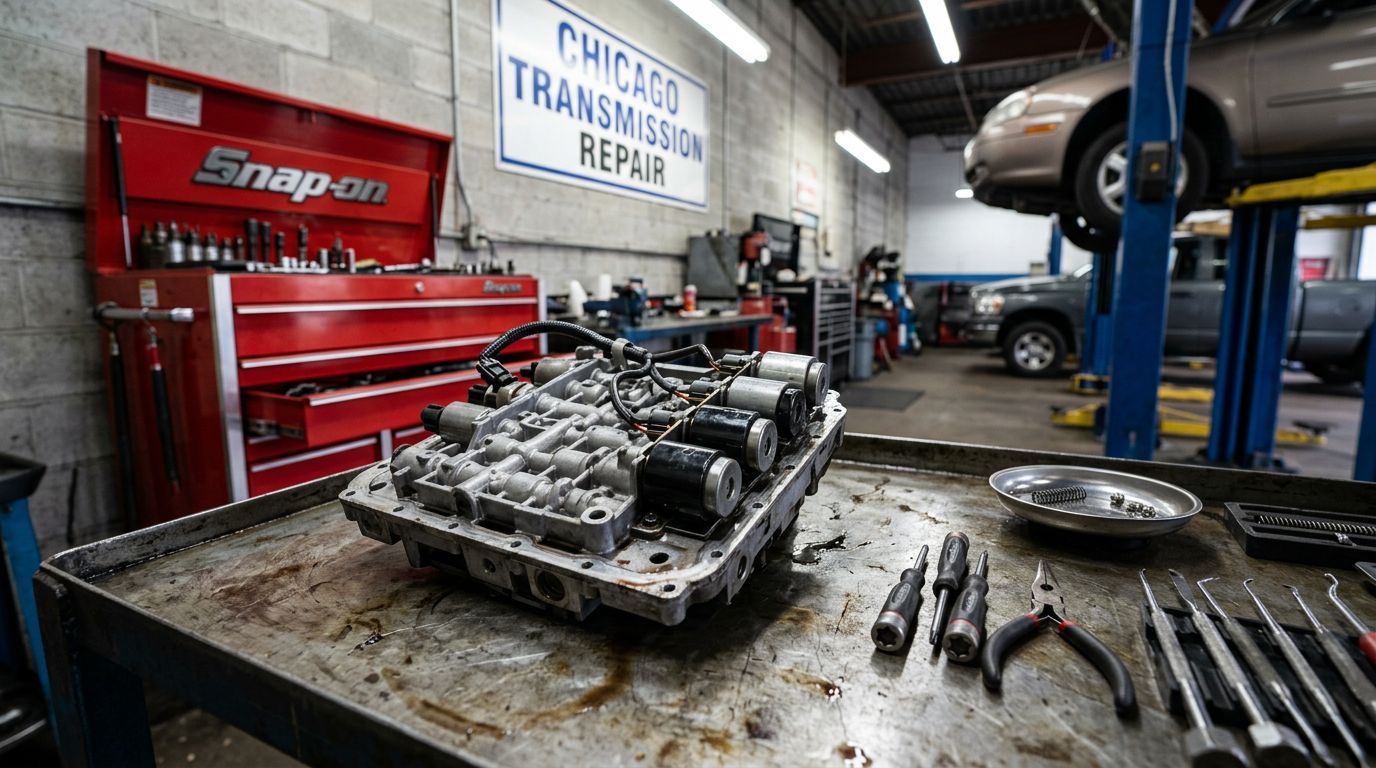
P0720 produces a wider range of symptoms than most transmission codes because the output speed sensor feeds so many different systems.
The most immediately noticeable symptom for many drivers is a malfunctioning speedometer. If the output speed sensor stops sending a signal, the speedometer may drop to zero, jump erratically, or freeze at a particular reading regardless of actual vehicle speed. If you are driving on the Kennedy Expressway and your speedometer suddenly reads zero, or if it is bouncing between 0 and 85 miles per hour while you are cruising at a steady 55, the output speed sensor circuit is a prime suspect. Beyond the inconvenience, an inaccurate speedometer creates a real legal risk - you have no reliable way to know whether you are within the posted speed limit, and a traffic stop on the Eisenhower or I-90/94 is an expensive proposition.
Harsh, delayed, or erratic shifting is the next most common symptom. Without a reliable output speed signal, the PCM cannot calculate the current gear ratio or determine when to command the next shift. The result is a transmission that shifts too early, too late, or not at all. Shifts may be accompanied by a harsh jolt or clunk. In some cases, the transmission may stay locked in a single gear - either because the PCM has entered limp mode intentionally or because it simply does not have enough data to command a change.
Limp mode is a frequent consequence of P0720, particularly when the signal is completely absent (a condition that would also set P0722). The PCM restricts the transmission to second or third gear and limits engine power, capping vehicle speed at roughly 25 to 40 miles per hour. This is a protective strategy designed to allow you to reach a repair facility, but it is not designed for expressway driving. If limp mode engages on the Dan Ryan during rush hour, you will need to exit immediately and navigate surface streets to the nearest shop.
Cruise-control failure is an often-overlooked symptom. The cruise-control system requires a valid vehicle speed signal to maintain a set speed and to determine when to disengage for safety. When P0720 is set, many vehicles automatically disable cruise control, which means your long commute from Schaumburg or Joliet into the city becomes a less comfortable affair.
ABS and traction-control warning lights may illuminate because these systems compare wheel-speed data to the output speed sensor's signal to detect wheel lockup or spin. Without a reliable output speed reference, the ABS module cannot accurately evaluate wheel-speed data, and it deactivates both ABS and traction control as a precaution. Losing these systems is a genuine safety concern during Chicago winters, when icy intersections and snow-covered on-ramps demand every electronic stability aid the vehicle can provide.
Stalling at idle or upon deceleration can occur in some vehicles where the PCM uses the output speed signal to manage torque-converter lockup at low speeds. If the PCM believes the vehicle is still moving (because the signal is erratic) when it is actually stopped, it may keep the converter locked, creating a load that stalls the engine.
Decreased fuel economy rounds out the symptom list. When the transmission cannot shift correctly and the torque-converter lockup clutch cannot engage at highway speeds, the engine operates at higher RPMs than necessary for every mile driven. For a daily Chicago commuter, this can mean a 10 to 15 percent increase in fuel costs until the fault is corrected.
Can You Drive With P0720?
The answer depends on which symptoms are present and how severe they are.
If the speedometer is inaccurate and cruise control has deactivated but the transmission still shifts through all gears without harshness or slipping, you can drive carefully to a repair shop. Use a GPS-based speedometer app on your phone as a temporary reference for speed, and plan the shortest route.
If the transmission is in limp mode, limit yourself to surface streets at 25 to 35 miles per hour and use hazard lights if you are significantly slower than surrounding traffic. Do not enter any expressway. If the shop is more than a few miles away, call a tow truck. A flatbed tow within the Chicago metro area usually costs far less than the transmission damage extended limp-mode driving can cause.
If the transmission is slipping, stalling, making unusual noises, or refusing to shift entirely, do not drive the vehicle. Have it towed immediately.
If ABS and traction-control warning lights are on, be especially cautious if road conditions are wet, icy, or snowy. Without ABS, your braking distance increases significantly, and without traction control, wheelspin on slippery surfaces is unmediated. Reduce speed, increase following distance, and avoid sudden braking or acceleration.
How P0720 Is Diagnosed
A proper diagnosis follows a structured sequence that isolates the root cause efficiently.
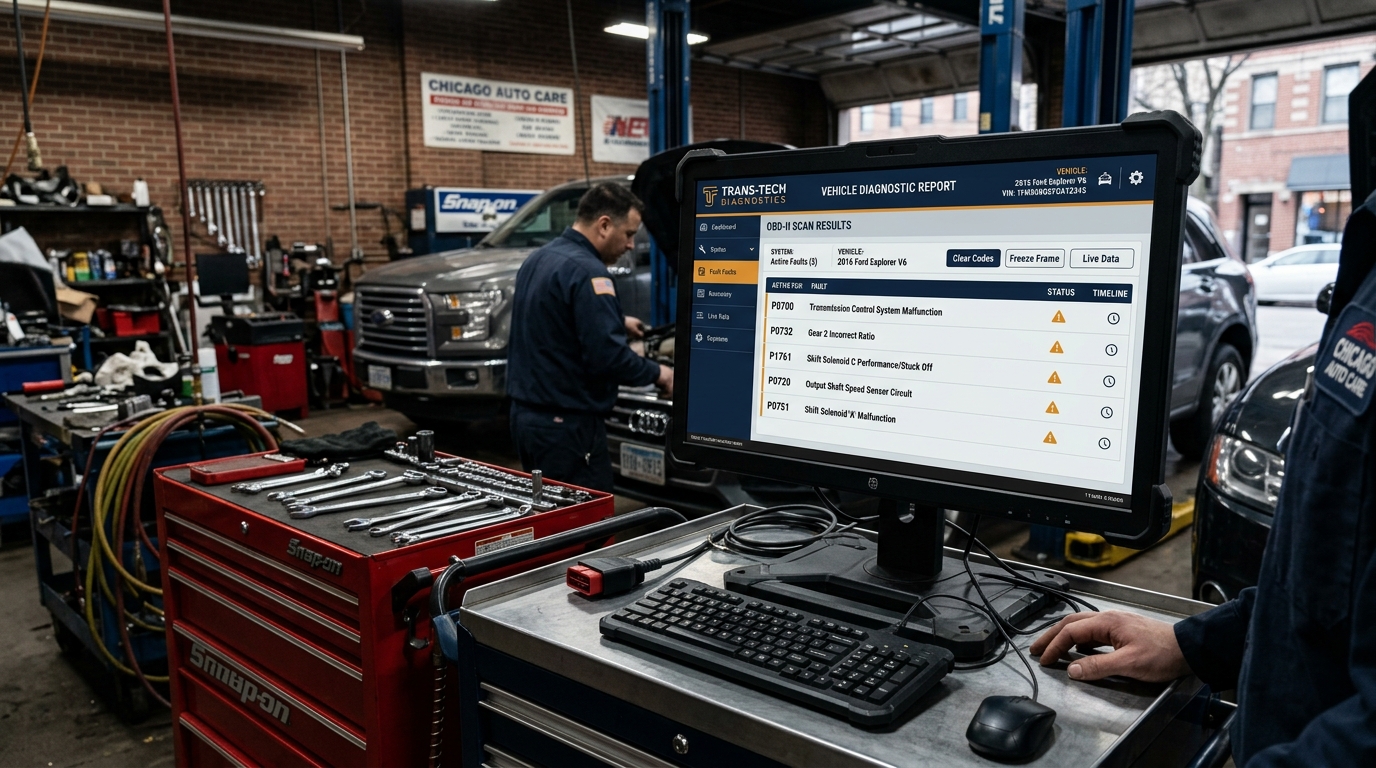
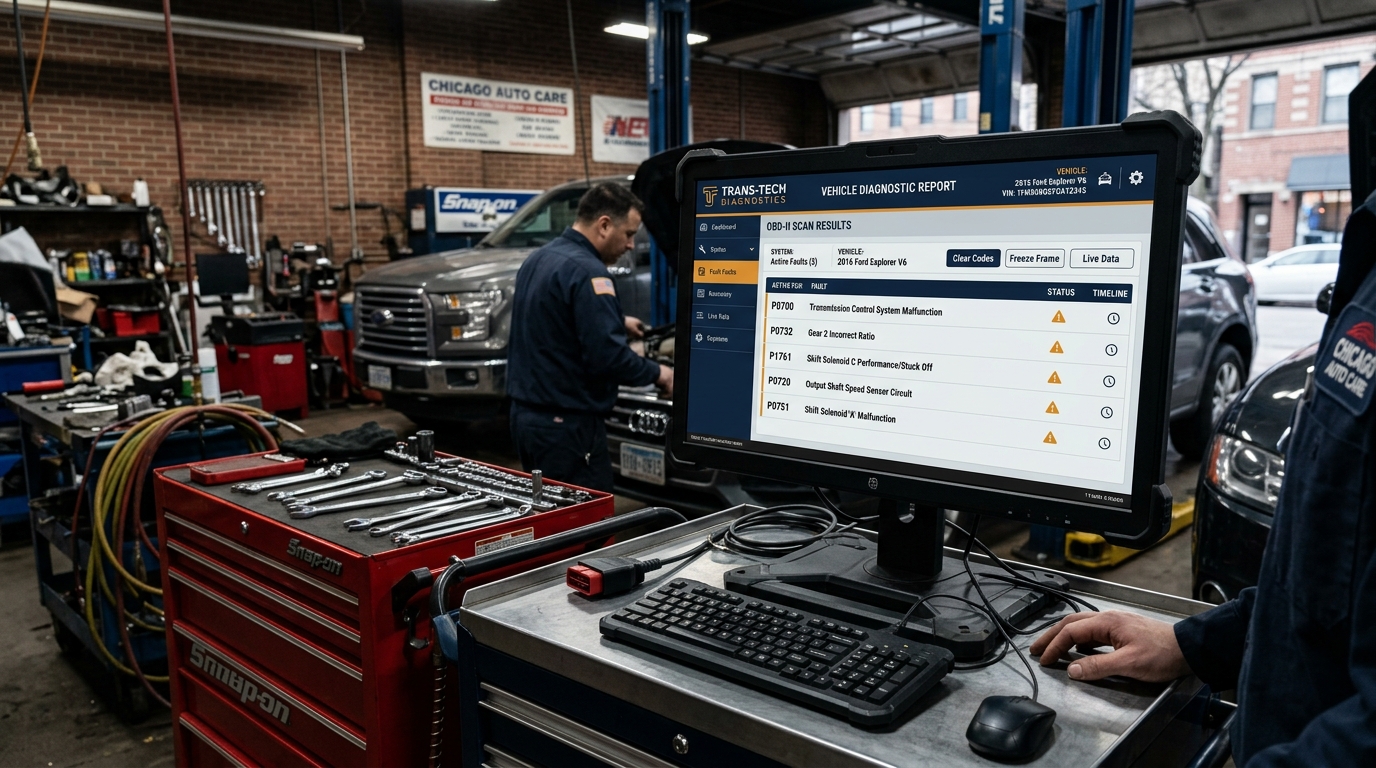
The first step is a comprehensive scan using a professional-grade scanner that reads both PCM and TCM codes, freeze-frame data, and pending codes. The freeze-frame snapshot tells the technician the exact conditions under which the code set - vehicle speed (as reported by other sensors), engine RPM, transmission temperature, throttle position, and the gear the transmission was in. Related codes are noted: P0700 (master transmission fault), P0715 (input speed sensor), P0721-P0723 (output speed sensor sub-codes), and any ABS or cruise-control codes that may have been triggered by the loss of the speed signal.
Next, the technician connects to the live data stream and monitors the output speed sensor reading while the vehicle is running and the wheels are spinning - either on the road or on a lift. A healthy two-wire sensor produces a smooth, proportional signal: the RPM reading climbs steadily as vehicle speed increases, with no sudden drops, jumps, or flat spots. A reading that is stuck at zero indicates a dead sensor or open circuit. A reading that jumps erratically suggests an intermittent connection, a damaged reluctor, or electromagnetic interference. A reading that is consistently different from what the wheel-speed sensors report (which can be checked in the ABS data) suggests a calibration issue or a mechanical problem with the output shaft.
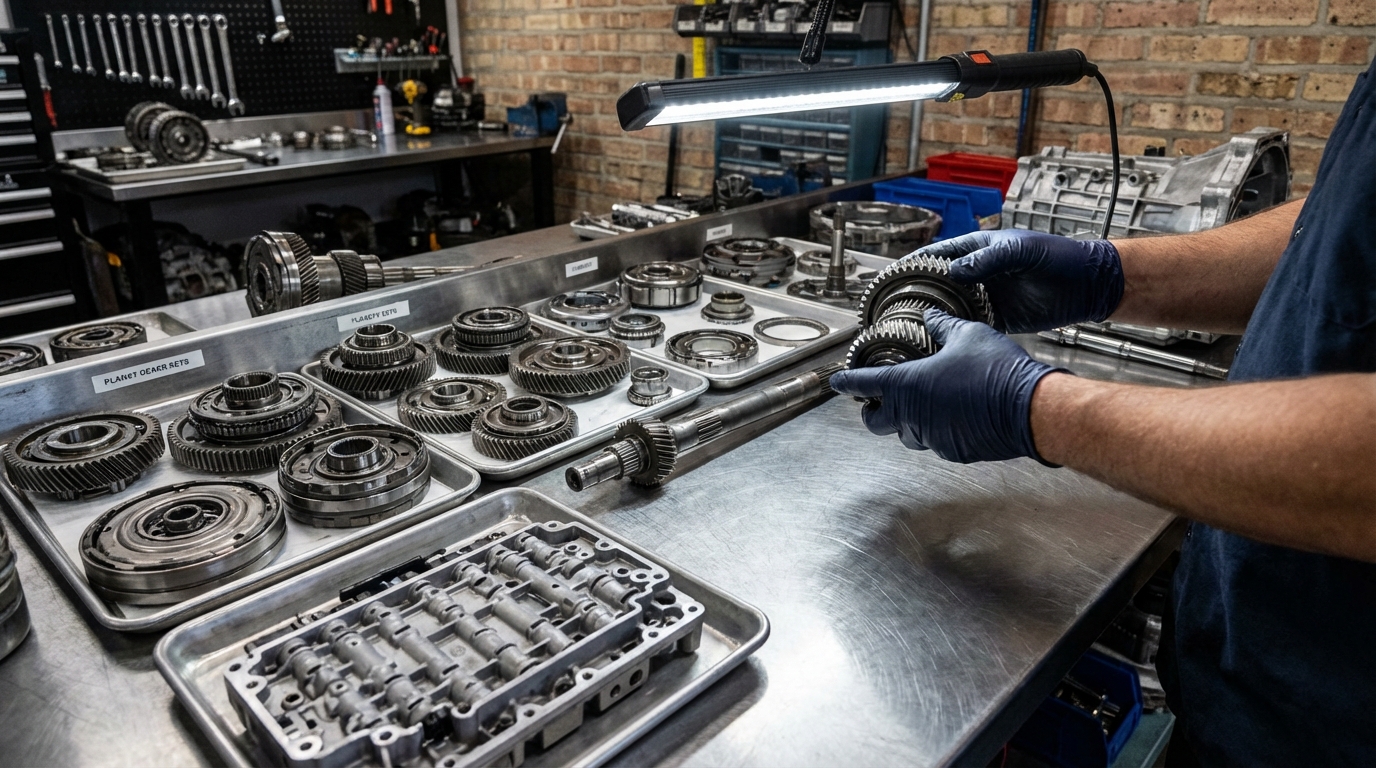
Transmission fluid is inspected for level, color, smell, and metallic contamination. Low or dark fluid with metallic flecks suggests internal wear that may be contaminating the sensor. Milky or foamy fluid indicates coolant intrusion or aeration, both of which can affect sensor operation.
Electrical testing follows. For a two-wire sensor, the technician disconnects it and measures coil resistance with a multimeter. Typical specifications range from 500 to 700 ohms for most two-wire output speed sensors, though this varies by manufacturer. A reading outside the specified range - infinite resistance means an open coil, very low resistance means a short - confirms a failed sensor. The wiring harness is tested for continuity from the sensor connector to the PCM connector, and the signal wire is checked for shorts to ground or to battery voltage.
For a three-wire Hall-effect sensor, the technician verifies that the reference voltage at the sensor connector reads approximately 5 volts with the ignition on and that the ground pin reads less than 0.1 ohms to chassis ground. An oscilloscope may be used to verify the signal waveform - a clean digital square wave at the correct frequency for the given vehicle speed.

If the sensor and wiring test within specification, the technician inspects the reluctor gear visually. On many vehicles, this requires removing the sensor and using a borescope or flashlight to examine the teeth. Missing, chipped, or heavily debris-coated teeth explain a P0720 despite a healthy sensor and wiring.
If all physical components test normal, the PCM or TCM becomes the suspect. The technician may attempt a software reflash to the latest calibration, and if that does not resolve the code, the module's internal input-conditioning circuit is likely failed.
P0720 Repair Costs: What to Expect
P0720 usually starts with output-speed-sensor diagnosis, but the final repair depends on what failed. The sensor may be bad, the connector may be corroded, the harness may be open or shorted, the reluctor may be damaged, or metal debris from internal wear may be confusing the signal.
A good diagnosis compares live speed-sensor data, checks the wiring and connector, inspects the fluid for debris, and confirms whether the transmission is otherwise shifting normally. If the vehicle is in limp mode, slipping, or showing ABS and traction-control warnings at the same time, do not assume it is only a simple sensor.
Ask for a written estimate after the shop confirms the root cause. Replacing a sensor without addressing contaminated fluid, wiring damage, or internal wear can bring the same code back.
Vehicles Commonly Affected by P0720
P0720 appears across all makes and models, but certain platforms are notably more susceptible.
Nissan and Infiniti vehicles are among the most frequently affected. The 7-speed automatic (RE7R01A) and various CVT transmissions used in models like the Altima, Maxima, Pathfinder, Infiniti Q50, Q60, and QX80 have a well-documented history of output speed sensor failures. Hyundai issued a technical service bulletin addressing known output speed sensor issues on several Elantra and Sonata models, acknowledging the problem and providing updated repair procedures. On these platforms, the output speed sensor is sometimes integrated into the valve body or tail housing in a way that makes replacement somewhat more labor-intensive than on vehicles with simple external sensors.
General Motors trucks and SUVs with the 4L60E, 4L80E, and 6L80 transmissions - including the Chevrolet Silverado, Tahoe, Suburban, and GMC Sierra and Yukon - see P0720 regularly. These transmissions use an externally mounted output speed sensor on the tail housing that is relatively easy to access and replace, keeping repair costs on the lower end.
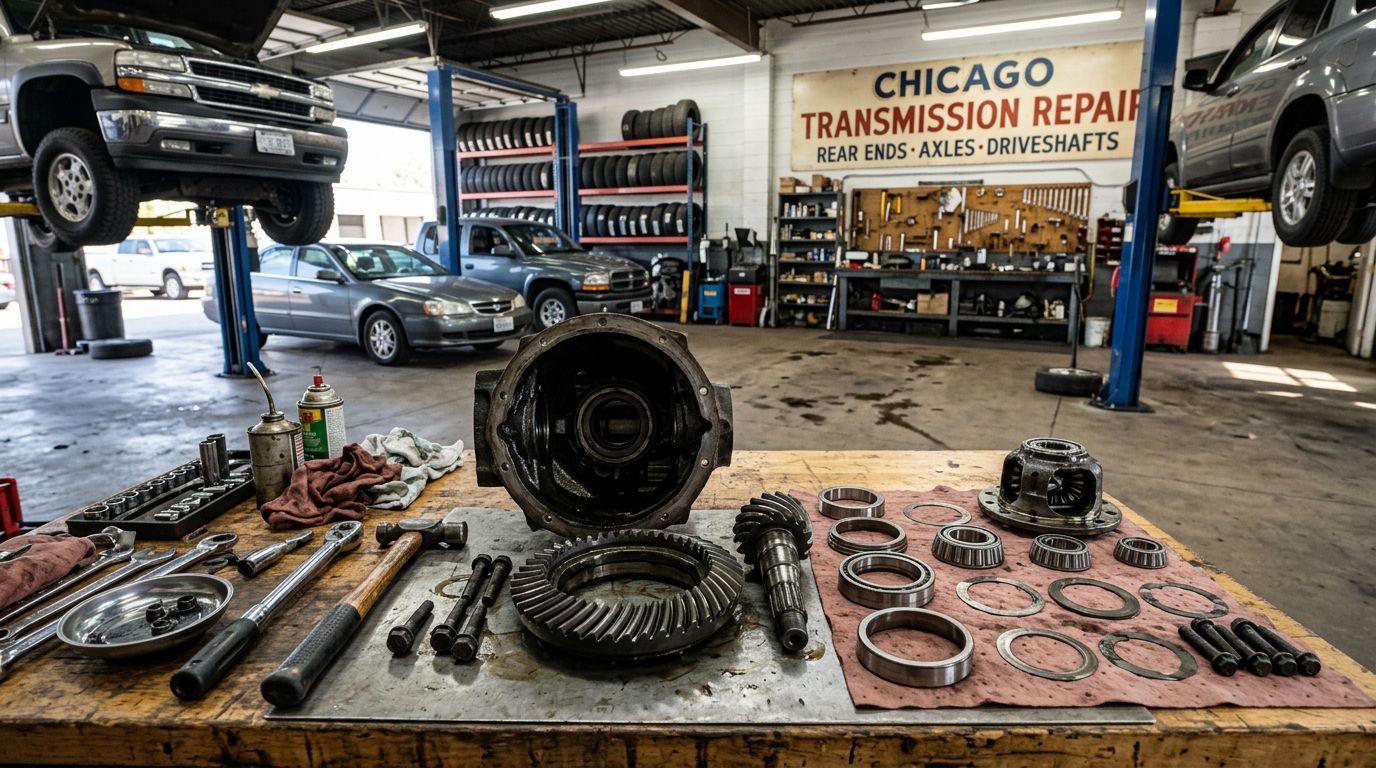
Chrysler, Dodge, and Jeep vehicles with the 42RLE, 45RFE, and 68RFE transmissions are also common P0720 candidates. The sensor location varies by transmission, but most are accessible without major disassembly.
Ford vehicles with the 5R55, 6R80, and 10R80 transmissions, including the F-150, Explorer, Edge, and Mustang, round out the list. Ford's diagnostic procedures for P0720 on certain models specifically call for verifying the integrity of the driven gear (the plastic gear that meshes with the output shaft), as these are known to strip at higher mileages.
Honda and Acura vehicles, while generally less prone to P0720 than the platforms listed above, can develop the code at higher mileages - typically above 120,000 miles - especially when fluid maintenance has been deferred. Honda transmissions are particularly sensitive to fluid condition, and contaminated fluid accelerates sensor degradation.
The Relationship Between P0720 and P0715
Because the previous article in this series covered P0715 - Input/Turbine Speed Sensor Circuit Malfunction - it is important to explain how these two codes interact. The input speed sensor and the output speed sensor work as a pair. The input sensor measures the speed of the transmission's input shaft (which rotates at a speed determined by the torque converter and the engine), while the output sensor measures the speed of the transmission's output shaft (which rotates at a speed determined by the engaged gear ratio). The ratio between these two readings tells the PCM which gear the transmission is actually in, and any deviation from the expected ratio triggers gear-ratio codes like P0730 through P0736.
When P0715 and P0720 appear simultaneously, the technician should investigate shared causes before replacing individual sensors. The most common shared cause is contaminated transmission fluid - metallic debris from internal wear accumulates on both sensors' magnetic tips, degrading both signals at the same time. A common ground fault in the transmission harness can also affect both sensors, as can a failing TCM that cannot process either signal correctly. Replacing one sensor without addressing the shared root cause is a common and expensive mistake: the new sensor fails within weeks or months because the fluid, wiring, or module problem was never resolved.
When only one code is present - either P0715 or P0720, but not both - the diagnosis is more likely to involve that specific sensor, its dedicated wiring, or its reluctor. The technician should still check the other sensor's live data as a cross-reference, since a borderline sensor that has not yet triggered its own code may be on the verge of failure.
How Chicago's Driving Conditions Contribute to P0720
Chicago's unique driving environment accelerates the conditions that lead to output speed sensor failure.
Road salt is arguably the single greatest contributing factor for the output speed sensor specifically. The sensor and its connector sit on the lower portion of the transmission case, fully exposed to the slush, brine, and road spray that coat the underside of every vehicle from late fall through early spring. Unlike the input speed sensor - which is often somewhat shielded by the bell housing - the output speed sensor is typically located on the tail housing or the side of the case, where it takes the full brunt of undercarriage exposure. Five consecutive Chicago winters can leave the connector pins so corroded that resistance on the signal wire increases by several hundred ohms, distorting the signal well before any visible green crust appears on the outside of the connector.
Temperature extremes stress the sensor in two ways. In winter, sub-zero mornings cause the sensor housing, wiring insulation, and connector seals to contract and become brittle. Micro-cracks that develop in these materials allow moisture intrusion that accelerates internal corrosion. In summer, the combination of ambient heat, transmission operating temperature, and the radiant heat from stop-and-go traffic on the Dan Ryan or the Stevenson can push the sensor's operating temperature past its design limits. This thermal cycling - freezing to overheating and back - repeats hundreds of times per year and is the primary mechanical aging mechanism for the sensor.
Potholes deliver direct mechanical shock to the sensor and its mounting. A hard hit can crack the sensor housing, jar the reluctor gear, or stress the wiring harness at the connector or a clamp point. Chicago streets - particularly the heavily trafficked arteries like Western Avenue, Ashland, and Pulaski - develop potholes that are essentially small craters by February. Each impact transfers force through the transmission case to the sensor and its mounting boss.
Stop-and-go traffic increases the number of shift cycles per mile, which means the output speed sensor processes more data per trip than on a vehicle driven primarily on open highways. This higher duty cycle does not directly wear the sensor, but it provides the PCM with more frequent opportunities to detect a marginal signal and set a code, meaning intermittent faults are caught sooner in city driving than in highway driving.
Prevention Tips for Chicago Drivers
Preventing P0720 requires the same proactive maintenance strategy discussed in the P0715 article, with additional emphasis on the output sensor's greater exposure to road spray and salt.
Change your transmission fluid every 30,000 miles under Chicago driving conditions. This removes the metallic debris that accumulates on both speed sensors and keeps the fluid's lubricating and thermal properties within specification. Use the exact ATF type listed in your owner's manual. Incorrect fluid can cause shifting problems regardless of sensor condition and may accelerate degradation of internal components that produce the debris that fouls sensors.
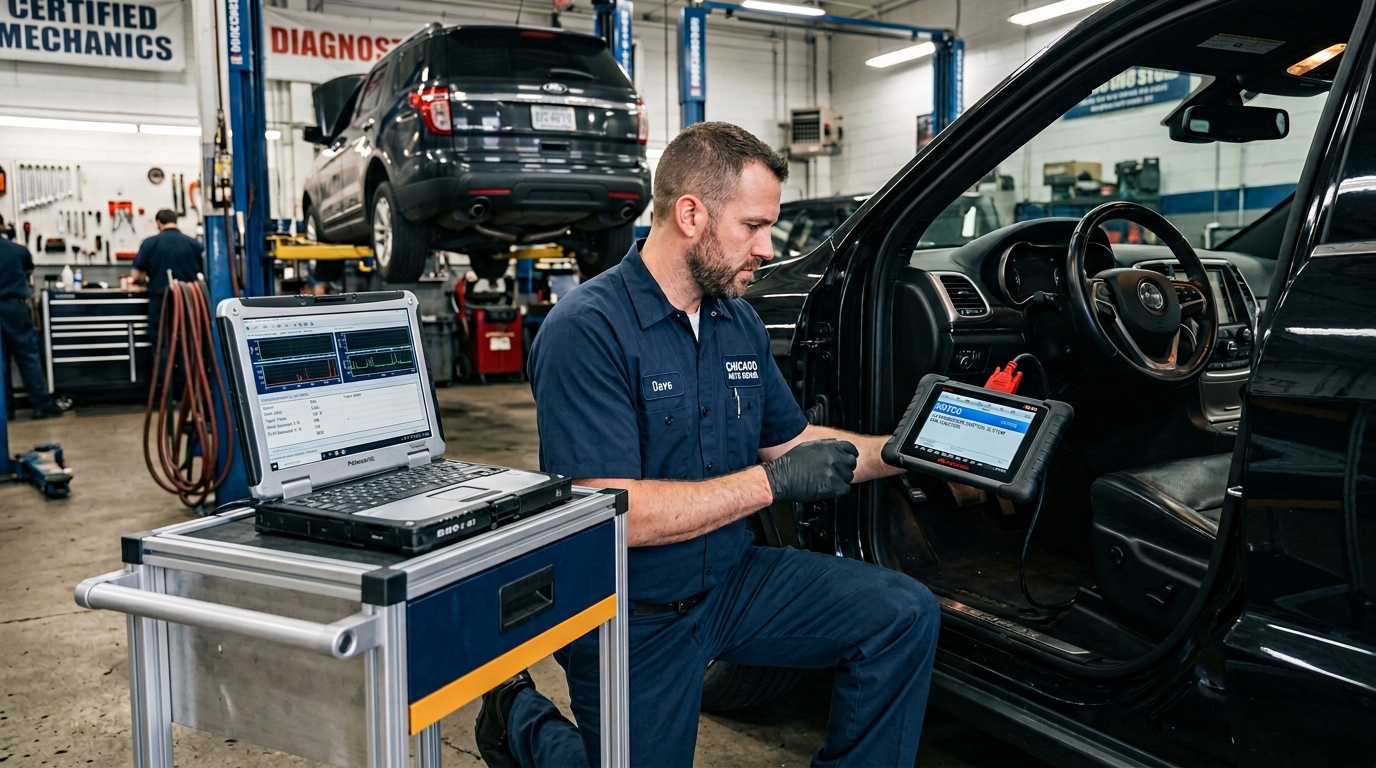
Inspect the output speed sensor connector at least once a year, ideally during a spring service visit after salt season ends. Because the output sensor sits lower and more exposed than the input sensor, it requires more vigilant attention. Pull the connector apart, clean any corrosion from the pins with electrical contact cleaner, and apply a fresh coat of dielectric grease. This five-minute annual ritual can prevent the gradual signal degradation that turns a maintenance item into a sensor replacement.
Consider an underbody wash or flush after heavy salt exposure. Many automatic car washes in the Chicago area offer an undercarriage spray option. Running your vehicle through this wash every two to three weeks during peak salt season (December through February) removes the concentrated brine that does the most corrosive damage. It is not a perfect solution, but it significantly slows the rate of corrosion on connectors, wiring, and ground points.
Pay attention to your speedometer, cruise control, and shift quality. The earliest signs of output speed sensor degradation are often subtle: the speedometer may flicker briefly at low speeds, cruise control may disengage unexpectedly once or twice, or a shift may feel slightly harsher than usual. These intermittent symptoms often correspond to P0723 (intermittent fault) before a hard failure sets P0720 or P0722. Catching the problem early - before the sensor dies completely - often means the repair is limited to cleaning a corroded connector or replacing a sensor rather than diagnosing a no-signal condition that requires more extensive testing.
Maintain your battery and charging system. A weak battery or corroded battery terminals cause voltage drops that can distort the reference voltage feeding three-wire speed sensors. A healthy battery and clean terminals ensure that the sensor always receives the stable 5-volt reference it needs to produce a clean signal. This is especially important in Chicago winters, where cold-cranking demands place maximum stress on the battery and alternator.
Frequently Asked Questions
What does P0720 mean in plain language?
P0720 means the computer that controls your transmission is not receiving a usable signal from the sensor that measures how fast the transmission's output shaft is spinning. Without this information, the transmission cannot shift correctly, the speedometer may not work, and systems like cruise control, ABS, and traction control may be disabled.
Is P0720 serious?
Yes. It affects more vehicle systems than almost any other single-sensor failure. Beyond transmission shifting problems, it can disable your speedometer, cruise control, ABS, and traction control. RepairPal and other diagnostic resources rate it as an urgent code that should not be ignored.
How much does it cost to fix P0720?
The most common repair is sensor replacement after the circuit is tested. Wiring repairs are also common when the harness or connector is damaged. TCM replacement is less common and should only be considered after the sensor and wiring are ruled out. A full transmission rebuild is only relevant if internal damage is present.
Can dirty transmission fluid cause P0720?
Yes. Metallic particles in degraded fluid accumulate on the sensor's magnetic tip and on the reluctor gear, preventing the sensor from generating clean pulses. A fluid and filter service may resolve the code in early-stage cases without requiring sensor replacement.
What is the difference between P0720 and P0722?
P0720 is the general circuit-malfunction code - something is wrong with the output speed sensor circuit but the specific failure mode is unspecified. P0722 specifically indicates that no signal is being received at all, pointing strongly toward a completely failed sensor, a severed wire, or a disconnected connector.
Does P0720 affect my speedometer?
In many vehicles, yes. The output speed sensor provides the speed signal that drives the speedometer. If the sensor fails, the speedometer may read zero, freeze at a random value, or jump erratically. If your speedometer is malfunctioning alongside shifting problems, P0720 is a very likely cause.
Does P0720 disable ABS and traction control?
It can. The ABS module uses the output speed sensor's signal as a reference to compare against individual wheel-speed sensors. When the output speed signal is absent or erratic, the ABS module cannot accurately detect wheel lockup or spin, so it deactivates both ABS and traction control as a safety precaution. You will typically see ABS and traction-control warning lights on the dashboard.
Can I clear P0720 and see if it comes back?
Clearing the code is a useful diagnostic step. If the code does not return after several drive cycles, the fault may have been intermittent or related to a temporary condition. If it returns within one to three drive cycles, the fault is persistent and requires physical repair. Either way, clearing the code does not fix the underlying problem.
Which vehicles are most prone to P0720?
Nissan and Infiniti vehicles with the 7-speed automatic and various CVT transmissions are among the most commonly affected. GM trucks with the 4L60E and 6L80, Chrysler and Dodge vehicles with the 42RLE and 45RFE, Ford F-150s and Explorers, and Hyundai Elantras and Sonatas (covered by a manufacturer TSB) also see elevated rates of P0720.
Should I replace the output speed sensor and the input speed sensor at the same time?
Not necessarily, unless both are confirmed faulty by testing. However, if both sensors are original on a high-mileage vehicle and the transmission pan is already being dropped for the repair, many technicians recommend replacing both as a preventive measure. The incremental cost of the second sensor is small compared to the labor of accessing it separately later.
1. P0700 - Transmission Control System Malfunction
2. P0730 - Incorrect Gear Ratio
3. P0740 - Torque Converter Clutch Circuit Malfunction
4. P0741 - Torque Converter Clutch Circuit Performance / Stuck Off
5. P0750 - Shift Solenoid A Malfunction
6. P0755 - Shift Solenoid B Malfunction
7. P0715 - Input/Turbine Speed Sensor Circuit Malfunction
8. P0720 - Output Speed Sensor Circuit Malfunction (just completed)
Have a Transmission Problem?
Get a free computer diagnostic from Chicago transmission repair support.