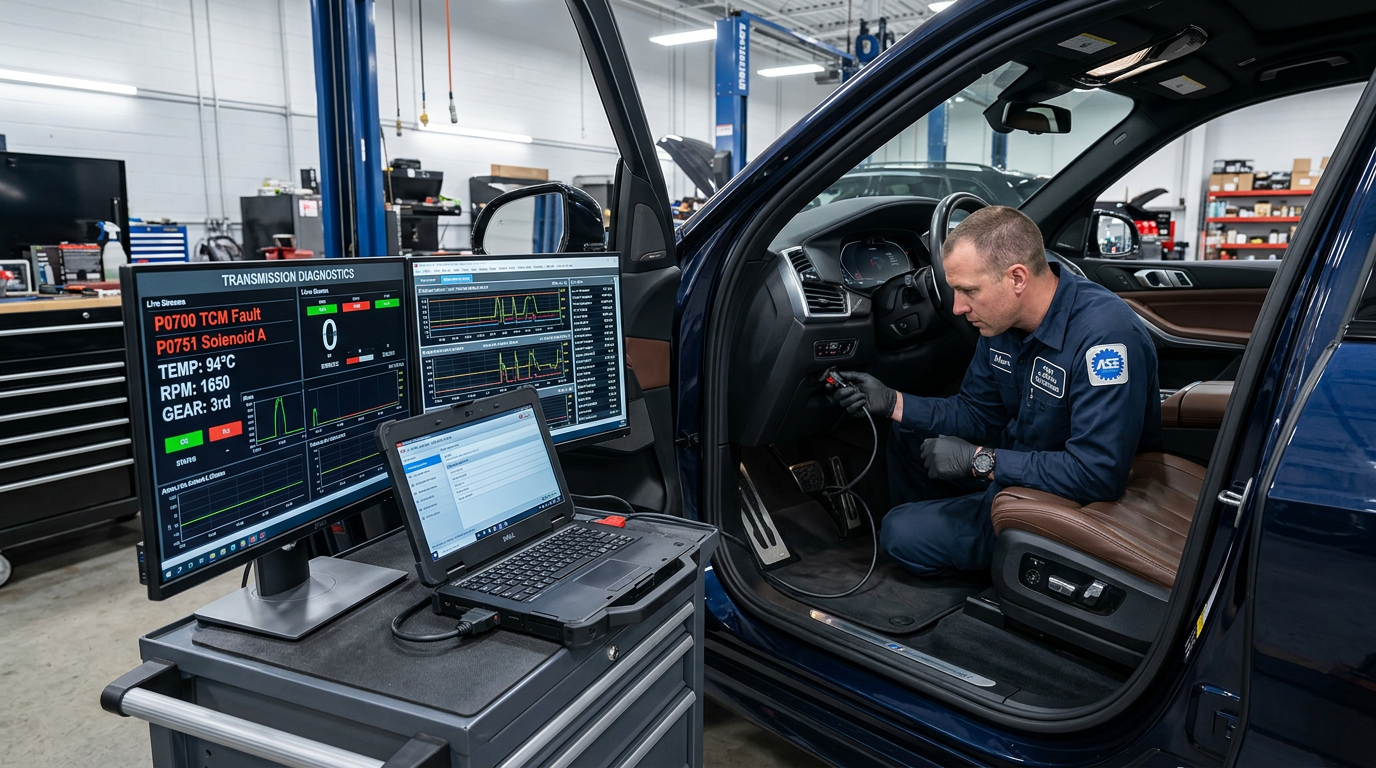
P0751 means shift solenoid A isn't opening when commanded, causing delayed shifts, limp mode, and gear lock-up. Learn causes, diagnosis, and Chicago-area repair costs.
What Does the P0751 Code Mean?
Diagnostic trouble code P0751 stands for "Shift Solenoid 'A' Performance or Stuck Off." It is a generic OBD-II powertrain code applicable to all automatic-transmission vehicles from 1996 onward. The code is set when the TCM or PCM commands shift solenoid A to open (energize) in order to execute a gear change, but the expected shift either never occurs or occurs with measurably abnormal quality - delayed timing, excessive RPM flare, or absent gear engagement altogether.
Shift solenoids are small electro-hydraulic valves bolted to the transmission's valve body. When the TCM energizes a solenoid's electromagnetic coil, a plunger moves inside the valve, redirecting pressurized transmission fluid through specific hydraulic passages to engage the clutch pack or band for a particular gear. If solenoid A fails to open when commanded, the hydraulic circuit for the gear it controls never receives fluid, and the shift doesn't happen.
Most automatic transmissions label their shift solenoids as A, B, C (or 1, 2, 3, etc.). Which physical gear change solenoid A controls depends on the transmission design. On GM's ubiquitous 4L60E, solenoid A is the "1-2 shift solenoid" - it controls the upshift from first to second gear. On Ford's 4R70W and 5R55, solenoid A governs a similar low-gear transition. On Honda's 4- and 5-speed automatics, shift solenoid A is part of the linear solenoid assembly on the valve body. Regardless of platform, the diagnostic logic is the same: the TCM sent the "open" command, monitored speed-sensor data and engine-load changes, and concluded that the expected gear ratio change did not occur within the calibrated time window. That mismatch triggers P0751.
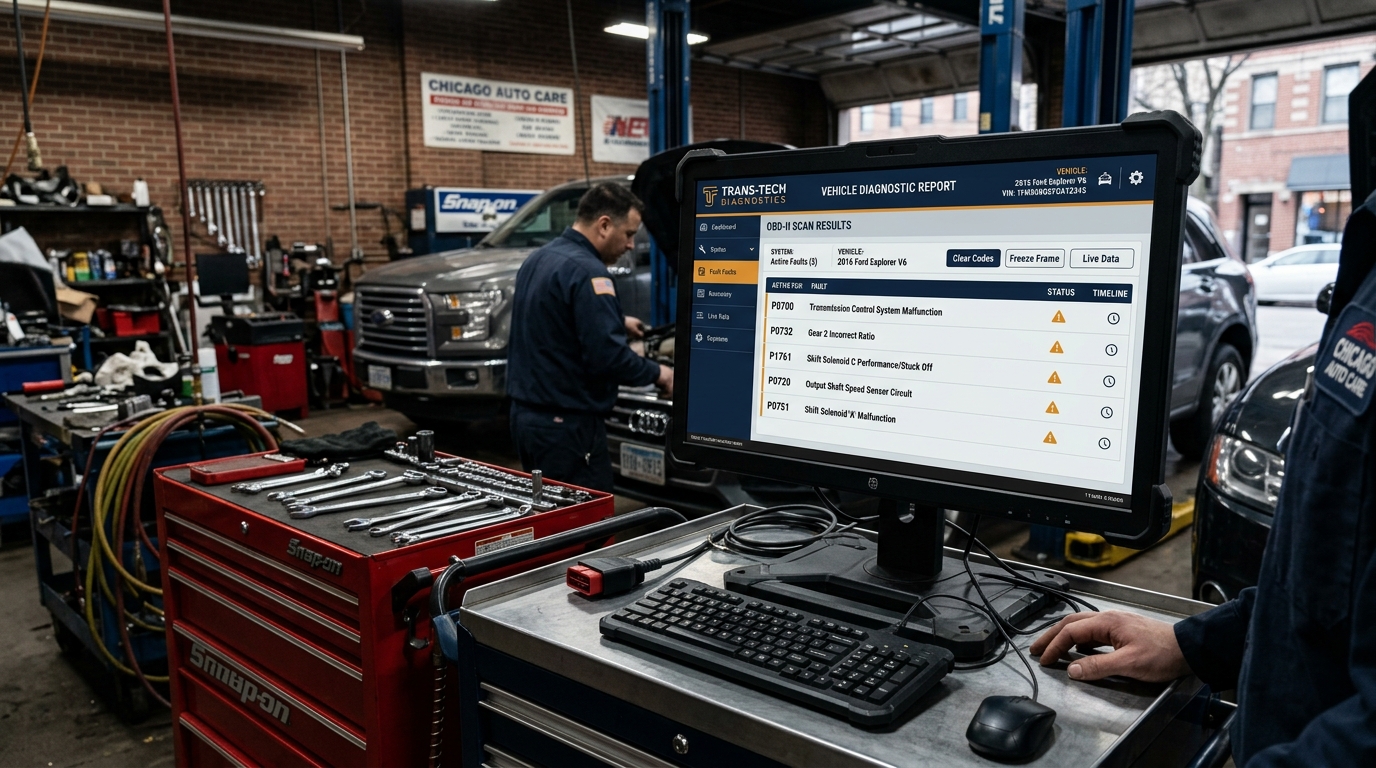
The "performance or stuck off" qualifier means the TCM is specifically flagging that the solenoid appears to remain in its default de-energized (closed) position. This is distinct from P0752 (stuck on), P0753 (electrical fault), and P0754 (intermittent). P0751 therefore points toward a mechanical blockage, hydraulic flow restriction, or a condition where the solenoid coil is electrically intact but the valve physically cannot move.
For Chicago drivers, the practical consequence is immediate and unmistakable: the transmission refuses to complete a gear change, stays stuck in a single gear, or enters limp mode - locking the vehicle in second or third gear at a maximum of 25-40 mph. This is a significant problem on expressways and arterials alike.
The P0750-P0754 Shift Solenoid "A" Code Family
Understanding the full family of solenoid A codes helps a technician narrow the failure mode before dropping the pan.
P0750 is the general shift solenoid A malfunction code - a broad flag that the solenoid circuit or its function is abnormal without specifying the direction of failure. P0751, the subject of this article, indicates the solenoid is stuck off or performing as though it were stuck off; the fluid pathway it controls is not opening. P0752 means the solenoid is stuck on - the fluid pathway remains open when it should close, causing the transmission to stay in or force the gear that solenoid A controls. P0753 is a pure electrical code, indicating an open or short circuit in the solenoid's wiring, connector, or coil. P0754 flags intermittent solenoid A operation - the valve works sometimes but not consistently, often pointing to a marginally clogged valve, a loose connector pin, or an internal wire that breaks contact under vibration or heat.
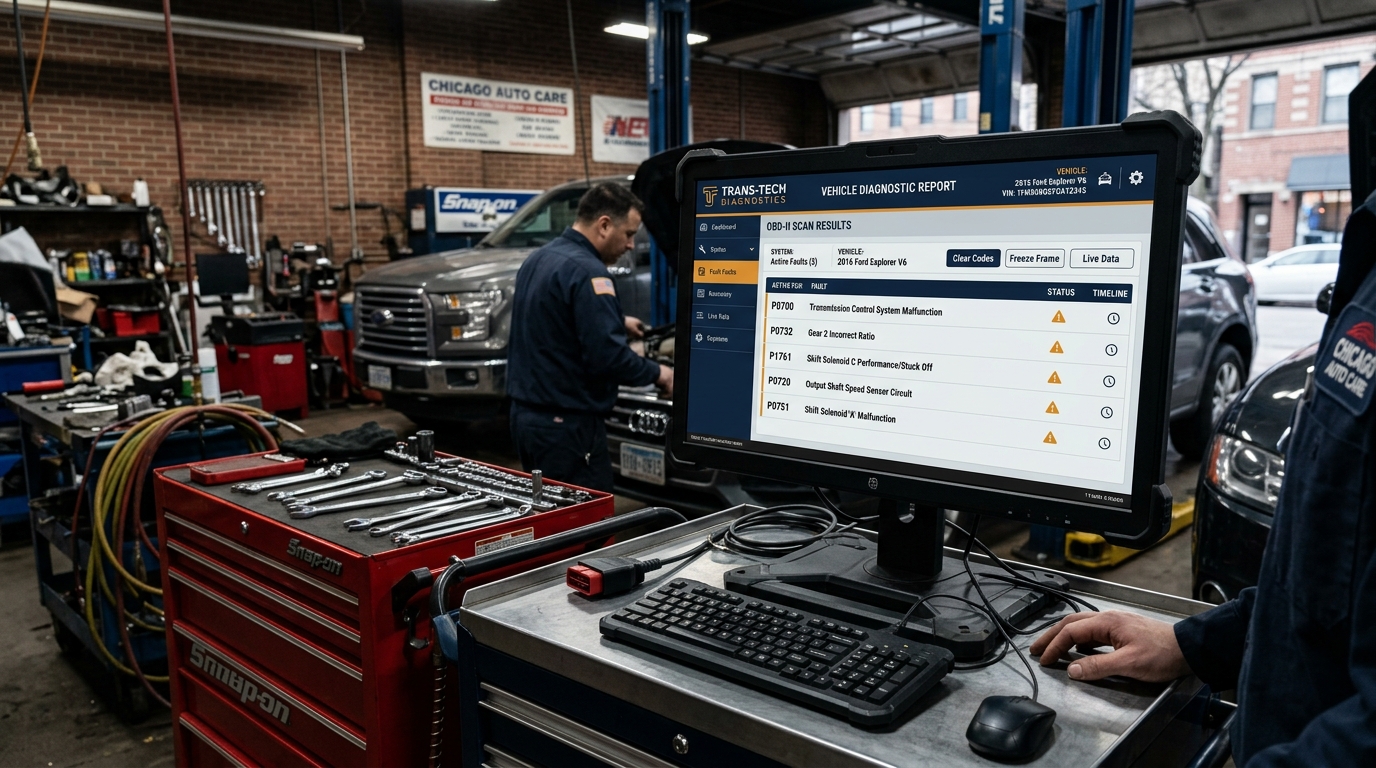
When P0751 appears alongside P0756 (shift solenoid B performance/stuck off), the issue is likely systemic rather than isolated to one solenoid - contaminated fluid, a clogged filter, or a valve-body-wide hydraulic problem should be investigated first. When P0751 appears with P0700, the latter is simply the TCM's generic request for the check-engine light and adds no additional diagnostic value. When P0751 appears with gear-ratio codes (P0731, P0732), the TCM is confirming that the missed shift has resulted in an incorrect ratio.
How Shift Solenoid A Works
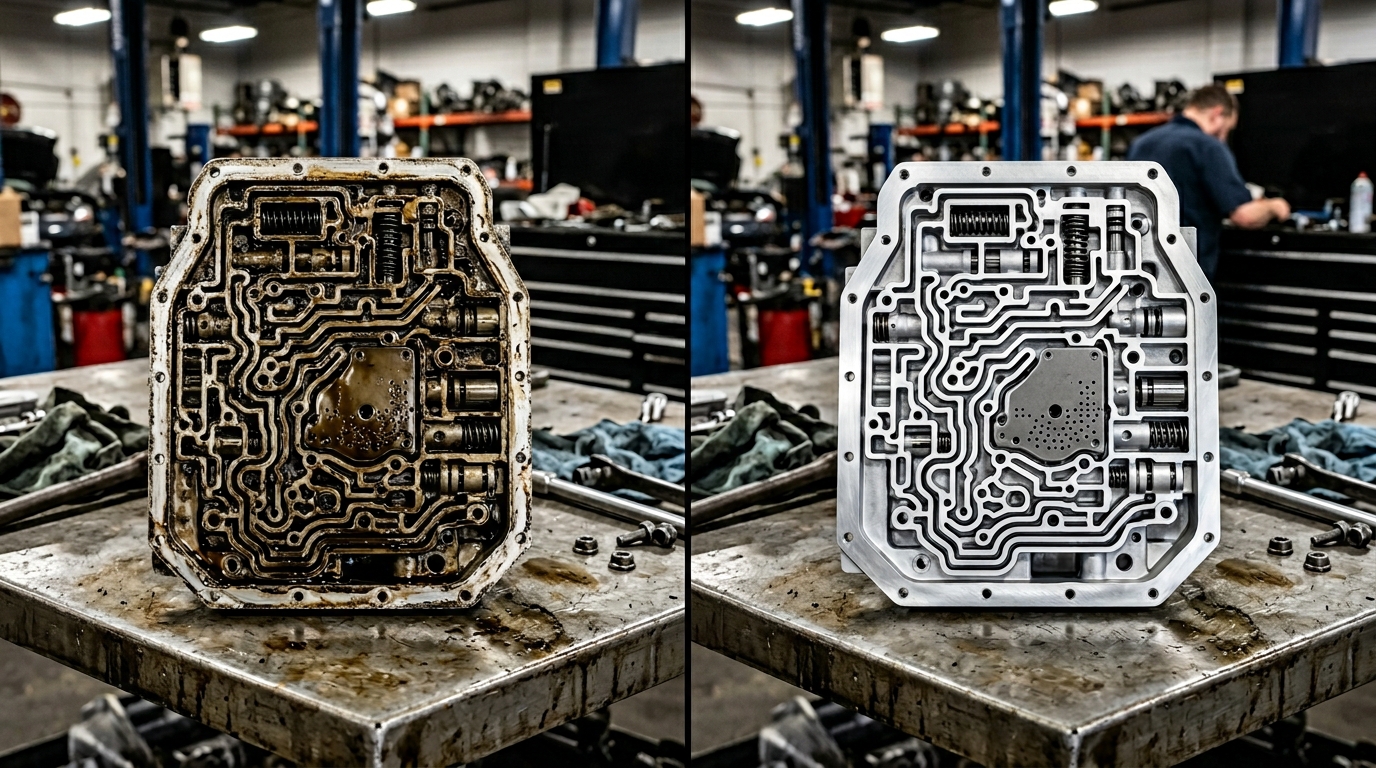
The shift solenoid is mounted on the valve body, which is the flat, machined aluminum casting inside the transmission pan. The valve body serves as the hydraulic "brain" - fluid under pressure enters it from the transmission pump, and the various solenoids and mechanical valves route that fluid to the correct clutch packs and bands to engage each gear.
Shift solenoid A is typically an on/off solenoid - it is either fully energized (open) or fully de-energized (closed), though some modern transmissions use variable-force or pulse-width-modulated solenoids for finer control. When the TCM determines that a shift is needed, it sends 12 V (or a PWM signal) to the solenoid's coil. The magnetic field pulls the solenoid plunger off its seat, opening a fluid passage. Pressurized fluid then flows through the passage, moves a shift valve in the valve body, and that shift valve directs mainline pressure to the apply side of the appropriate clutch pack while simultaneously exhausting the release side of the previous gear's clutch. The gear change is complete in roughly 200-500 milliseconds on a properly functioning transmission.
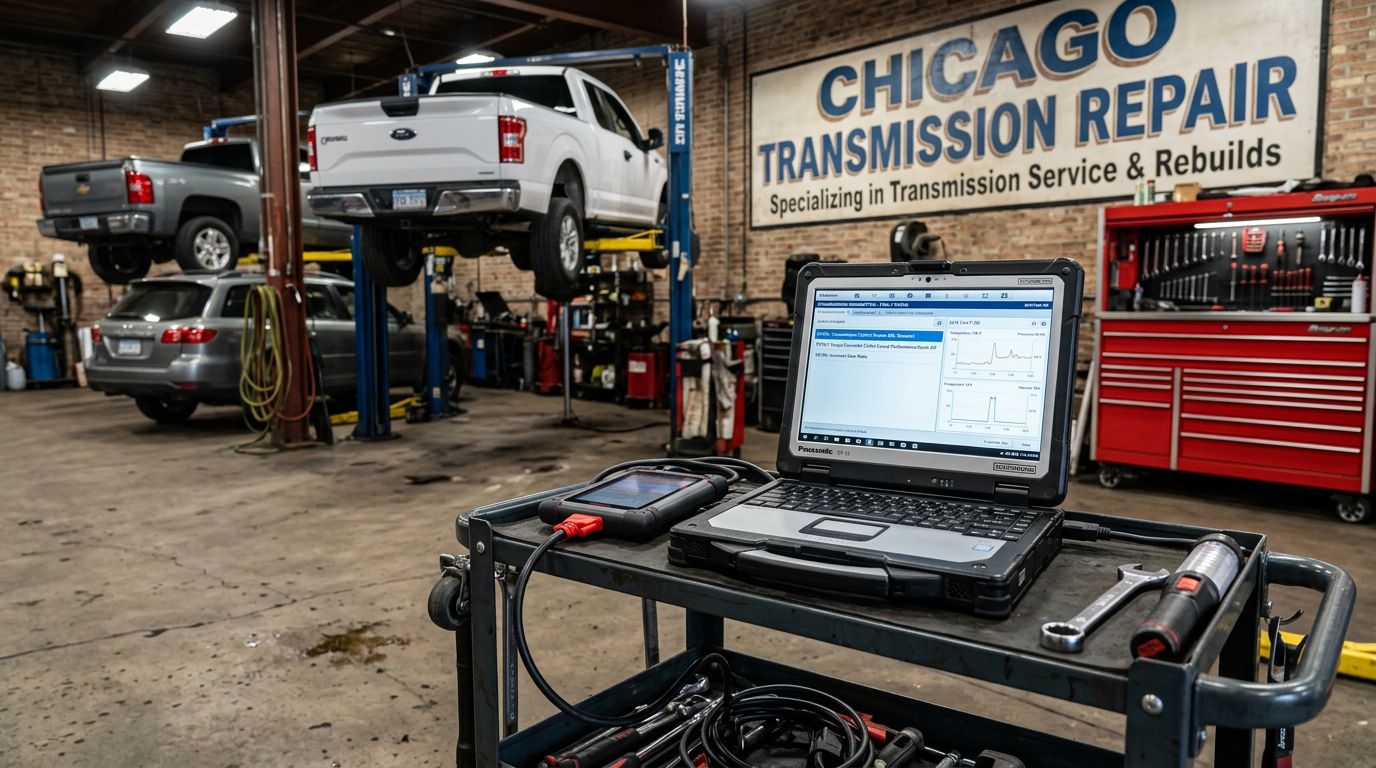
The TCM verifies the shift by comparing the input (turbine) speed sensor reading to the output speed sensor reading. If the ratio between them matches the expected ratio for the commanded gear within a calibrated tolerance window, the shift is considered successful. If the ratio does not change - or changes too slowly, too abruptly, or to the wrong value - the TCM logs the appropriate code. For P0751, the TCM specifically sees that the ratio remained unchanged (or changed insufficiently) after commanding solenoid A on, indicating the solenoid did not open.
Common Causes of P0751
Dirty or degraded transmission fluid is the single most frequent cause and accounts for an estimated 30-40% of P0751 cases across all platforms. As automatic transmission fluid ages, it accumulates friction-material dust, metal wear particles, and oxidation by-products. These contaminants circulate through the valve body's precision-machined passages and collect around solenoid plungers. A thin film of varnish or a small particle wedged between the plunger and bore is enough to prevent the solenoid from moving when energized. In Chicago's climate, where winters below 0 degrees F cause fluid to thicken dramatically and summers above 90 degrees F accelerate oxidation, the fluid degradation cycle is compressed. A 30,000-mile fluid-change interval that works fine in a mild climate may need to be shortened to 25,000 miles for a Chicago commuter vehicle.
A clogged transmission filter restricts flow to the valve body, reducing the pressure available to move shift valves even if the solenoid itself opens. The filter - usually a felt or mesh screen located between the pan and the valve body - traps debris over time. When it becomes saturated, the pump cannot deliver adequate volume. Symptoms mimic a stuck solenoid because the shift valve lacks the pressure to complete its stroke.
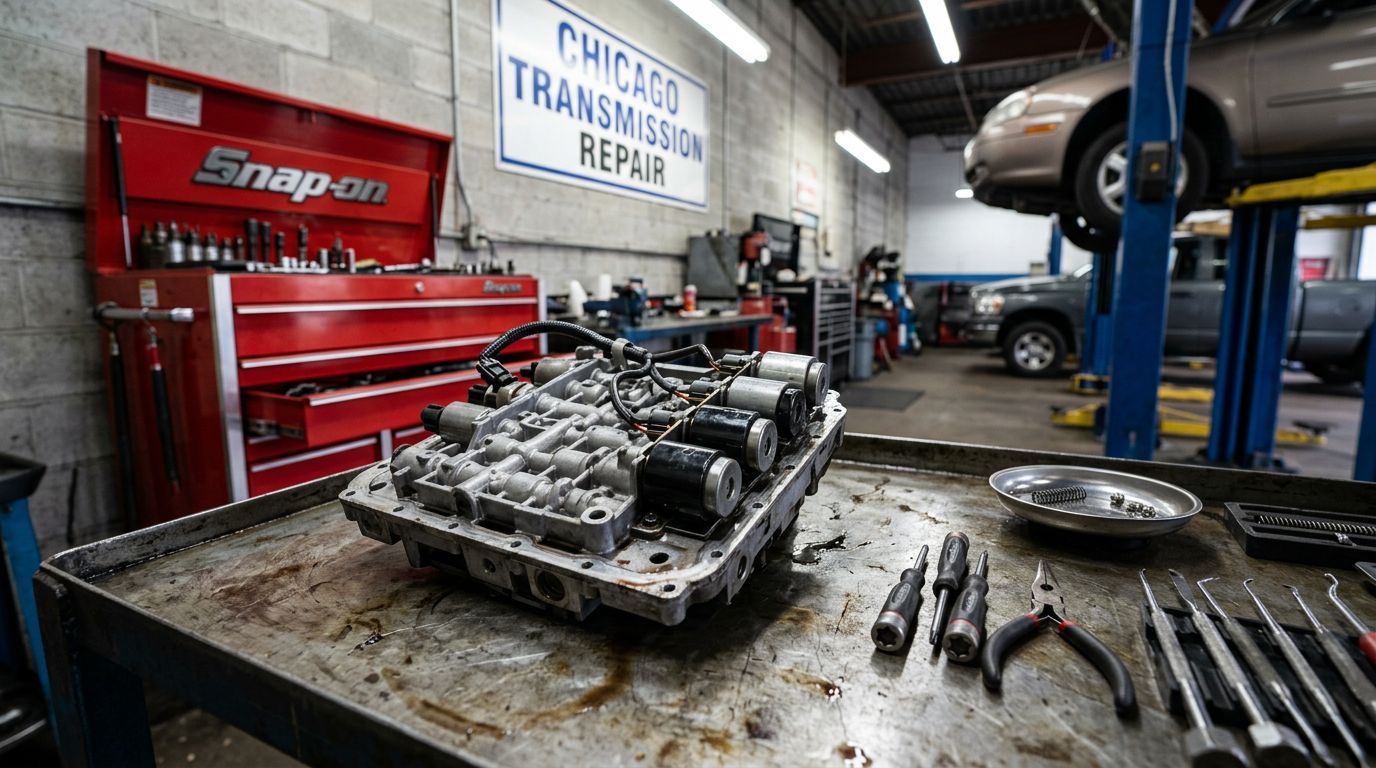
A failed or mechanically stuck shift solenoid constitutes roughly 40% of P0751 cases. The solenoid's internal plunger can seize from corrosion, score marks on the valve bore, or a cracked return spring. Electrically, the coil may still measure within specification on a resistance test (typically 20-40 ohms on GM units, 12-25 ohms on Ford, 12-25 ohms on Honda), but the valve is physically unable to move. This is why P0751 is classified as a "performance" code rather than an "electrical" code - the circuit works, but the mechanical result does not.
Worn valve-body bores represent a more serious condition. The aluminum bore in which the shift valve rides can become enlarged or scored over tens of thousands of shift cycles. When the bore is oversize, fluid bypasses the valve seal even when the solenoid opens, and the resulting pressure drop is insufficient to apply the clutch pack. GM Technical Service Bulletin PIP4831E specifically addresses valve-body debris and bore wear as root causes for solenoid performance codes on 6L80 and 6L90 transmissions. Aftermarket correction kits (such as the Sonnax Zip Kit) provide oversized valves and sleeves to restore bore integrity.
Wiring and connector faults cause P0751 less frequently than with the electrical code P0753, but they can still contribute. A high-resistance connection - from a corroded pin, a partially broken wire, or a degraded internal transmission harness - may allow enough current to keep the coil energized but not enough magnetic force to move the plunger against spring pressure and fluid drag. This marginal condition is especially likely in cold weather when copper wire resistance increases slightly and fluid viscosity raises the force needed to move the plunger.
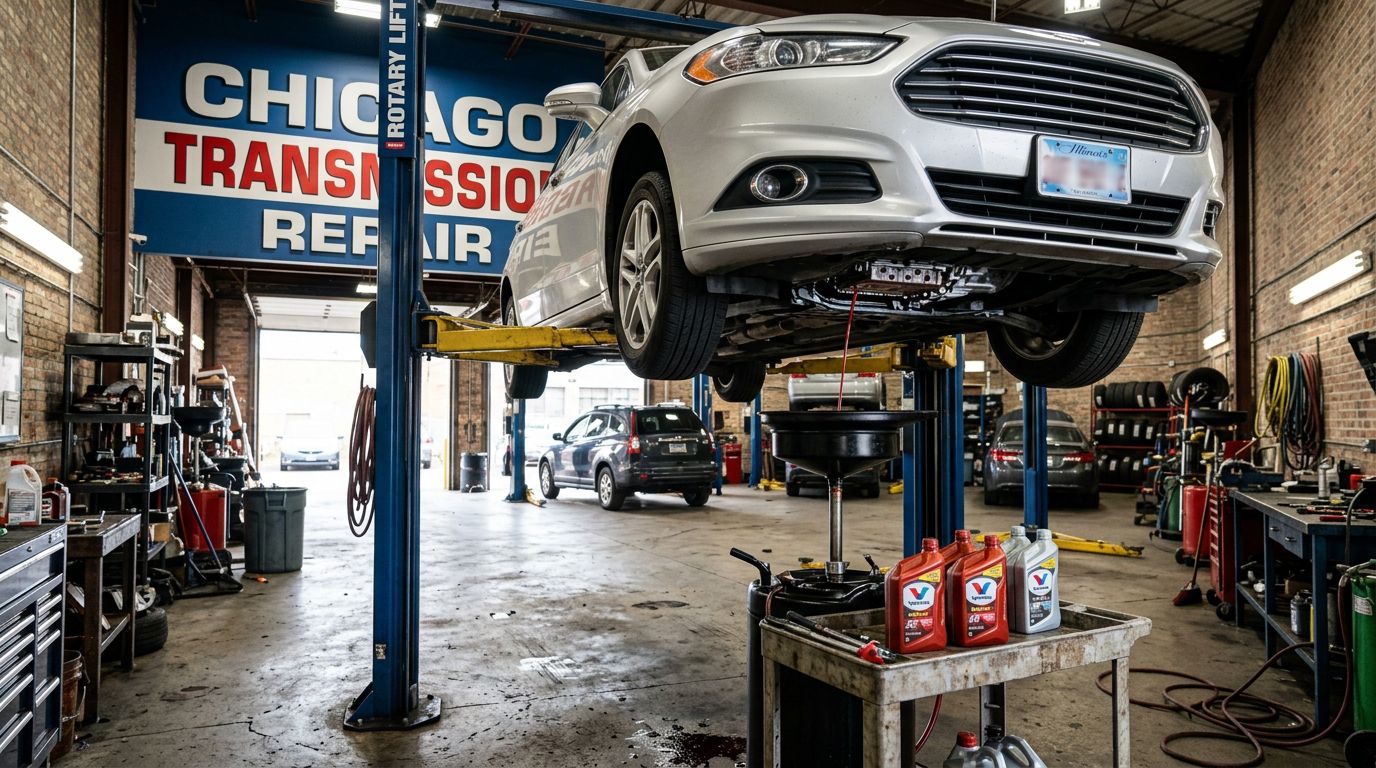
TCM or TEHCM failure is the least common but most expensive cause. On GM 6L80/6L90 transmissions, the TCM is integrated into the Transmission Electro-Hydraulic Control Module (TEHCM), which sits inside the pan in the hot-fluid environment. Heat-cycle fatigue can crack solder joints on the circuit board, producing intermittent or absent output signals to the solenoid. GM TSB PI1344B documents this failure mode specifically for 2010-model vehicles, where a sticking "Clutch Select Solenoid Valve 2" - functionally equivalent to solenoid A on the 6-speed - results in the truck starting in 4th gear, a classic stuck-off symptom.
Symptoms Chicago Drivers Will Notice
The most obvious symptom is a delayed or absent upshift from first to second gear (on transmissions where solenoid A controls the 1-2 shift). The vehicle accelerates normally in first gear, the engine RPM climbs past the expected shift point (typically 2,500-3,500 RPM depending on throttle input), and instead of a smooth shift, there is nothing - the engine continues to rev freely while the vehicle remains in first gear. Some drivers describe this as the transmission "not catching" or "revving without going faster."
When the TCM detects the missed shift, it typically forces limp mode within one to three drive cycles. Limp mode locks the transmission in a single gear - usually second or third - to prevent further damage. In limp mode, maximum vehicle speed is limited to approximately 25-40 mph. For a Chicago driver, limp mode turns a routine commute into a hazardous crawl. Maintaining 25 mph on the Kennedy or Dan Ryan is unsafe; even surface streets like Ashland, Western, or Cicero become difficult when cross-traffic is flowing at 35-45 mph.
Harsh or "clunking" shifts may occur if the solenoid is partially functional - it opens slowly or incompletely, causing a delayed and abrupt application of the clutch pack. The passenger-cabin sensation is a hard "bang" during the gear change, sometimes accompanied by a metallic noise from the transmission tunnel.
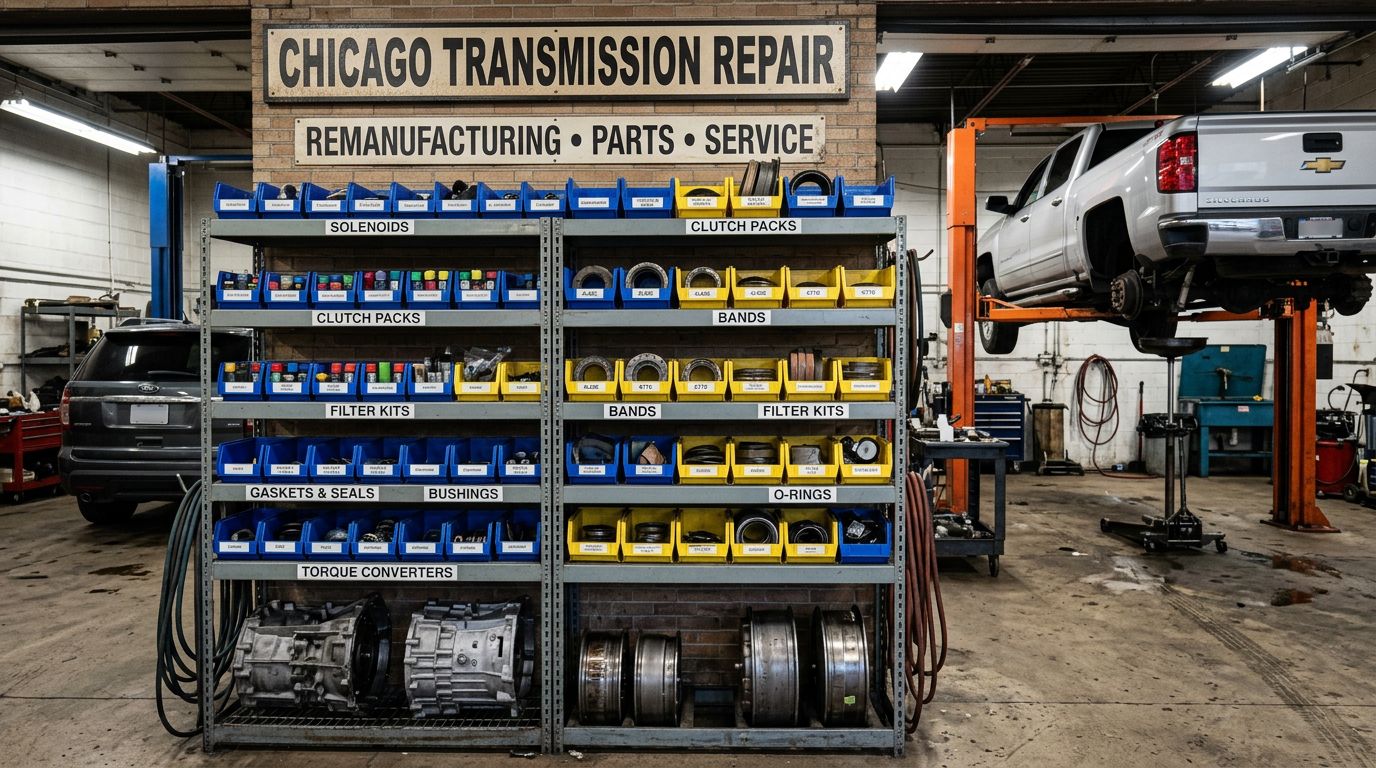
Transmission slipping is common when the solenoid opens partially. The clutch pack receives some fluid but not full apply pressure, so it slips rather than locking. Engine RPM flares upward without a corresponding increase in vehicle speed, and the fluid temperature rises because the slipping clutch is converting mechanical energy into heat.
Transmission overheating frequently follows slipping. The extra heat accelerates fluid degradation, worsens debris contamination, and further clogs solenoids and filter - a self-reinforcing cycle that can escalate a solenoid replacement into a rebuild if ignored.
Reduced fuel economy results from the transmission's inability to reach higher gear ratios. A vehicle stuck in second gear at highway speed will consume significantly more fuel, potentially 20-40% more than normal.
The check-engine light illuminates with P0751 stored, often accompanied by P0700.
Can You Drive with P0751?
You can drive short distances - to the nearest repair facility, for example - but continued driving with P0751 is inadvisable. If the transmission is in limp mode, the limited speed makes expressway driving dangerous. If the transmission is slipping rather than in limp mode, every mile driven generates heat that damages clutch packs, seals, and other internal components.
If the vehicle will only operate in first gear (solenoid A is controlling the 1-2 shift and it's completely stuck off), surface-street driving at very low speed is possible but engine RPM will be extremely high. Sustained high-RPM operation in first gear can overheat the engine and transmission rapidly.
The safest approach: if the nearest transmission shop is more than a few miles away, or if any expressway driving is required, have the vehicle towed. Chicago-area tow costs (quoted after diagnosis) are a fraction of the damage bill from driving an overheating transmission.
Diagnosis Steps
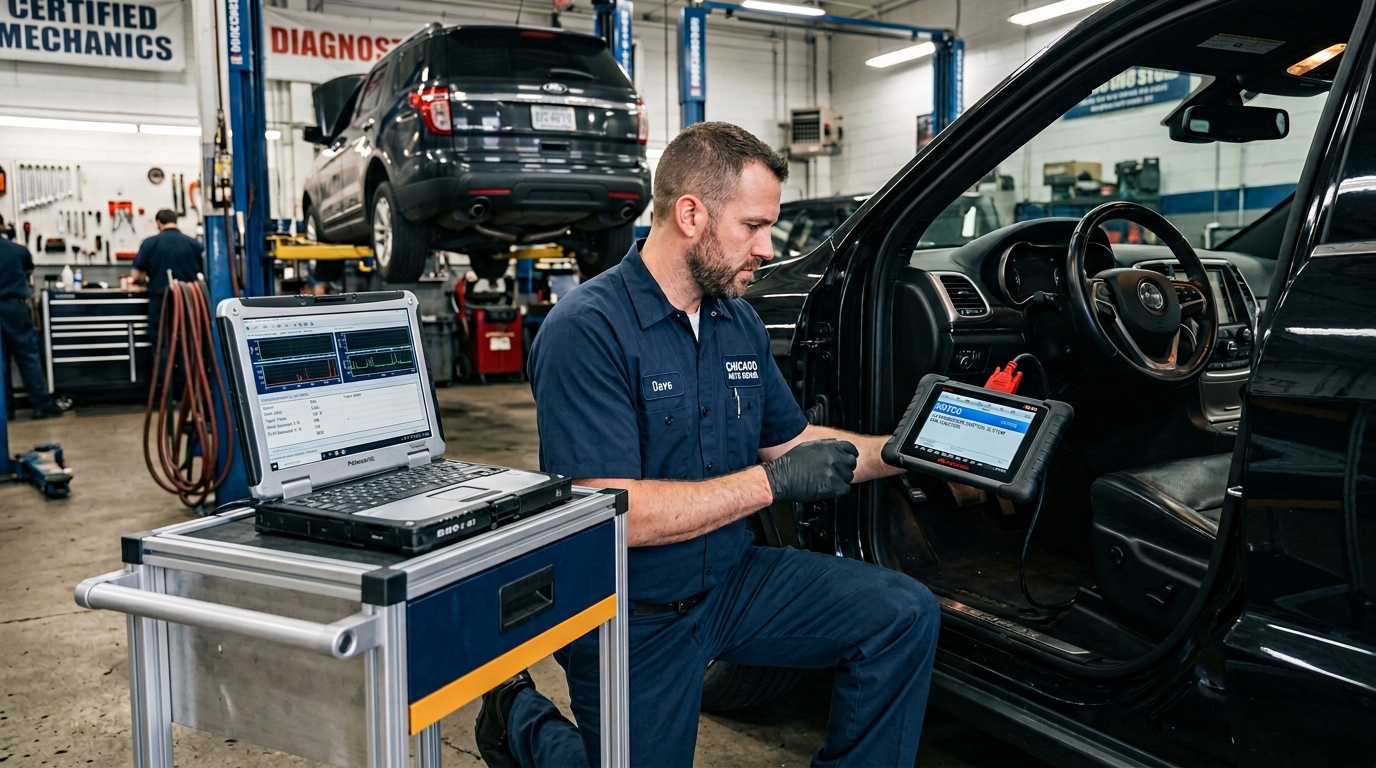
A full OBD-II scan retrieves all stored and pending codes. The technician looks for companion codes - P0700, P0756, P0731, P0732, P0894 - that provide context. Freeze-frame data captures the engine RPM, vehicle speed, throttle position, and transmission temperature at the moment the fault was detected.
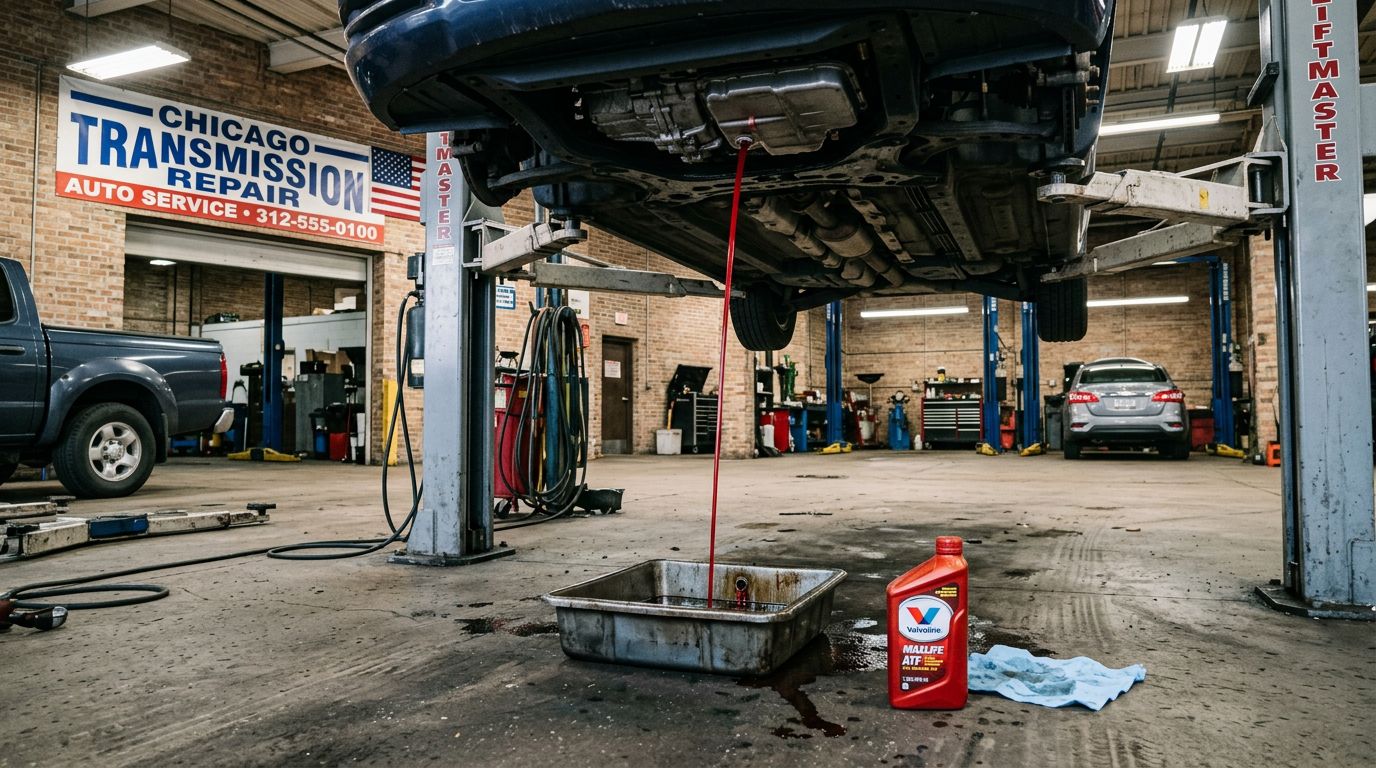
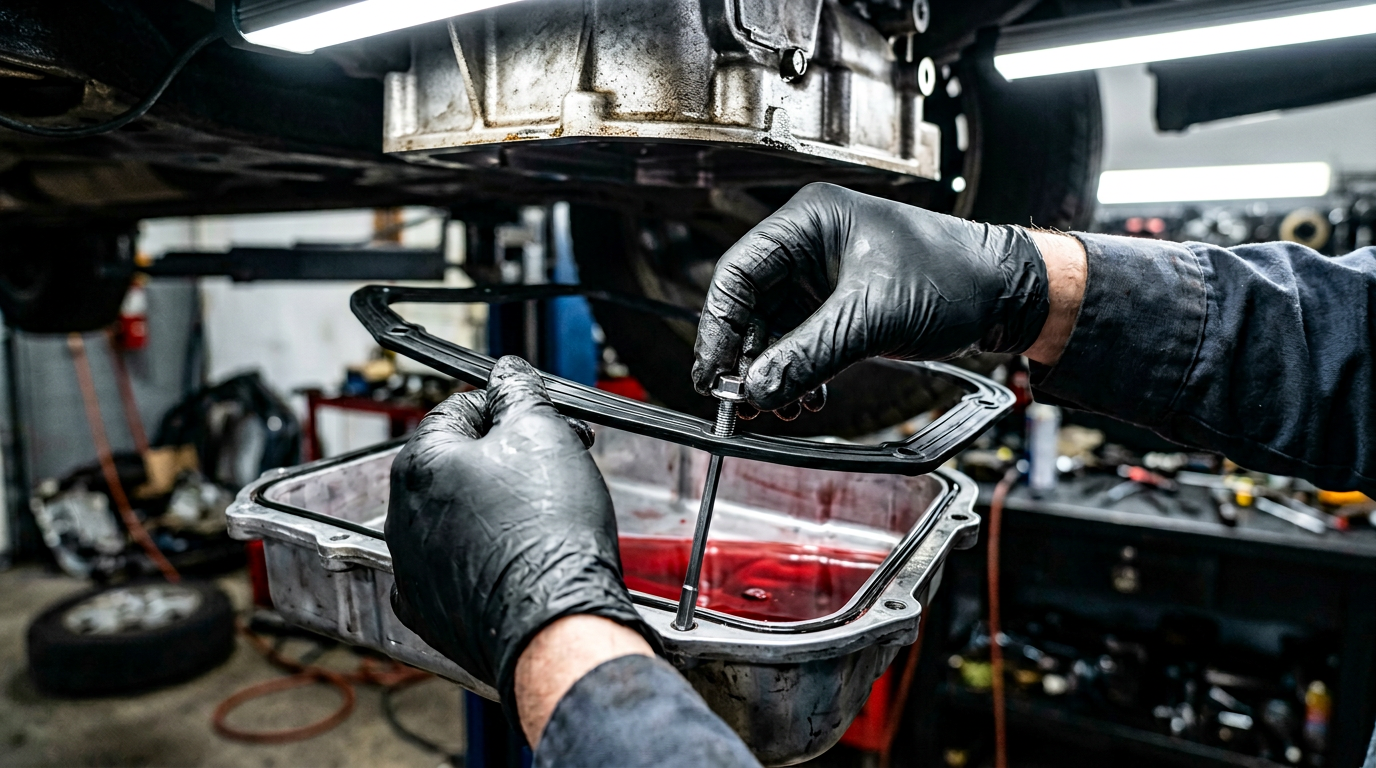
Transmission fluid inspection is the critical first step before any disassembly. The technician checks fluid level against the manufacturer's specification (usually on a warm dipstick) and evaluates color, clarity, and odor. Healthy ATF is translucent pink or light red with a mildly sweet scent. Dark brown or black fluid with a burnt smell indicates severe degradation. Fluid wiped on a white towel that shows metallic specks or dark grit signals internal wear debris. If the fluid is degraded, a fluid-and-filter service is the first corrective action; in some cases, this alone resolves P0751.
Live data monitoring during a road test (if safely possible) reveals the solenoid's commanded state versus actual shift behavior. With a professional scan tool, the technician observes "Shift Solenoid A Status" - the TCM's command to energize or de-energize the solenoid. If the status shows "ON" but the input-to-output speed ratio does not change, the solenoid is confirmed stuck off mechanically or the hydraulic circuit is blocked. If the status shows "OFF" when it should be "ON," the fault is in the TCM's command logic.
Bidirectional solenoid testing, available on dealer-level and advanced aftermarket scan tools, allows the technician to manually command solenoid A on and off while the vehicle is in Park. An audible "click" from the transmission pan and a corresponding change on the live-data pressure reading confirm the solenoid is functional. No click or pressure change points to a seized solenoid, blocked bore, or wiring issue.
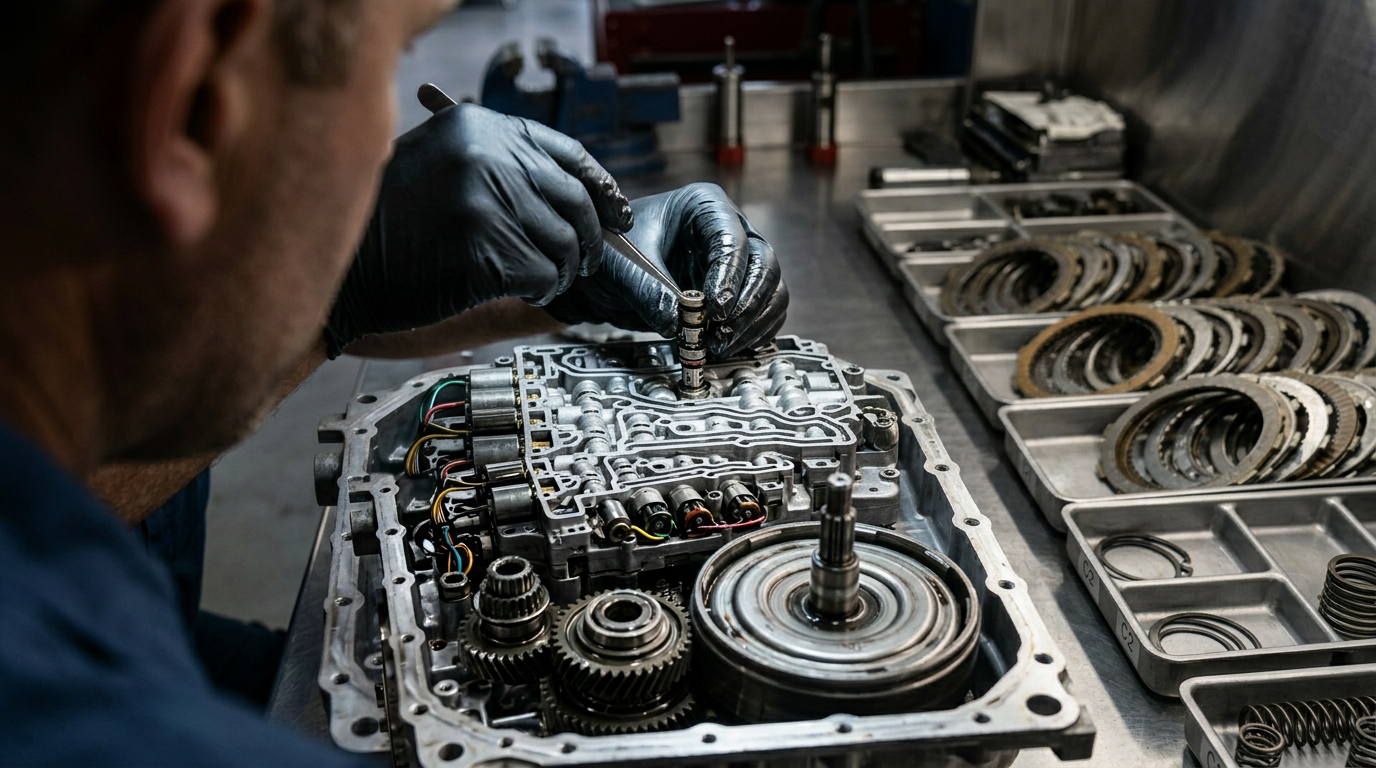
Pan-drop inspection is warranted if fluid service and electrical tests do not resolve the code. Removing the pan exposes the valve body, solenoid pack, and the pan magnet. The technician checks the magnet for excessive metal accumulation (a handful of fine particles is normal over 30,000+ miles; chunks or thick sludge is not), inspects the solenoid for physical damage, and measures solenoid resistance with a multimeter. On GM 4L60E transmissions, the 1-2 shift solenoid should read 20-40 ohms. On 6L80 transmissions, on/off solenoids also read 20-40 ohms. On Ford and Honda units, typical ranges are 12-25 ohms. An open circuit (infinite resistance) or near-zero resistance confirms coil failure; however, a solenoid that passes the resistance test can still be mechanically stuck, so physical operation testing is essential.
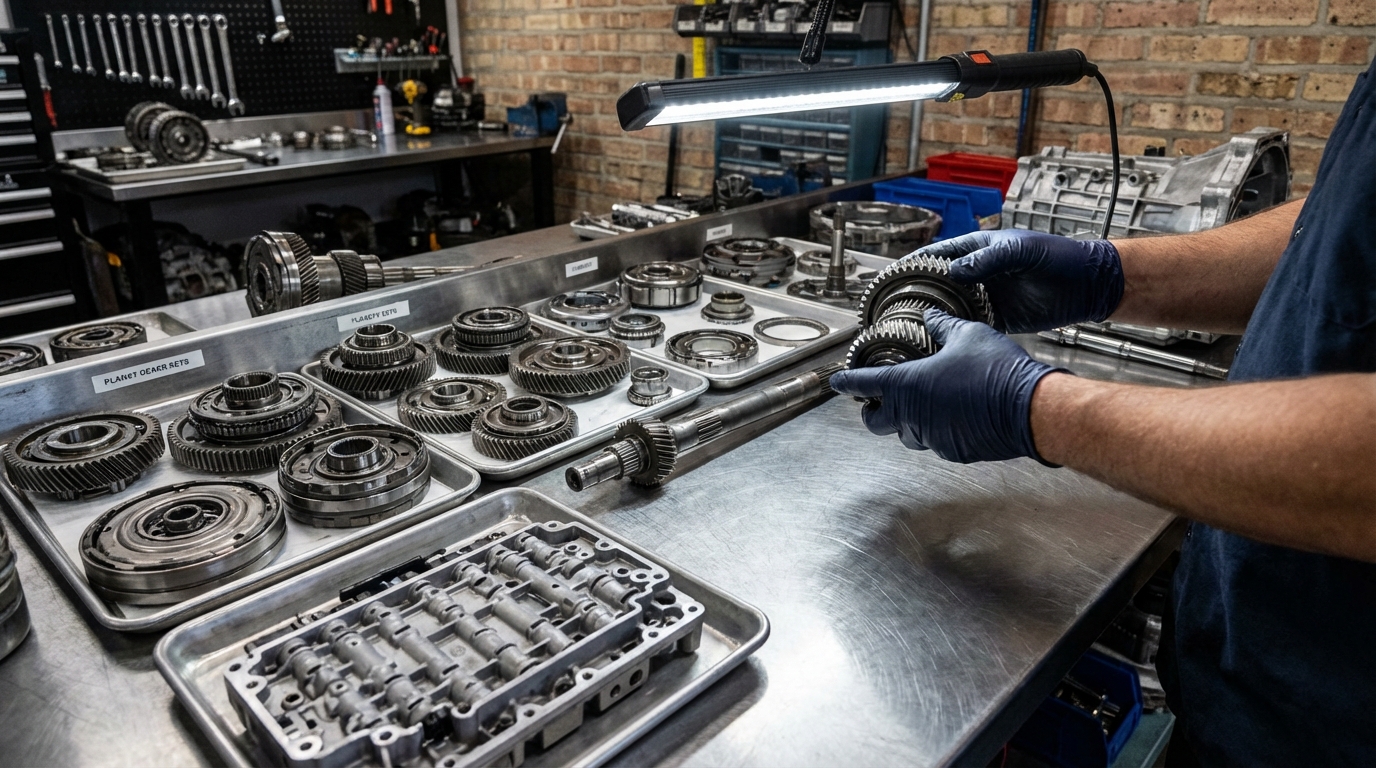
Valve-body inspection follows if the solenoid itself tests good. The technician checks the shift-valve bore for scoring, checks fluid passages for blockage, and examines any check balls for correct seating. On 6L80 transmissions, GM TSB PI1344B specifically calls for inspecting the Clutch Select Solenoid Valve 2 bore for scratches and replacing the lower valve body if damage is found. An updated valve-body spacer plate gasket (which provides higher oil volume to the solenoid) resolves the issue on early 6L80 units per GM service information.
TCM or TEHCM evaluation is the final step. If all hydraulic and mechanical components check out, the technician tests TCM output signals using the scan tool's live-data PWM monitoring. Absent or fixed-duty-cycle output when a variable signal is expected confirms internal module failure.
Repair Cost Ranges
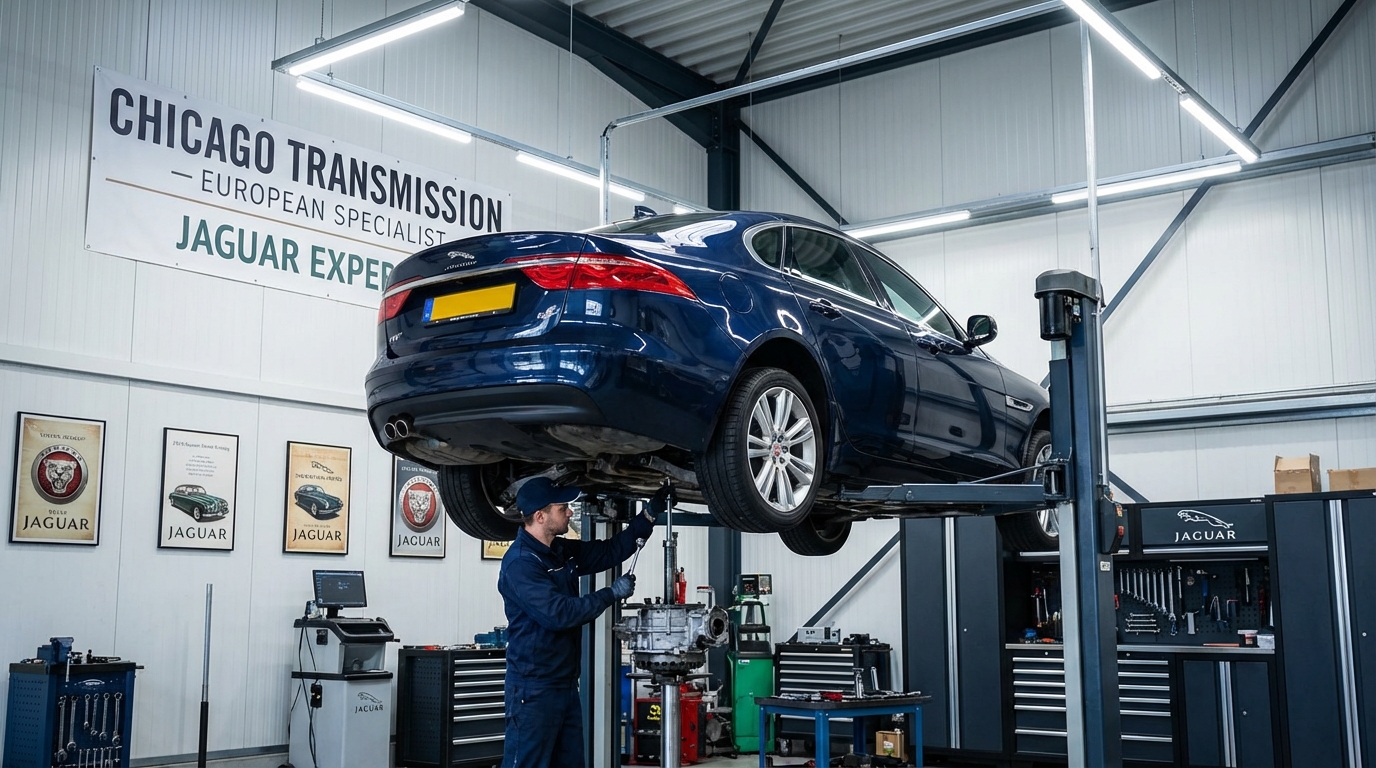
TEHCM replacement (GM 6L80/6L90). The TEHCM integrates the TCM and all solenoids into a single assembly. OEM ACDelco is recommended, VIN programming is required, and labor is typically 2-3 hours. This is significant because on these transmissions, you cannot replace an individual solenoid - the entire module must come out.
Internal wiring harness replacement. The transmission's internal harness connects the solenoids to the external case connector. On high-mileage vehicles, the harness can become brittle from heat exposure, causing intermittent opens that are difficult to diagnose. The part itself is -; labor is 1.5-2.5 hours with the pan already removed.
TCM replacement (non-TEHCM vehicles) for a VIN-matched unit programming and labor.
Full transmission rebuild, if internal damage has spread to clutch packs, bands, or the planetary gear set,. A remanufactured transmission.
Vehicles Most Commonly Affected
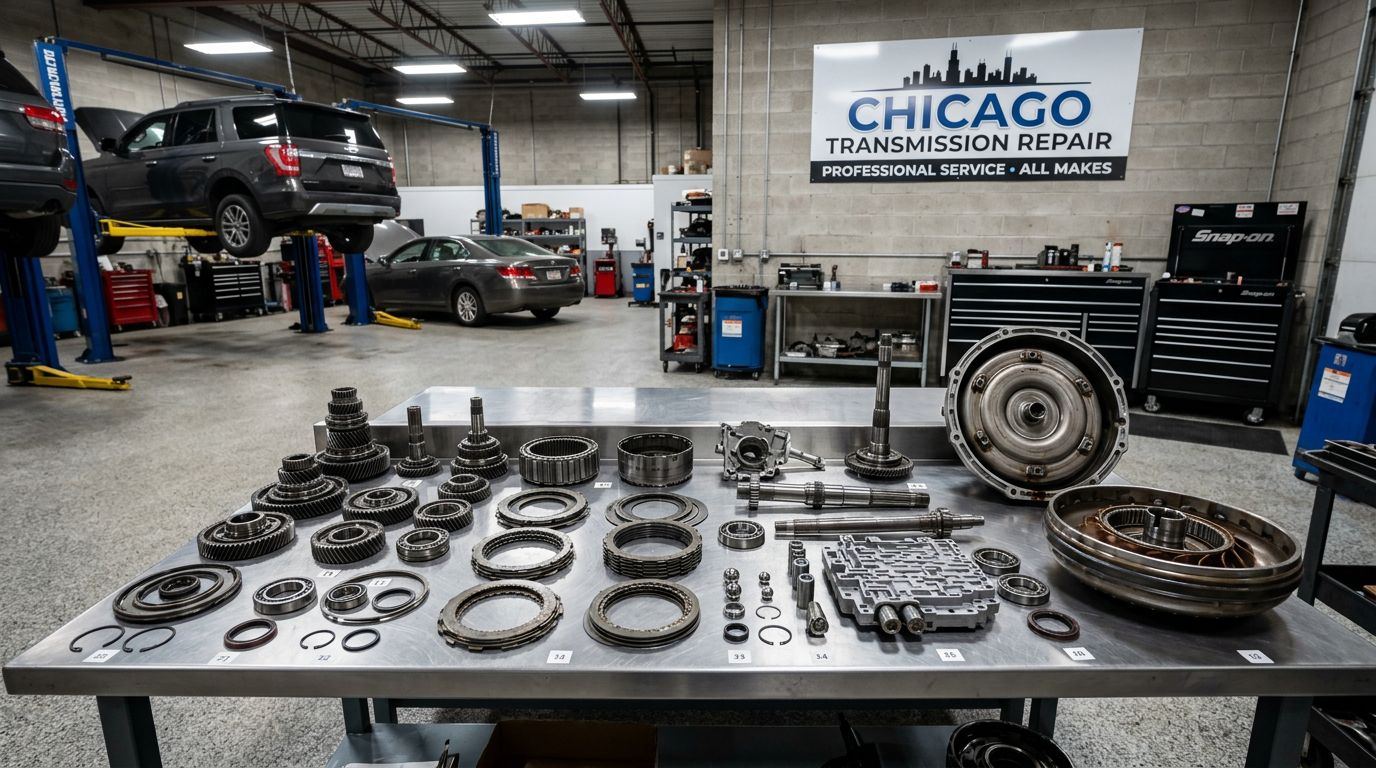
GM trucks and SUVs dominate P0751 reports. The Chevrolet Silverado, Tahoe, Suburban, GMC Sierra, and Yukon with the 4L60E 4-speed automatic are the most frequent platform. The 1-2 shift solenoid on the 4L60E is a well-known wear item. GM's newer 6L80 and 6L90 6-speed transmissions in 2007-and-later full-size trucks also produce P0751 regularly, with the integrated TEHCM unit adding complexity and cost to the repair. GM TSBs PI1344B and PIP4379K specifically address this code.
Ford vehicles with the 4R70W/4R75W (Crown Victoria, F-150, Explorer through mid-2000s) and the 5R55W/5R55S (Explorer, Mountaineer, Mustang) commonly report P0751. Ford's solenoid pack is generally accessible through the pan, keeping repair costs moderate.
Honda Accord and Civic models with 4- and 5-speed automatics trigger P0751 from contaminated fluid or a failing linear solenoid. The Honda Accord V6 (2003-2007) is particularly well-represented in P0751 forum discussions, often alongside pressure-control codes like P0747.
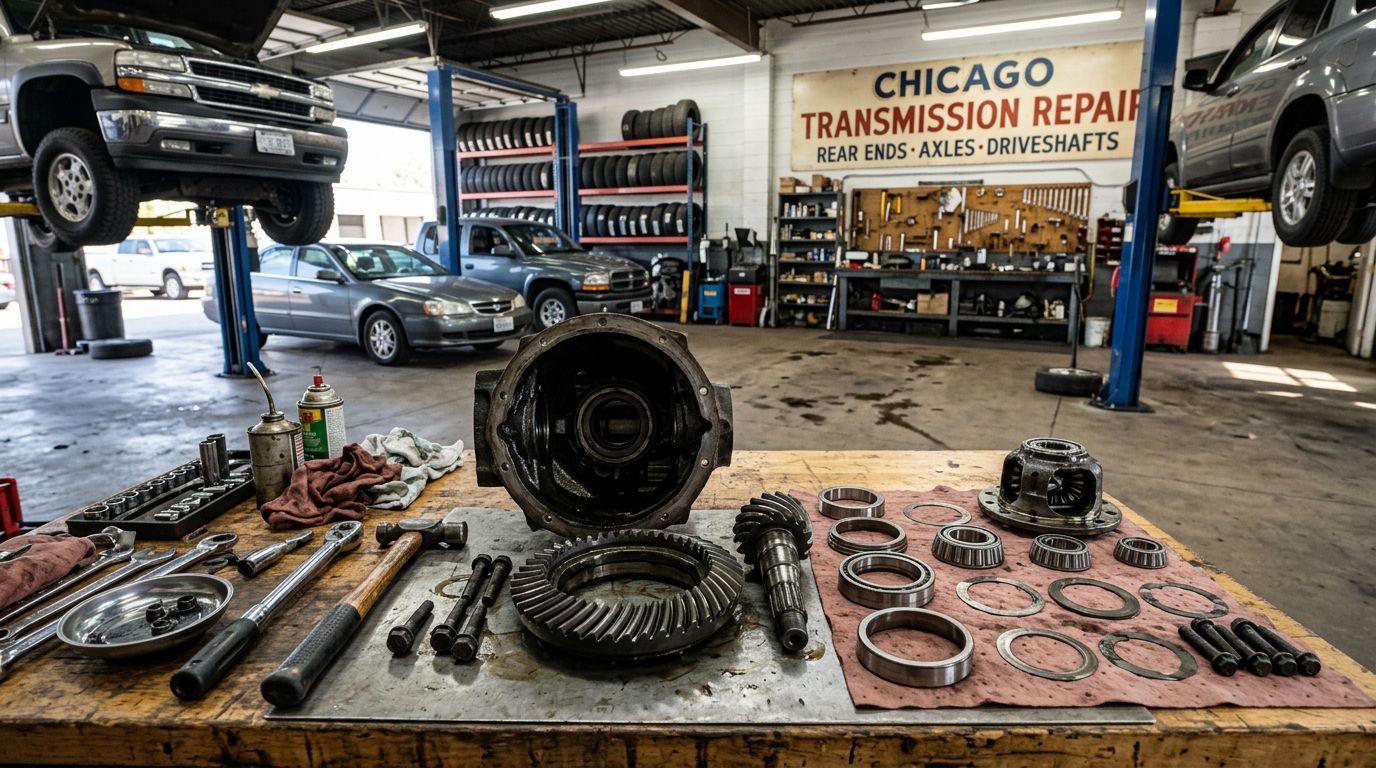
Chrysler, Dodge, and Jeep vehicles with the 42RLE (Wrangler, Liberty) and 45RFE/545RFE (Ram, Durango, Grand Cherokee) transmissions see P0751 from solenoid and valve-body wear. The 62TE transaxle in Chrysler minivans and the Dodge Journey also produces this code.
Lexus and Toyota models with the A750E and A760E transmissions report P0751 at higher mileages, typically from fluid contamination.
Duramax-equipped GM trucks (2500HD/3500HD) with the Allison 1000 can set manufacturer-specific versions of solenoid performance codes, though the generic P0751 also appears.
Chicago-Specific Factors
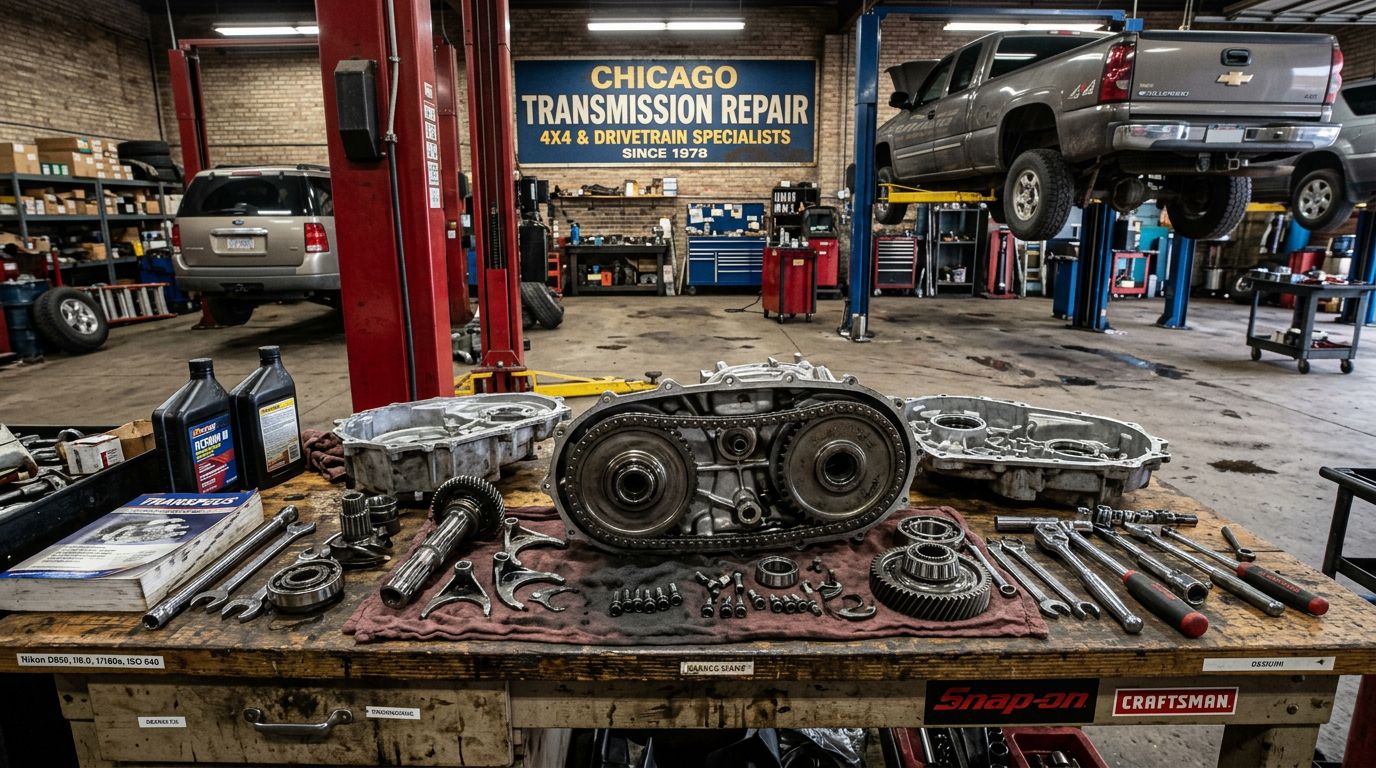
Cold-weather viscosity is a major contributor. When Chicago's winter temperatures drop to 0 degrees F or below, transmission fluid thickens substantially. Thick fluid requires more force to flow through the valve body's precision passages, and more magnetic force from the solenoid coil to move the plunger against the denser fluid. A solenoid that operates marginally in warm weather - perhaps with slight varnish buildup or a weak spring - may fail outright in January. Many Chicago drivers report P0751 appearing for the first time on the coldest mornings of the year, only to have the code clear and shifting return to normal once the transmission warms up. This intermittent cold-start presentation is a hallmark of a solenoid that is on the verge of failure.
Road salt corrodes the external transmission connector and any exposed harness sections. The connector is typically located on the driver's side of the transmission case, in the direct path of road spray from the front tires. Salt-induced corrosion increases pin resistance, reducing the current delivered to the solenoid coil. Over multiple seasons, this gradual resistance increase can push a borderline solenoid from "barely functioning" to "stuck off."
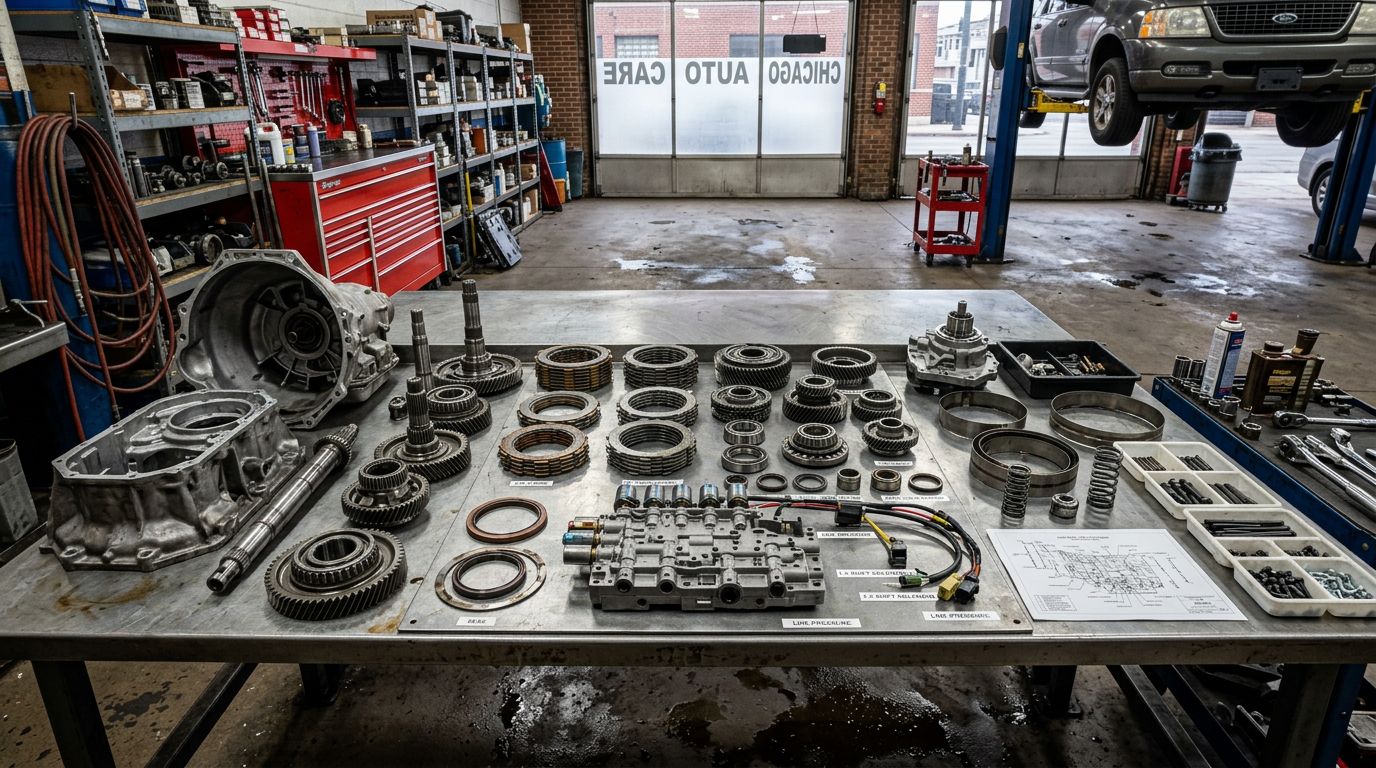
Stop-and-go traffic density increases the total number of shift cycles per mile. Every acceleration-deceleration event requires solenoid A to open and close, fatiguing the coil, wearing the plunger bore, and cycling the return spring. A vehicle driven primarily on Chicago's congested arterials will accumulate shift cycles at two to three times the rate of a highway commuter, reaching the solenoid's wear limit at a correspondingly lower odometer reading.
Pothole impacts can dislodge check balls inside the valve body or unseat a solenoid's O-ring seal, creating a pressure leak that mimics a stuck-off condition. Chicago's notoriously poor road surfaces contribute incremental valve-body damage season after season.
Prevention Tips
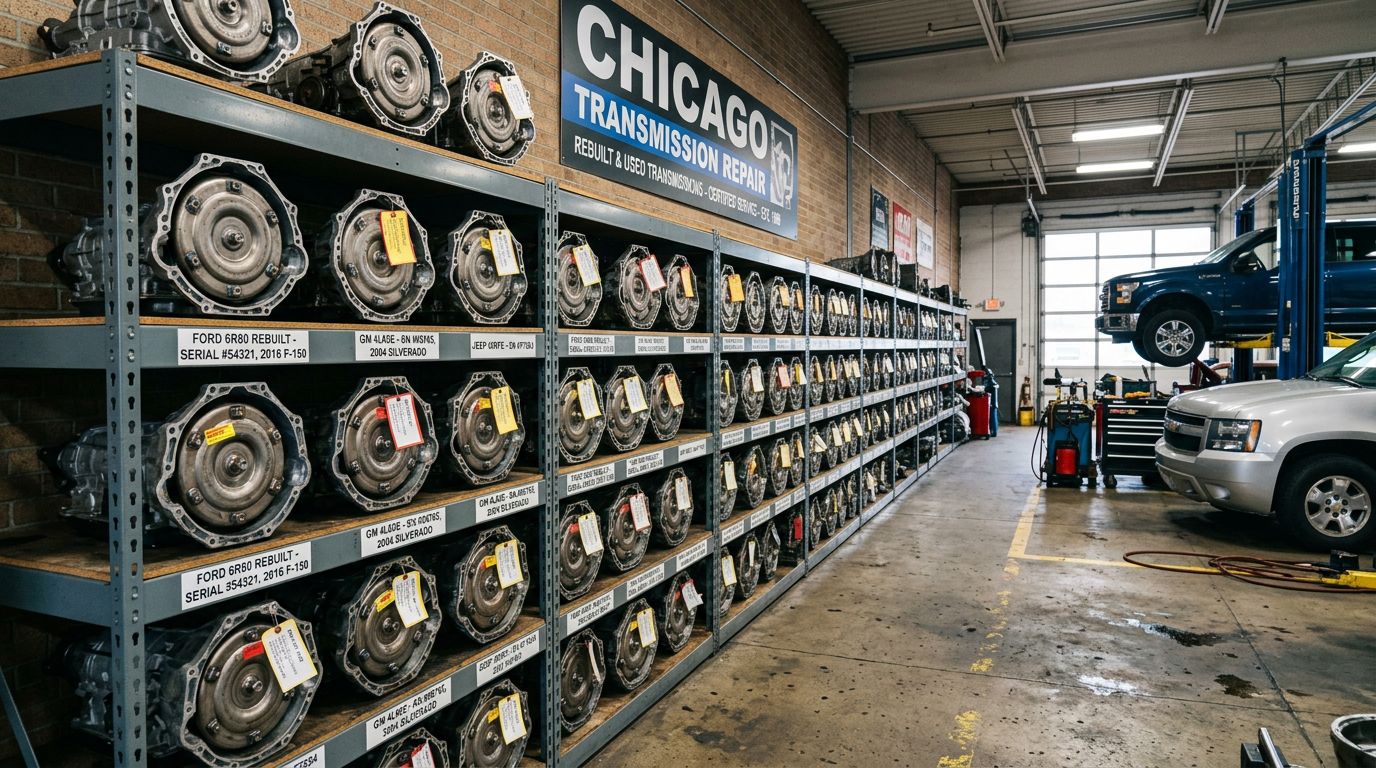
Change transmission fluid and filter every 30,000 miles, or every 25,000 miles if the vehicle is driven primarily in city traffic, towed with, or operated in temperature extremes. Fresh, properly specified fluid (DEXRON-VI for GM, MERCON V or MERCON LV for Ford, Honda DW-1 for Honda) maintains correct viscosity and lubricant properties that keep solenoid plungers moving freely.
Clean the external transmission connector annually after salt season. Unplug the connector, inspect pins for green or white corrosion, spray with electrical contact cleaner, allow to dry, apply a thin film of dielectric grease to each pin cavity, and re-seat firmly.
Allow the transmission to warm up before aggressive driving on cold mornings. Idling for 60-90 seconds in Park, then driving gently for the first mile, gives the fluid time to reach a viscosity that allows solenoids to operate properly.
Address intermittent shift-quality changes promptly. If the first shift of the morning feels harsh or delayed but improves after the vehicle warms up, the solenoid is already showing early signs of the condition that produces P0751. A fluid service at this stage - - - can add tens of thousands of miles before the solenoid physically fails.
Monitor for companion codes. A scan after any check-engine-light event that produces P0700 should always check for underlying transmission codes. Catching P0751 early, before the solenoid is completely stuck or before slipping damages clutch packs, is the difference between a repair and a rebuild.
Frequently Asked Questions
What does P0751 mean in plain language?
The computer told one of your transmission's internal valves (shift solenoid A) to open so the transmission could shift gears, but the gear change either didn't happen or happened poorly. The valve appears to be stuck in the closed position.
How serious is P0751?
It's serious enough to warrant prompt attention. If the transmission enters limp mode, you'll be limited to 25-40 mph - too slow for safe expressway driving. If the transmission slips instead of entering limp mode, the resulting heat can cause rapid internal damage. However, the repair itself is often moderate in cost if caught early.
What does it typically cost to fix P0751?
For a fluid service that resolves the issue: quoted after diagnosis. For solenoid replacement: quoted after diagnosis. For a TEHCM replacement on GM 6-speed transmissions: quoted after diagnosis. For valve-body work: quoted after diagnosis. For a full rebuild (worst case): quoted after diagnosis. The wide range depends on the root cause and how long the vehicle was driven with the symptom.
Can a fluid change really fix P0751?
Yes, in 15-20% of cases. If the solenoid is sticking due to varnish or debris in degraded fluid, fresh fluid with clean friction modifiers can free the plunger. However, if the solenoid is mechanically worn or the coil is weak, a fluid change will only provide temporary relief.
What is the difference between P0750 and P0751?
P0750 is a general solenoid A malfunction code - it says something is wrong but doesn't specify the failure direction. P0751 specifically says the solenoid is stuck off or performing as if it were stuck off. P0751 provides more diagnostic direction.
What is the difference between P0751 and P0753?
P0751 is a performance/mechanical code - the solenoid's electrical circuit may test fine, but the valve isn't moving. P0753 is an electrical code - the TCM detects an open circuit, short circuit, or abnormal resistance in the solenoid's wiring. Different root causes require different diagnostic approaches.
Why does P0751 show up more in winter?
Cold transmission fluid is thicker. Thick fluid requires more solenoid force to move, and it flows more slowly through valve-body passages. A solenoid with marginal varnish buildup or a weak coil that functions in warm fluid may fail to open in cold, thick fluid. This is why many Chicago drivers first see P0751 on the coldest mornings.
Can I replace the solenoid myself?
On vehicles where the solenoid is accessible through the pan (GM 4L60E, Ford 4R70W, many Chrysler units), a mechanically inclined DIYer can perform the job with basic hand tools, a drain pan, and the correct replacement solenoid and filter. On GM 6L80/6L90 transmissions, the solenoid is part of the TEHCM, which requires dealer-level programming after replacement - not a practical DIY job.
Does P0751 affect all gears or just one?
It primarily affects the gear change that solenoid A controls - typically the 1-2 upshift. However, because the TCM may enter limp mode in response, all gear changes are affected once limp mode is active.
Which vehicles are most prone to P0751?
GM trucks with the 4L60E and 6L80 transmissions are the most commonly reported platforms. Ford vehicles with 4R70W and 5R55 transmissions, Honda Accords with 4/5-speed automatics, and Chrysler/Dodge/Jeep vehicles with 42RLE and 45RFE transmissions are also frequently affected.
H2 sections: 12
Series tally - Articles completed (14 of 50):
| # | Code | Topic |
|---|------|-------|
| 1 | P0700 | Transmission Control System Malfunction |
| 2 | P0730 | Incorrect Gear Ratio |
| 3 | P0740 | TCC Circuit Malfunction |
| 4 | P0741 | TCC Performance / Stuck Off |

| 5 | P0715 | Input/Turbine Speed Sensor Circuit |
| 6 | P0720 | Output Speed Sensor Circuit |
| 7 | P0750 | Shift Solenoid A Malfunction |

| 8 | P0755 | Shift Solenoid B Malfunction |
| 9 | P0218 | Transmission Fluid Over-Temperature |
| 10 | P0780 | Shift Malfunction |
| 11 | P0706 | Transmission Range Sensor |
| 12 | P0613 | TCM Processor Fault |
| 13 | P0742 | TCC Circuit Stuck On |
| 14 | P0751 | Shift Solenoid A Performance / Stuck Off |
Next up: P0756 - Shift Solenoid "B" Performance / Stuck Off
Want me to keep rolling?
Have a Transmission Problem?
Get a Diagnosis-first inspection from Chicago transmission repair support.