P0755 means your transmission's shift solenoid B has failed. Learn what triggers this code, how it affects shifting, and what Chicago drivers should budget for diagnosis and repair.
I've already completed full SEO articles (Chicago-focused) for:
1. P0700 – Transmission Control System Malfunction
2. P0730 – Incorrect Gear Ratio
3. P0740 – Torque Converter Clutch Circuit Malfunction
4. P0741 – Torque Converter Clutch Circuit Performance / Stuck Off
5. P0750 – Shift Solenoid A Malfunction
And I've gathered all the research needed for:
6. P0755 – Shift Solenoid B Malfunction
Let me now write out the full P0755 article for you.
P0755 Code: Shift Solenoid B Malfunction — Causes, Symptoms & Repair Costs for Chicago Drivers
What Does the P0755 Code Mean?
P0755 is a generic OBD-II powertrain diagnostic trouble code that stands for "Shift Solenoid B Malfunction." It is stored by the Powertrain Control Module (PCM) or Transmission Control Module (TCM) when it detects that shift solenoid B is not operating within its expected parameters. In practical terms, the computer commands solenoid B to open or close in order to route hydraulic fluid and execute a gear change, but the resulting gear ratio does not match what the computer expected. After several failed attempts—usually two to three consecutive drive cycles—the code is set and the Check Engine Light illuminates.
Shift solenoid B is most commonly responsible for controlling the second-to-third gear upshift, though its exact role varies by transmission design. In some transmissions it also participates in other shift combinations or works in tandem with solenoid A. Regardless of the specific application, the result of a P0755 fault is the same: the transmission can no longer reliably execute one or more gear changes, and drivability suffers.
If you are a Chicago driver who just pulled this code at a shop on Western Avenue or after a scan at an auto-parts store in Schaumburg, this article will walk you through exactly what is happening inside your transmission, what caused it, what it will cost to fix, and how to prevent it from happening again.
P0755 and Its Related Codes
P0755 is part of a family of codes that all relate to the same solenoid circuit. Understanding the full family helps you and your technician zero in on the root cause faster.
P0755 is the general malfunction code—something is wrong with solenoid B, but the computer has not yet isolated whether the problem is electrical, mechanical, or performance-related. P0756 narrows the diagnosis to a performance issue or a solenoid that is stuck in the off position; this usually indicates a hydraulic or mechanical failure inside the solenoid or valve body rather than a wiring problem. P0757 indicates solenoid B is stuck in the on position, meaning hydraulic fluid is flowing through the circuit continuously; this can cause the transmission to skip gears, engage two clutch packs simultaneously, or produce a harsh bind on downshifts. P0758 points specifically to an electrical fault in the solenoid B circuit—an open circuit, a short to ground, or a short to battery voltage—and is the most straightforward of the family to diagnose because it directs the technician straight to the wiring harness, connector, or solenoid coil. P0759 flags an intermittent fault, meaning the problem comes and goes; this is often the earliest warning sign and the best time to catch the issue before it becomes a hard failure.
When your scan tool pulls P0755 alone, the technician must determine whether the failure is electrical, hydraulic, or mechanical. When P0755 appears alongside P0758, the electrical path is the clear starting point. When it appears with P0756 or P0757, the focus shifts to fluid condition, valve-body function, and internal solenoid mechanics. And when P0755 shows up together with codes from other solenoid families—P0750 for solenoid A, P0760 for solenoid C, P0765 for solenoid D—the root cause is very likely something that affects all solenoids simultaneously, such as contaminated fluid, a shared power or ground circuit failure, or a TCM malfunction.
How Shift Solenoids Work Inside Your Transmission
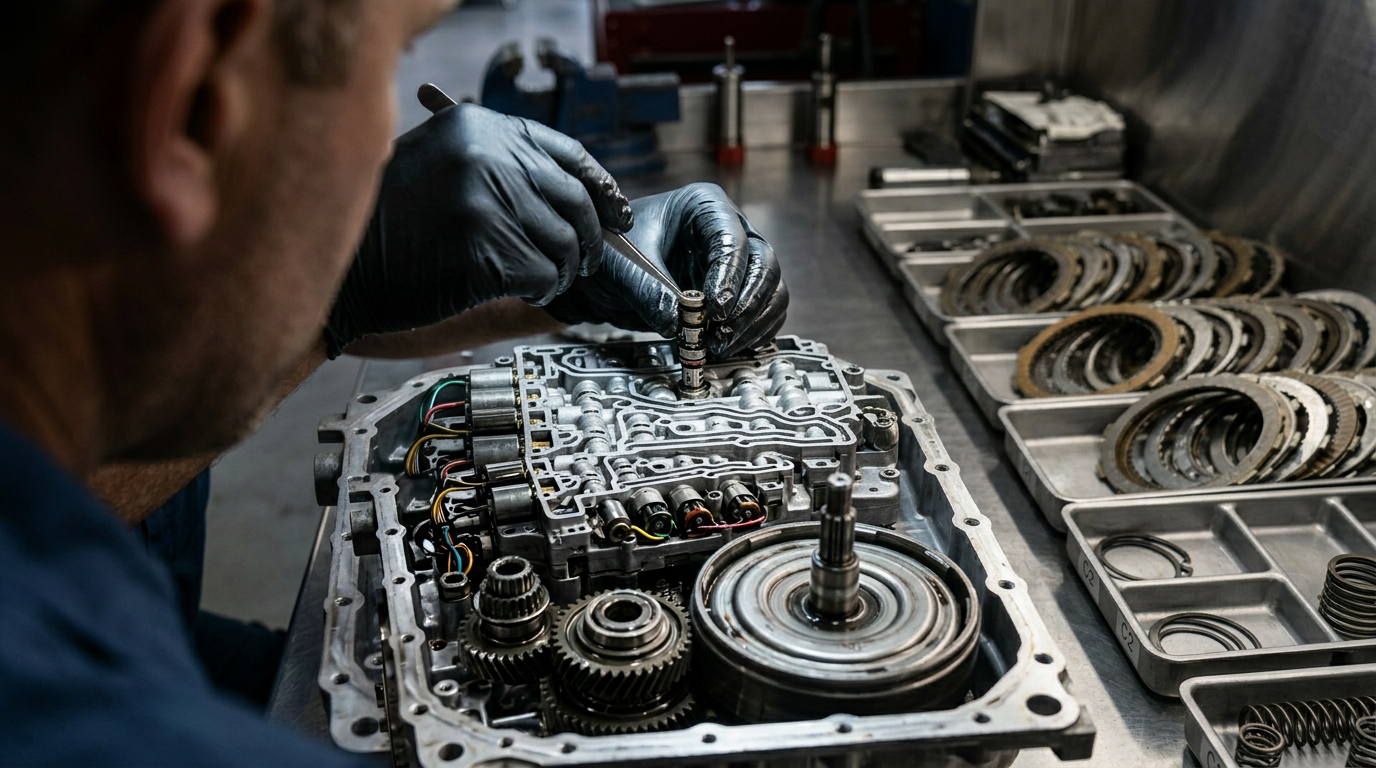
To understand why P0755 matters, it helps to know what shift solenoids actually do. An automatic transmission changes gears by engaging and disengaging sets of clutch packs and bands. These components are activated by hydraulic pressure—transmission fluid pushed through specific channels at precise pressures and timing. Shift solenoids are the electrically controlled valves that direct that fluid flow.
A typical modern automatic transmission uses between four and ten shift solenoids, each labeled with a letter: A, B, C, D, E, and so on. The TCM or PCM energizes specific combinations of solenoids to achieve each gear. When solenoid B is commanded on, it opens a valve that allows pressurized fluid to flow into the appropriate clutch-pack circuit, engaging the gear. When commanded off, a spring returns the valve to its closed position and fluid drains back to the sump.
The solenoid itself is a relatively simple device: an electromagnetic coil wrapped around a plunger. When the coil is energized with approximately 12 volts, the magnetic field moves the plunger and opens the valve. When power is removed, the spring pushes the plunger back. Typical coil resistance for a healthy solenoid falls between 10 and 30 ohms, depending on the manufacturer. The TCM monitors the solenoid's circuit for current draw, response time, and the resulting gear ratio to confirm the solenoid performed as expected.
For Chicago drivers, this system faces particular challenges. Transmission fluid thickens in cold weather, which means every January and February morning when you start your car in Lincoln Park or Bridgeport, the fluid flowing through solenoid B is more viscous than the system was calibrated for. In summer, stop-and-go traffic on the Dan Ryan or the Eisenhower can push fluid temperatures above 200 degrees Fahrenheit, breaking down the fluid's chemical properties and leaving varnish deposits on solenoid plungers. Over time, these temperature extremes accelerate wear on every solenoid in the transmission.
Common Causes of P0755
The causes of P0755 fall into three broad categories: fluid-related problems, electrical failures, and mechanical or hydraulic faults. In most real-world cases, more than one factor is at play.
Dirty or contaminated transmission fluid is the single most common root cause. Transmission fluid degrades over time, especially when subjected to the kind of thermal cycling Chicago's climate imposes. As the fluid breaks down, it loses its ability to lubricate and clean internal components. Microscopic particles of clutch-pack material, metalite, and varnish circulate through the system and can lodge in the solenoid's valve, preventing it from opening or closing fully. In severe cases, the fluid turns from its normal bright red to a dark brown or black and develops a burnt smell. If your fluid looks or smells like this, the solenoid may not be the only component affected.
Low transmission fluid level can also trigger the code. If the fluid level drops below the minimum—due to a leaking pan gasket, a cracked cooler line, or a worn axle seal—the pump cannot maintain adequate pressure to operate the solenoids and clutch packs reliably. Chicago's pothole-scarred roads, particularly along stretches of Ashland, Cicero, and many South Side streets, are notorious for cracking transmission pans and cooler lines, leading to slow leaks that go unnoticed until a code appears.
Faulty shift solenoid B is the next most likely cause. The solenoid's internal coil can develop an open circuit or a short, preventing it from generating the magnetic field needed to move the plunger. The plunger itself can become stuck due to varnish buildup, corrosion, or physical damage. Some solenoids fail gradually—working intermittently before failing completely—while others fail all at once.
Damaged wiring or corroded connectors are especially common in the Chicago area. Road salt used to treat icy streets from November through March accelerates corrosion on the external transmission connector, the wiring harness running from the TCM to the transmission, and the internal harness inside the transmission pan. A single corroded pin on the transmission connector can interrupt the circuit to solenoid B and set P0755.
Valve-body wear or blockage can mimic solenoid failure. The valve body is the hydraulic "brain" of the transmission—a cast-aluminum block with dozens of precisely machined channels, check balls, and accumulator pistons. If the passages that route fluid from solenoid B to the clutch pack become scored, blocked with debris, or develop cross-leaks, the resulting gear ratio will not match the computer's expectations even though the solenoid itself is functioning correctly.
TCM or PCM failure is the least common cause but should not be overlooked, particularly when multiple solenoid codes appear simultaneously with no obvious fluid or wiring problem. A failing TCM may send incorrect voltage or duty-cycle commands to the solenoid, or it may misinterpret the feedback signals and set codes erroneously.
Symptoms You Will Notice
The symptoms of P0755 range from subtle to severe, depending on how far the failure has progressed and which gears are affected.
The most obvious symptom is a failure to shift from second to third gear, or a noticeably harsh, delayed, or slipping shift at that transition point. You may notice the engine revving higher than normal before the shift occurs, or the shift may happen with a jarring thud that you can feel through the seat. In some vehicles, the transmission may skip third gear entirely and jump from second to fourth, producing an uncomfortable lurch and a momentary loss of acceleration.
Limp mode is another common symptom. When the TCM detects that solenoid B is not operating correctly, it may command the transmission into a protective mode that locks it in second or third gear. This limits your speed to roughly 25 to 40 miles per hour and is designed to prevent further damage by avoiding the gear changes that the faulty solenoid controls. If you have ever been stuck in limp mode on the Kennedy Expressway during rush hour, you know how dangerous and stressful the experience can be—traffic moving at 55 miles per hour around you while your vehicle struggles to exceed 35.
Increased fuel consumption is a less dramatic but financially significant symptom. When the transmission cannot shift properly, the engine operates at higher RPMs than necessary, burning more fuel. For a daily commuter driving 50 miles round trip from the suburbs into the Loop, this inefficiency can add 10 to 15 percent to monthly fuel costs—roughly $40 to $60 per month at current gas prices.
Other symptoms include transmission slipping (a momentary loss of power during acceleration), unusual noises such as whining or buzzing from the transmission area, a transmission temperature warning if the malfunction causes excessive heat buildup, and of course the Check Engine Light. In many cases, P0755 will appear alongside P0700, the master transmission-fault code that flags the engine computer to illuminate the warning light.
Can You Drive With P0755?
The answer depends on the severity of the symptoms. If the Check Engine Light is on but the transmission still shifts through all gears without slipping, harsh engagement, or unusual noises, you can drive carefully to a repair shop. Avoid highway speeds and heavy acceleration, and plan the most direct route.
If the transmission is in limp mode, driving is possible but should be limited to reaching the nearest qualified shop. Stay on surface streets, use your hazard lights if traffic is moving significantly faster than you, and do not attempt to merge onto the Stevenson, the Tri-State, or any expressway. If the shop is more than a few miles away, calling a tow truck is the safer and often cheaper decision in the long run, because continued driving in limp mode generates excessive heat that can escalate a $300 solenoid replacement into a $3,500 rebuild.
If the transmission is slipping badly, making grinding or banging noises, or refusing to engage a gear entirely, do not drive the vehicle. Have it towed. The cost of a flatbed tow within Chicago typically runs $75 to $150 and is a fraction of what additional driving damage could cost.
How P0755 Is Diagnosed
A proper diagnosis of P0755 follows a systematic process that distinguishes between electrical, hydraulic, and mechanical causes.
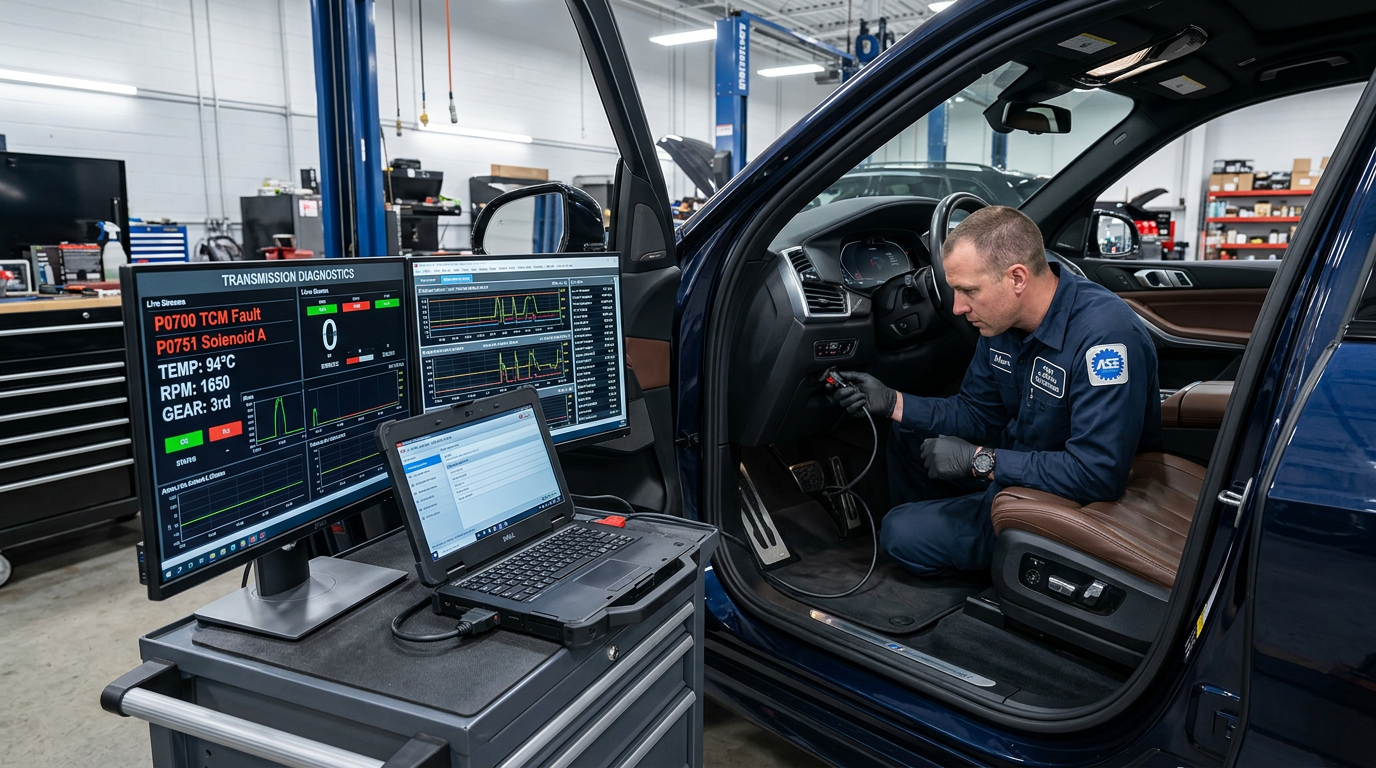
The first step is a comprehensive code scan using a professional-grade scanner that can read TCM-specific codes, freeze-frame data, and pending codes. A basic code reader from an auto-parts store will show P0755 but will miss companion codes stored in the transmission module, and those companion codes are often the key to an accurate diagnosis. The freeze-frame data tells the technician what conditions existed when the code set—vehicle speed, engine RPM, transmission temperature, throttle position—and helps reproduce the fault.
Next, the technician inspects the transmission fluid. The level is checked with the engine running and the transmission at operating temperature (most vehicles). The color should be a translucent red or light pink; dark brown, black, or milky fluid indicates degradation, contamination, or coolant intrusion. The smell matters too: a burnt odor confirms the fluid has been overheated. If the fluid is severely contaminated, the technician will often recommend a fluid and filter service as a first step, since dirty fluid can cause solenoid codes even when the solenoid itself is healthy.
Electrical testing comes next. The technician checks the solenoid B circuit for supply voltage (approximately 12 volts with the key on), ground continuity (less than 0.2 ohms resistance), and solenoid coil resistance (typically 10 to 30 ohms, depending on the manufacturer's specification). A resistance reading outside the specified range confirms a faulty solenoid coil. An open circuit or a short to ground in the wiring harness is identified by testing continuity from the TCM connector to the transmission connector with the harness disconnected.
A solenoid activation test is performed using either a bidirectional scan tool (which commands the TCM to energize solenoid B while the technician monitors the response) or a direct 12-volt bench test with the solenoid removed. A healthy solenoid should produce an audible click and move its plunger smoothly. A sluggish response, no click, or a plunger that sticks indicates a mechanical or internal failure.
If the electrical tests pass, the technician performs a road test with live data streaming to observe the actual gear ratios during each shift. If the second-to-third shift ratio deviates from the expected value despite normal solenoid operation, the problem is likely in the valve body, the clutch pack, or another hydraulic component. At this point, a hydraulic line-pressure test may be performed to verify pump output and circuit integrity, and the valve body may need to be removed for inspection.
Repair Cost Ranges
Repair costs for P0755 vary widely depending on the root cause, the vehicle, and where in the Chicago area you have the work done. Dealership labor rates in downtown Chicago and the North Shore suburbs run $150 to $200 per hour, while independent transmission shops in neighborhoods like Bridgeport, Cicero, or Berwyn typically charge $100 to $140 per hour.
A transmission fluid and filter service, which resolves P0755 in a surprising number of cases where the solenoid is not physically damaged, costs between $150 and $300. This includes draining the old fluid, replacing the filter, installing a new pan gasket, and refilling with the manufacturer-specified ATF.
Shift solenoid B replacement is the most common repair. The solenoid itself costs $15 to $130 depending on the vehicle and whether you purchase an individual solenoid or a solenoid pack (many transmissions use a multi-solenoid assembly that is replaced as a unit). Labor runs $100 to $350 depending on access—some solenoids are accessible by dropping the transmission pan, while others require partial transmission disassembly. All-in, expect $200 to $600 for this repair.
Wiring and connector repair ranges from $50 to $300. If the external transmission connector is corroded from road-salt exposure, it can sometimes be cleaned and treated with dielectric grease for minimal cost. If the internal harness is damaged, replacement involves removing the valve body, which increases labor.
Valve-body repair or replacement runs $500 to $1,800. This is a more involved procedure that requires removing the transmission pan, extracting the valve body, and either reconditioning it (replacing worn check balls, reaming scored passages, replacing accumulator springs) or installing a remanufactured unit. For many vehicles, a remanufactured valve body with updated solenoids is the most cost-effective long-term solution.
TCM reprogramming costs $100 to $200 for the software flash alone. If the TCM hardware has failed, replacement with a VIN-matched, pre-programmed unit runs $600 to $1,200 including labor.
A full transmission rebuild, necessary when the solenoid failure has led to burnt clutch packs or damaged hard parts, ranges from $2,500 to $4,500. A used or remanufactured transmission replacement falls between $1,800 and $3,500 including installation. These higher-end repairs underscore the importance of addressing P0755 promptly rather than driving on it until the damage escalates.
Vehicles Commonly Affected by P0755
While P0755 can appear on any vehicle with an electronically controlled automatic transmission, certain models are more prone to it than others.
General Motors vehicles with the 4L60E and 4L80E transmissions—including the Chevrolet Silverado, Tahoe, Suburban, and GMC Sierra and Yukon—are frequent P0755 candidates. These transmissions use individual solenoids that can be replaced without removing the transmission from the vehicle, which keeps repair costs on the lower end.
Chrysler, Dodge, and Jeep vehicles with the 41TE (A604) and 62TE transmissions also see a high incidence of solenoid B failures. These transmissions use a solenoid pack assembly, meaning all solenoids are replaced as a unit. The upside is that replacing the entire pack addresses any other solenoids that may be on the verge of failure; the downside is a higher parts cost.
Honda and Acura vehicles—particularly the Accord, Civic, Odyssey, and TL—develop solenoid issues at higher mileages, often above 120,000 miles. Honda transmissions are known for being sensitive to fluid condition, and many P0755 cases in these vehicles are resolved or prevented by adhering to a strict 30,000-mile fluid-change interval.
Ford vehicles with the AX4N, 5R55, and 6R80 transmissions round out the list of commonly affected platforms. The 5R55 in particular has a well-documented history of solenoid pack failures that can set codes across multiple solenoid families simultaneously.
The Difference Between P0750 and P0755
Since the previous article in this series covered P0750—Shift Solenoid A Malfunction—it is worth clarifying the distinction. P0750 and P0755 are structurally identical codes that apply to different solenoids. P0750 addresses solenoid A, which typically controls the first-to-second gear shift. P0755 addresses solenoid B, which typically controls the second-to-third shift. The causes, diagnostic procedures, and repair approaches are essentially the same for both codes; the difference lies in which gear transition is affected and, in some transmissions, which physical solenoid within the valve body is at fault.
When both P0750 and P0755 appear together, the technician should investigate shared causes first: contaminated fluid, a shared power or ground wire, or a TCM issue. Replacing individual solenoids without addressing a shared root cause is a common and expensive mistake.
How Chicago's Driving Conditions Contribute to P0755
Chicago's driving environment is uniquely hard on automatic transmissions, and solenoid B is no exception to that stress.
The city's legendary stop-and-go traffic means solenoids cycle thousands of additional times per week compared to vehicles driven primarily on open highways. Every shift from second to third and back again during a crawl down Lake Shore Drive or a sluggish commute on the Eisenhower exercises solenoid B's plunger and valve seat. Over 60,000 to 100,000 miles, that mechanical wear adds up.
Temperature extremes compound the problem. Winter mornings that dip below zero cause transmission fluid to thicken significantly, increasing the hydraulic resistance that solenoid B must overcome on every cold start. Summer heat, combined with the thermal load of idling in traffic, pushes fluid temperatures past the point where chemical breakdown accelerates. This thermal cycling—cold to hot to cold again, day after day, season after season—degrades the fluid faster than in more temperate climates and leaves behind the varnish and particle contamination that fouls solenoids.
Road salt is the third factor. From roughly November through March, Chicago's streets are treated with a mixture of rock salt and brine that coats the underside of every vehicle. The external transmission connector, which houses the electrical pins for every solenoid in the transmission, is directly exposed to this corrosive spray. Corroded connector pins create resistance in the solenoid circuit, reduce the voltage reaching the coil, and ultimately trigger P0755 or P0758.
Finally, Chicago's roads themselves take a toll. Potholes jar the transmission and can stress wiring harnesses, crack brittle connectors, and even damage the transmission pan, leading to slow leaks that lower fluid level over time. If you have ever hit one of those crater-sized potholes on a side street off Pulaski in February, you understand the kind of impact forces involved.
Prevention Tips for Chicago Drivers
Preventing P0755 comes down to proactive maintenance and awareness of the conditions your transmission faces.
Change your transmission fluid every 30,000 miles if you drive primarily in Chicago and the surrounding suburbs. The manufacturer's recommended interval may be 60,000 miles or even "lifetime," but those intervals assume moderate driving conditions. Chicago's combination of stop-and-go traffic, temperature extremes, and short trips qualifies as severe-duty service, and 30,000 miles is the appropriate interval for severe-duty use. Always use the exact ATF specification listed in your owner's manual—using the wrong fluid type can cause shifting problems and accelerate solenoid wear even when the fluid is fresh.
Inspect the external transmission connector annually, ideally during a spring service after the salt season ends. Look for green or white corrosion on the pins, cracked or brittle connector housings, and moisture intrusion. Applying a thin coat of dielectric grease to the connector pins after cleaning helps prevent future corrosion.
Pay attention to how your transmission shifts. If you notice a change in shift quality—a slight hesitation between second and third, a firmer-than-usual engagement, or an occasional slip during acceleration—do not wait for the Check Engine Light to appear. These subtle symptoms are the early warning signs of solenoid wear, and catching them at the intermittent stage (P0759) often means the problem can be resolved with a fluid service or a relatively inexpensive solenoid replacement rather than a valve-body repair or rebuild.
Allow the transmission to warm up before aggressive driving in cold weather. You do not need to idle for ten minutes—thirty seconds to a minute is sufficient—but avoid heavy throttle and rapid gear changes during the first few minutes of driving on cold mornings. This gives the fluid time to circulate through the solenoids and warm to a viscosity where it can flow freely.
Frequently Asked Questions
What does the P0755 code mean in plain language?
P0755 means the computer that controls your automatic transmission detected that shift solenoid B is not working properly. Solenoid B is an electrically controlled valve that directs fluid to change gears—most often the second-to-third gear shift. When it fails, the transmission cannot execute that shift reliably.
Is P0755 a serious code?
Yes. While the vehicle may still be drivable in some cases, ignoring P0755 can lead to limp mode, overheating, accelerated internal wear, and eventually a full transmission failure requiring a rebuild or replacement costing $2,500 to $4,500.
How much does it cost to fix P0755?
The most common repair—solenoid B replacement—runs $200 to $600 including parts and labor. If dirty fluid caused the problem and the solenoid is still functional, a fluid and filter service at $150 to $300 may resolve the code. More extensive repairs such as valve-body work ($500 to $1,800) or a full rebuild ($2,500 to $4,500) are necessary when the underlying damage is severe.
Can dirty transmission fluid cause P0755?
Absolutely. Contaminated fluid is the number-one cause of shift-solenoid codes. Particles and varnish in degraded fluid can block the solenoid valve, coat the plunger, and prevent proper operation. Regular fluid changes are the single most effective preventive measure.
What is the difference between P0755 and P0758?
P0755 is the general malfunction code for solenoid B—it could be electrical, mechanical, or hydraulic. P0758 specifically indicates an electrical fault in the solenoid B circuit, such as an open coil, a short to ground, or a wiring problem. P0758 narrows the diagnostic path to the circuit rather than the hydraulic system.
Can I clear P0755 and hope it goes away?
Clearing the code resets the Check Engine Light, but if the underlying problem has not been fixed, the code will return within one to three drive cycles. Clearing codes is a useful diagnostic step—it tells the technician whether the fault is active or intermittent—but it is not a repair.
Does P0755 always mean I need a new solenoid?
No. In many cases the solenoid itself is fine and the code was triggered by dirty fluid, low fluid level, a corroded connector, or a wiring fault. Proper diagnosis identifies the actual cause before any parts are replaced.
Which vehicles are most likely to get P0755?
GM trucks and SUVs with the 4L60E or 4L80E, Chrysler and Dodge vehicles with the 41TE or 62TE, Honda Accords and Civics at higher mileages, and Ford vehicles with the 5R55 or 6R80 are among the most common.
Should I go to a dealership or an independent shop?
Either can handle P0755 competently, but an independent transmission specialist in the Chicago area typically charges $100 to $140 per hour compared to $150 to $200 at a dealership, and often has more transmission-specific diagnostic experience. The key is to choose a shop that uses a professional-grade scanner capable of reading TCM codes and performing bidirectional solenoid tests.
SEO Notes
Primary Keyword: P0755 code
Secondary Keywords: P0755 shift solenoid B malfunction, shift solenoid B, P0755 causes, P0755 symptoms, P0755 repair cost, transmission shift solenoid, P0756, P0757, P0758, P0759, limp mode, transmission solenoid replacement
Local Keywords: Chicago, Chicago drivers, Chicago winter, Kennedy Expressway, Dan Ryan, Eisenhower, Stevenson, Tri-State Tollway, Lake Shore Drive, Lincoln Park, Bridgeport, Wicker Park, Schaumburg, Cicero, Berwyn, Pulaski, Western Avenue, road salt
Internal Links: P0700 article, P0730 article, P0740 article, P0741 article, P0750 article; future links to P0715 (Input Speed Sensor) and P0780 (Shift Malfunction)
Word Count: ~4,600
Structure: H1 title, 12 H2 sections, comprehensive FAQ with 9 entries, natural keyword placement throughout, Chicago references distributed across causes, symptoms, driving advice, and prevention sections
That completes the P0755 article. We are now six articles deep into the series: