P0756 means shift solenoid B isn't opening when commanded, blocking the 2-3 upshift and causing limp mode. Learn causes, diagnosis, and Chicago-area repair costs quoted after diagnosis.
What Does the P0756 Code Mean?
Diagnostic trouble code P0756 stands for "Shift Solenoid 'B' Performance or Stuck Off." It is a generic OBD-II powertrain code that applies to all automatic-transmission vehicles from 1996 onward. The TCM or PCM sets P0756 when it commands shift solenoid B to energize for a gear change but the expected shift either does not occur or occurs with measurably abnormal quality - excessive delay, RPM flare, or total absence of ratio change.
Shift solenoid B is one of several electro-hydraulic valves mounted on the transmission's valve body. Its specific job varies by transmission design, but on most platforms it controls the 2-3 upshift - the transition from second gear to third gear. On GM's 4L60E it is the "2-3 shift solenoid." On GM's 6L80 it is designated "SS2" or "Shift Solenoid 2." On Ford's 5R55 and 4R70W families it controls a mid-range gear transition. On Honda 4- and 5-speed automatics it is part of the linear solenoid assembly governing mid-range shifts. Regardless of platform, the diagnostic logic is identical: the TCM sent the "energize" command, monitored input and output speed sensors, and determined that the gear ratio did not change as expected within its calibrated time window. That mismatch sets P0756.
The "performance or stuck off" qualifier tells a technician that the solenoid appears to remain in its default de-energized (closed) position. The fluid pathway it controls is not opening. This is mechanically or hydraulically driven - a physically stuck valve, a clogged passage, or a pressure drop - rather than a pure electrical open/short (which would set P0758). The solenoid coil may measure perfectly on a resistance test, yet the valve physically does not move. This distinction is critical for directing the diagnosis toward hydraulic or mechanical causes first, rather than chasing wiring faults.
For Chicago drivers the practical impact is immediate: the transmission skips the 2-3 shift, stays locked in second gear or lower, or the TCM forces limp mode - locking the vehicle into a single gear at a maximum of 25-40 mph. Navigating expressway traffic at that speed is unsafe, and even surface-street driving becomes hazardous when surrounding traffic expects 35-45 mph.
The P0755-P0759 Shift Solenoid "B" Code Family
P0756 belongs to the solenoid B sub-family. Understanding where it sits narrows the diagnosis before the pan is dropped.
P0755 is the general shift solenoid B malfunction - a broad flag that something is wrong with the solenoid circuit or its function without specifying the failure direction. P0756 (this article) means the solenoid is stuck off or performing as if it were stuck off; the hydraulic pathway does not open. P0757 means the solenoid is stuck on - the pathway stays open when it should close, forcing or holding the gear solenoid B controls. P0758 is a pure electrical code - an open or short circuit in the solenoid wiring, connector, or coil itself. P0759 flags intermittent solenoid B operation - the valve works some of the time but not consistently.
When P0756 appears alongside P0751 (solenoid A stuck off), the problem is likely systemic rather than isolated to a single solenoid. Contaminated fluid, a saturated filter, or valve-body-wide debris should be the primary investigation target. This pair - P0751 plus P0756 - is one of the most frequently reported dual-solenoid combinations on GM 6L80 trucks and Duramax-equipped HD models. When P0756 appears with P0741 (TCC stuck off), the combination strongly suggests torque converter clutch failure has shed debris into the fluid, clogging multiple solenoids and passages simultaneously. This is a well-documented failure progression on GM 6L80/6L90 transmissions and is addressed in multiple Technical Service Bulletins.
How Shift Solenoid B Works
The operating principle of solenoid B is identical to solenoid A, described in the P0751 article - an electromagnetic coil moves a plunger to open a hydraulic passage, fluid pressure moves a shift valve, and that shift valve directs mainline pressure to the appropriate clutch pack to engage the next gear. The key difference is which gear change solenoid B controls and where it sits in the valve body.
On most transmissions, solenoid B controls a mid-range upshift. When the TCM determines - based on vehicle speed, throttle position, engine load, and transmission temperature - that the vehicle should move from second to third gear, it energizes solenoid B. The coil generates a magnetic field that pulls the plunger off its seat, opening a fluid channel. Pressurized fluid flows through the channel, repositions the 2-3 shift valve, and mainline pressure is routed to the third-gear clutch pack while the second-gear apply circuit is exhausted. The TCM confirms the shift by comparing the input-to-output speed ratio before and after the command. If the ratio matches the expected third-gear value within tolerance, the shift is successful. If it does not change, P0756 is stored.
Because solenoid B controls a mid-range shift, its failure produces a distinctly different driving experience than solenoid A failure. Instead of the vehicle struggling from a dead stop (as with P0751), the vehicle accelerates normally through first and second gears, then "hangs" - engine RPM climbs past the expected shift point and the transmission never enters third. The engine rev-limiter may eventually intervene if the driver continues to accelerate, or the TCM may force limp mode after detecting the missed shift.
Common Causes of P0756
Contaminated transmission fluid from torque converter clutch failure is the single most important cause on GM 6L80/6L90 platforms and is documented in GM TSBs PIE0371A, PIP4379M, PIP5100A, and PIP5100. The OEM torque converter's TCC lock-up clutch is a known weak point. Under normal use - especially with the heat cycles generated by Chicago's aggressive stop-and-go traffic - the clutch material delaminates and sheds fine metallic particles (often described as "coffee grounds" or "metallic glitter") into the fluid. This debris circulates through the valve body and clogs the precision bores around shift solenoids, jamming them in the off position. When a technician drops the pan on a 2013-2019 Silverado, Sierra, Tahoe, or Yukon with P0756 and finds the pan magnet coated in thick metallic sludge, the diagnosis is virtually certain: the torque converter has failed and contaminated the entire hydraulic system. Fixing only the solenoid without replacing the converter guarantees the new solenoid will fail the same way within months.
Dirty or degraded fluid (absent torque converter failure) is the leading cause on non-GM platforms. As ATF ages, it accumulates friction-material dust, oxidation by-products, and microscopic metal wear particles. These contaminants varnish solenoid plungers and clog valve-body passages. In Chicago's climate, where winter cold thickens the fluid and summer heat accelerates oxidation, the fluid degradation cycle is compressed. Honda Fit and Accord owners report P0756 appearing preferentially on cold mornings - "Some days I only have 2nd and 3rd gear on cold starts; after a drive if I turn off then back on all gears work" - because the thickened cold fluid cannot dislodge marginal debris from the solenoid bore until the transmission reaches operating temperature.
A failed or mechanically stuck shift solenoid accounts for roughly 30-40% of cases. The solenoid plunger can seize from corrosion, bore scoring, or a cracked return spring. On GM 6L80 transmissions, the solenoid is integrated into the TEHCM (Transmission Electro-Hydraulic Control Module), meaning an individual solenoid replacement is not practical - the entire TEHCM must be replaced as a unit (quoted after diagnosis). On Ford and Chrysler units, individual solenoid replacement is usually possible.
Valve-body bore wear is particularly relevant on Ford Explorer 6F55 (2015-2019) transmissions, where a known manufacturing defect in the direct clutch cylinder causes snap-ring displacement, catastrophic internal damage, and P0756 alongside codes P0715 and P2701. Ford TSBs SSM 46069 and SSM 50861 document this issue. On 2020-2022 Explorers with the 10R60/10R80 10-speed transmission, sticking valves in the main control valve body are the primary cause, addressed by Ford TSBs 20-2403 and 21-2046.
Wiring and connector faults are less common with P0756 (a performance code) than with P0758 (an electrical code), but high-resistance connections can reduce the current delivered to the solenoid coil, producing insufficient magnetic force to move the plunger against spring pressure and fluid drag. Chicago road salt corroding the external transmission connector is a recurring contributor.
TCM or TEHCM failure is the least common cause but carries the highest repair cost. On GM trucks, the TEHCM sits inside the pan in the hot-fluid environment, and heat-cycle solder fatigue can degrade its output drivers over time.
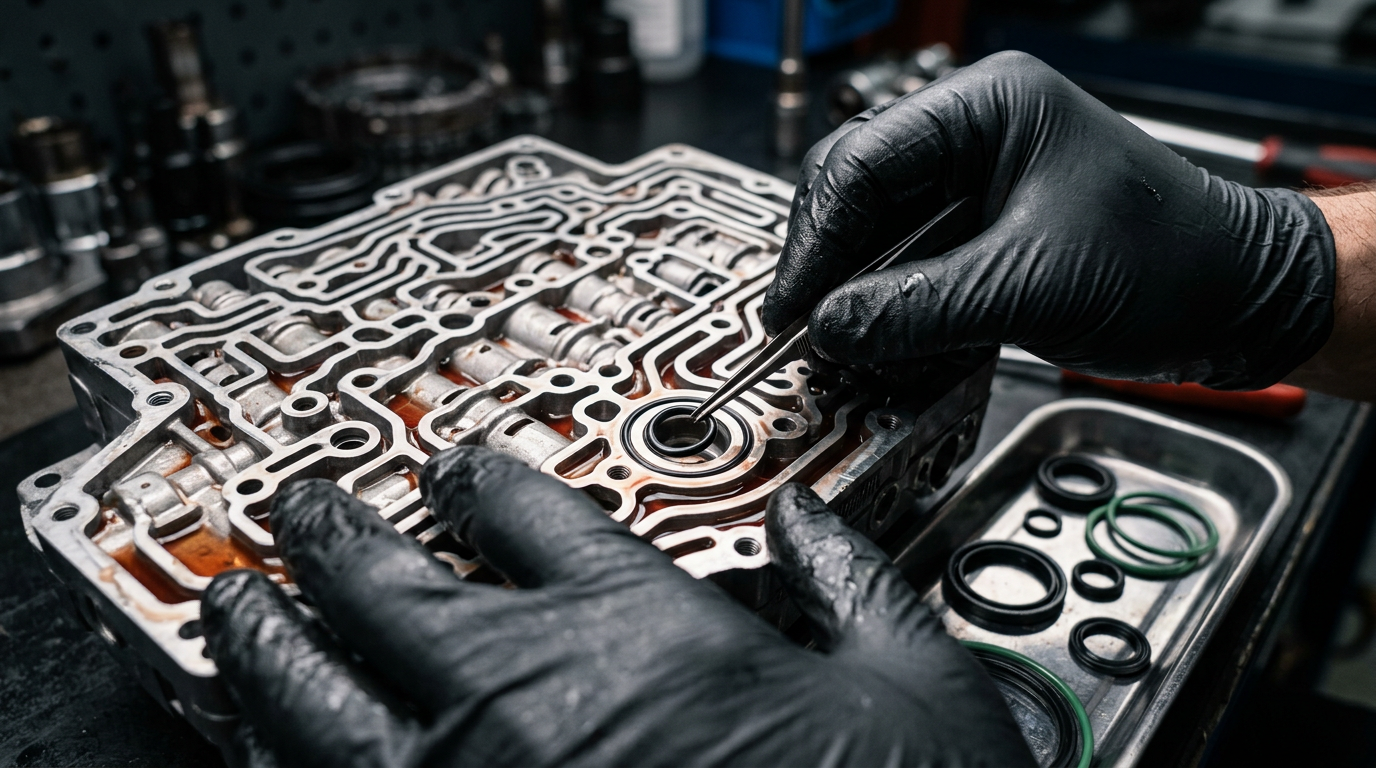
A clogged transmission filter restricts pump output to the valve body, reducing the pressure available to complete the shift even if the solenoid opens correctly. A filter change alone - part of a standard fluid service - can resolve P0756 in cases where the filter is saturated but the solenoid and fluid are otherwise acceptable.
Symptoms Chicago Drivers Will Notice
The most prominent symptom is the failure to upshift from second to third gear. The vehicle accelerates normally in first and second, but as the engine approaches the 2-3 shift RPM (typically 3,000-4,000 RPM at moderate throttle), nothing happens. The engine continues to rev without a corresponding speed increase, or the shift occurs with a harsh, delayed "bang" that is felt throughout the cabin.
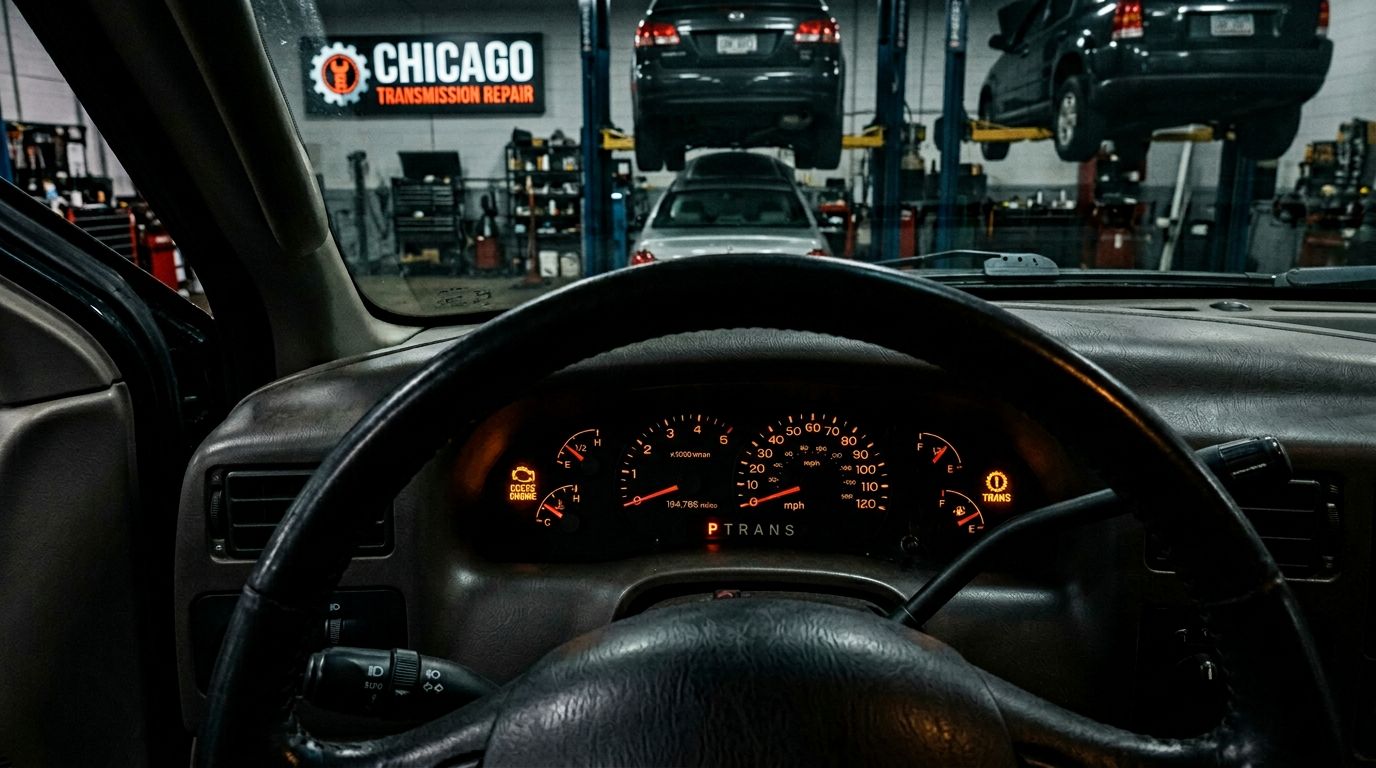
Limp mode activation is common within one to three drive cycles of the initial failure. The TCM locks the transmission into a single protective gear - usually third - limiting maximum speed to roughly 25-40 mph. For a Chicago driver, limp mode makes expressway use impossible and even surface streets like Ashland, Pulaski, or Halsted become difficult to navigate at safe traffic speeds.
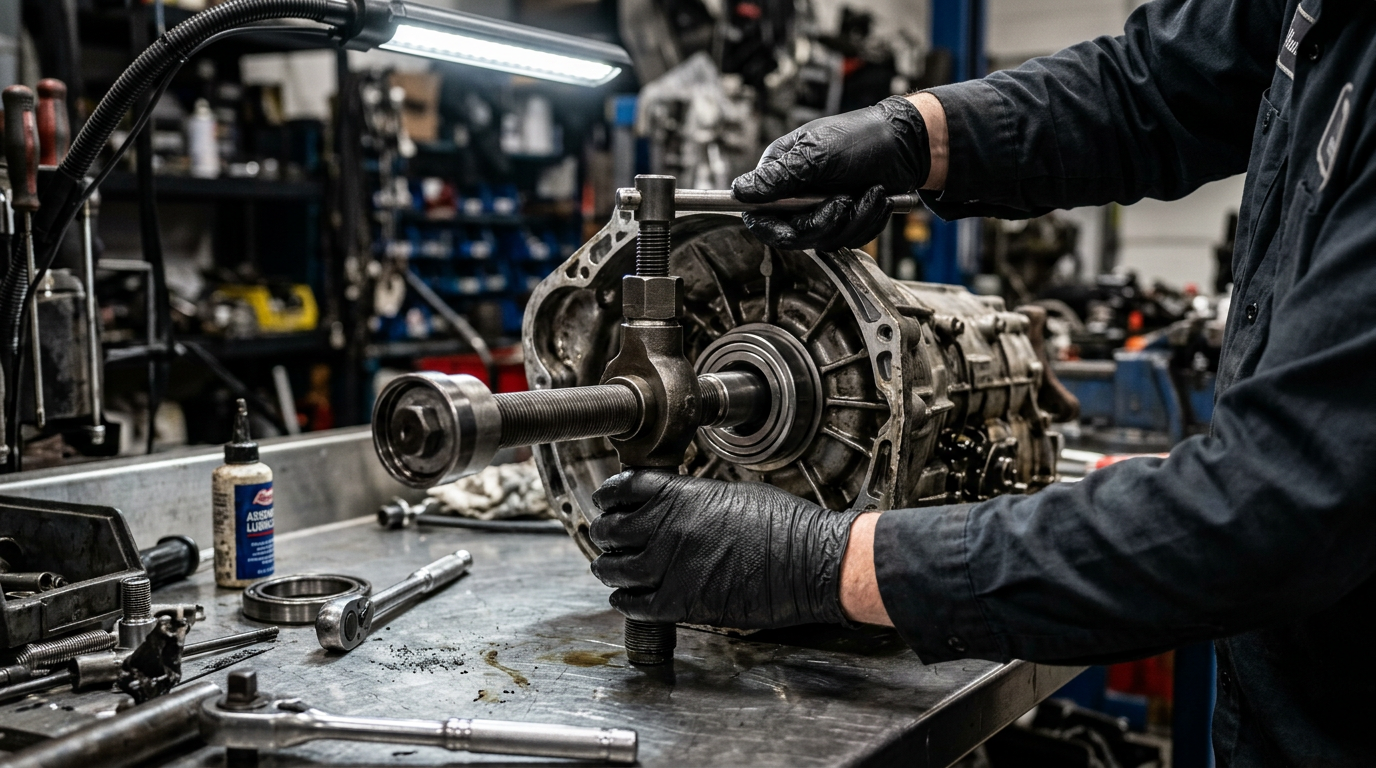
Transmission slipping occurs when the solenoid opens partially. The third-gear clutch pack receives some apply pressure but not enough for a clean lock-up, so it slips. Engine RPM flares without matching vehicle acceleration, and the resulting friction generates heat in the transmission. Sustained slipping is one of the fastest paths from a solenoid replacement to a rebuild.
Transmission overheating follows slipping. The P0218 (transmission over-temperature) code may appear alongside P0756 if the condition persists. Overheated fluid accelerates debris formation, which further clogs solenoids and passages - a destructive feedback loop.
Shuddering at 35-55 mph, particularly on light acceleration, is a telltale sign of torque converter debris-related P0756 on GM platforms. The shudder results from intermittent clutch application as debris partially blocks and then releases from the solenoid bore.
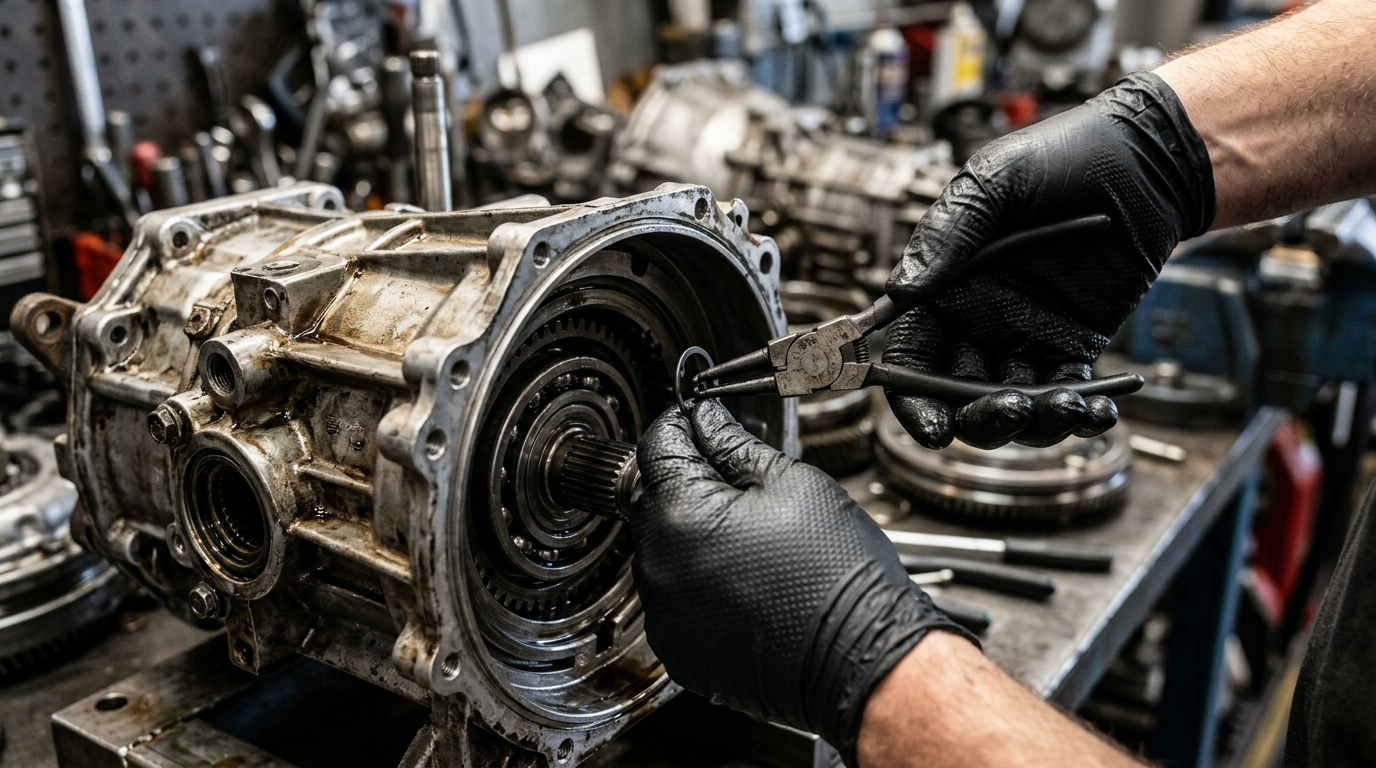
Reduced fuel economy results from the transmission's inability to reach optimal gear ratios. A vehicle stuck in second gear at 50 mph burns substantially more fuel than one operating in third or fourth.
The check-engine light illuminates, typically with P0756 and P0700 stored. On GM vehicles, P0741 may also be present, indicating the underlying torque converter failure.
Can You Drive with P0756?
Driving should be limited to the minimum distance needed to reach a repair facility. If the transmission is in limp mode, the speed limitation makes expressway travel dangerous - a 30-mph vehicle on the Kennedy or Eisenhower is a collision hazard. If the transmission is slipping rather than in limp mode, every additional mile generates heat that compounds internal damage.
If the vehicle is only missing the 2-3 shift but first and second gears work normally, careful surface-street driving at low speed is possible for a short distance. Keep RPMs below 4,000 to minimize strain and heat generation.
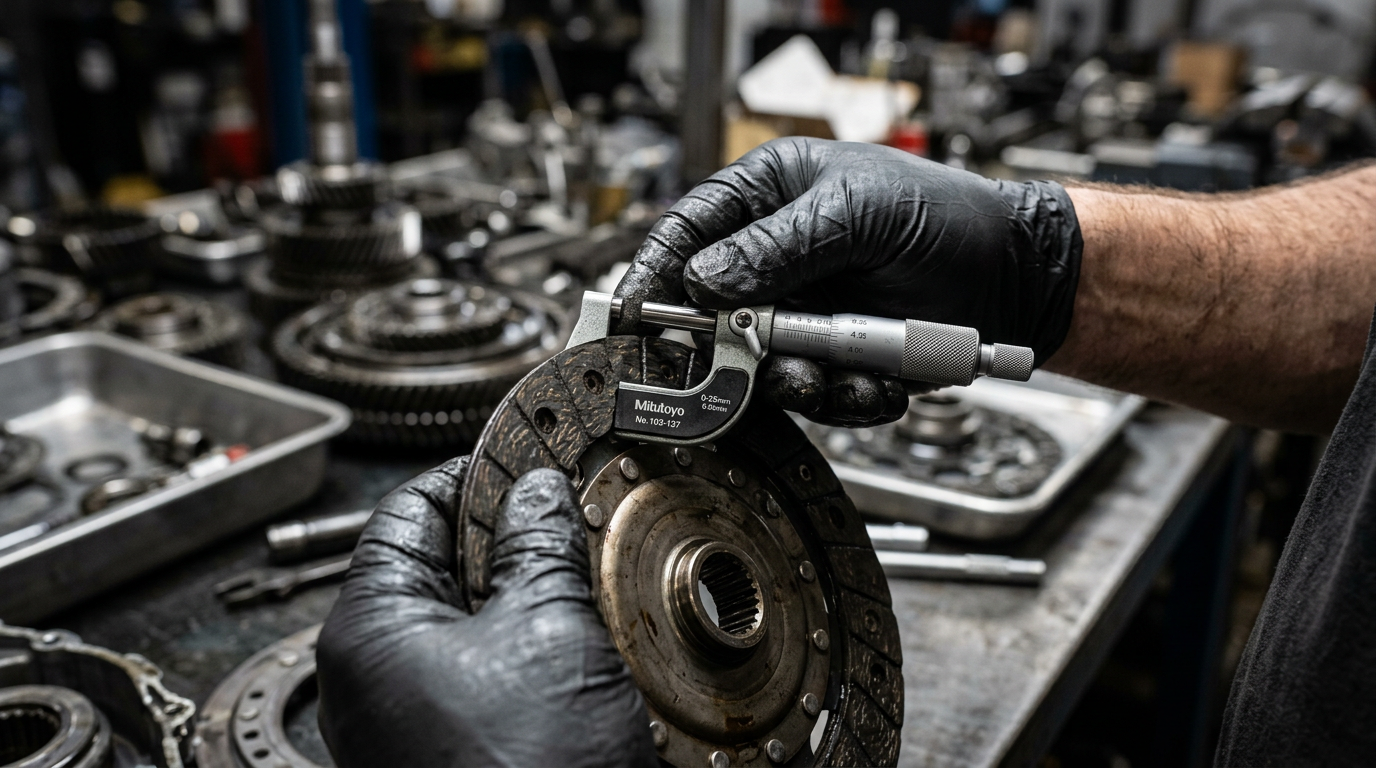
If the transmission is stuck in a single gear and will not shift at all, or if the vehicle shudders violently, tow it. A Chicago-area flatbed tow (quoted after diagnosis) costs far less than the - rebuild that results from driving an overheating, debris-contaminated transmission.
Diagnosis Steps
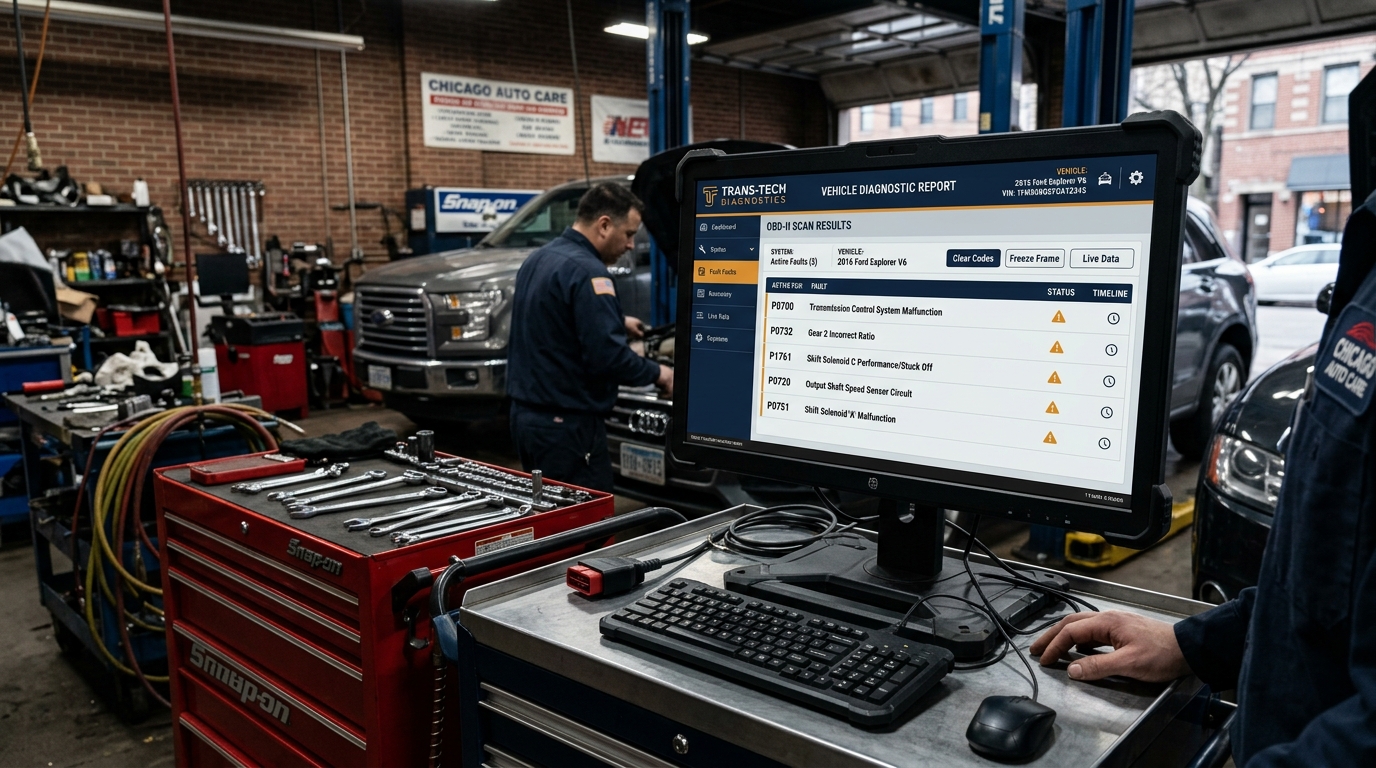
A full OBD-II scan retrieves all stored and pending codes. The technician focuses on companion codes - P0700, P0751, P0741, P0757, P0758, and any gear-ratio codes - because their presence dramatically narrows the root cause. Freeze-frame data captures operating conditions at the moment of fault detection.
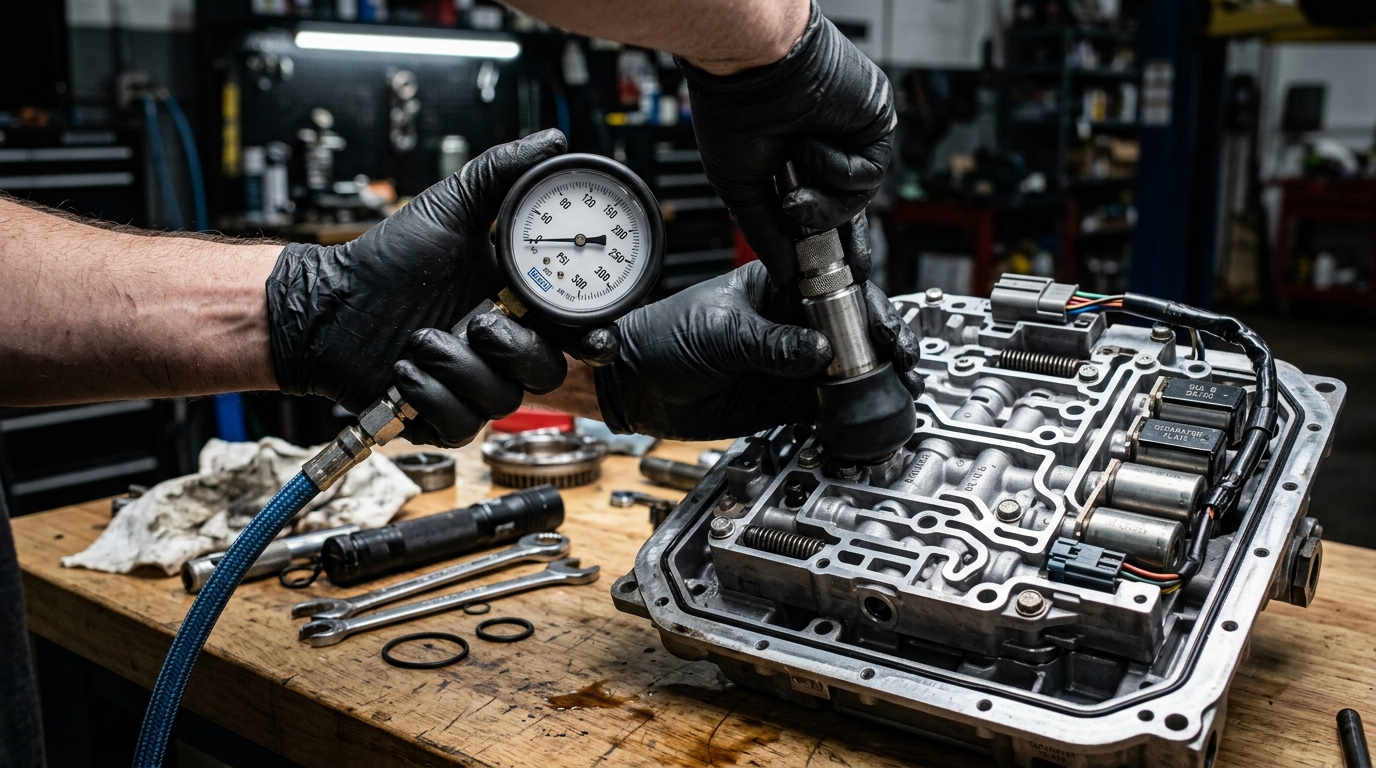
Transmission fluid inspection is the most important single diagnostic step. The technician checks level, color, clarity, and odor. Pink or light-red translucent fluid with no burnt smell suggests the fluid itself is not the primary issue. Dark brown or black fluid with a burnt smell indicates severe degradation. Metallic "glitter" or sludge on the dipstick or pan magnet is the hallmark of torque converter clutch failure on GM platforms and changes the repair scope entirely - from a solenoid swap to a converter replacement with full system flush.
Live data monitoring during a road test (if safely possible) reveals the solenoid's commanded state versus the actual shift outcome. With a professional scan tool, the technician watches "Shift Solenoid B Status" while the vehicle accelerates through the 2-3 shift range. If the command shows "ON" but the input-to-output speed ratio does not change to the expected third-gear value, the solenoid is confirmed stuck off mechanically, or the hydraulic path is blocked. If the command shows "OFF" when it should be "ON," the fault is in the TCM's command logic.
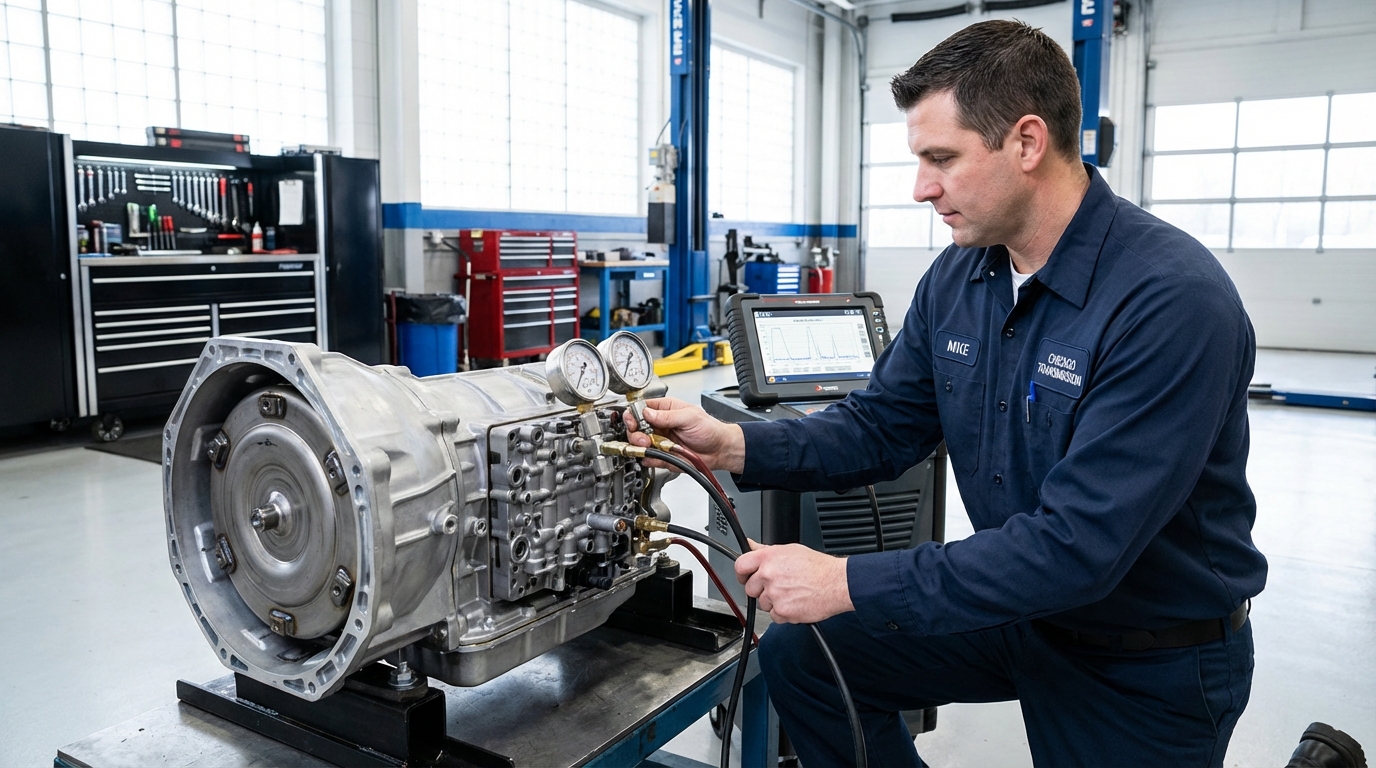
Bidirectional solenoid testing allows the technician to manually command solenoid B on and off from the scan tool while the vehicle is stationary. An audible "click" and a corresponding live-data pressure change confirm the solenoid is functional. No response confirms a physical or hydraulic failure. On GM vehicles, a "Solenoid Cleaning Process" automated routine can be run through the GDS2/Tech2 scan tool - it cycles all solenoids rapidly to dislodge minor debris. If this clears the code temporarily, fluid contamination is confirmed as the root cause.
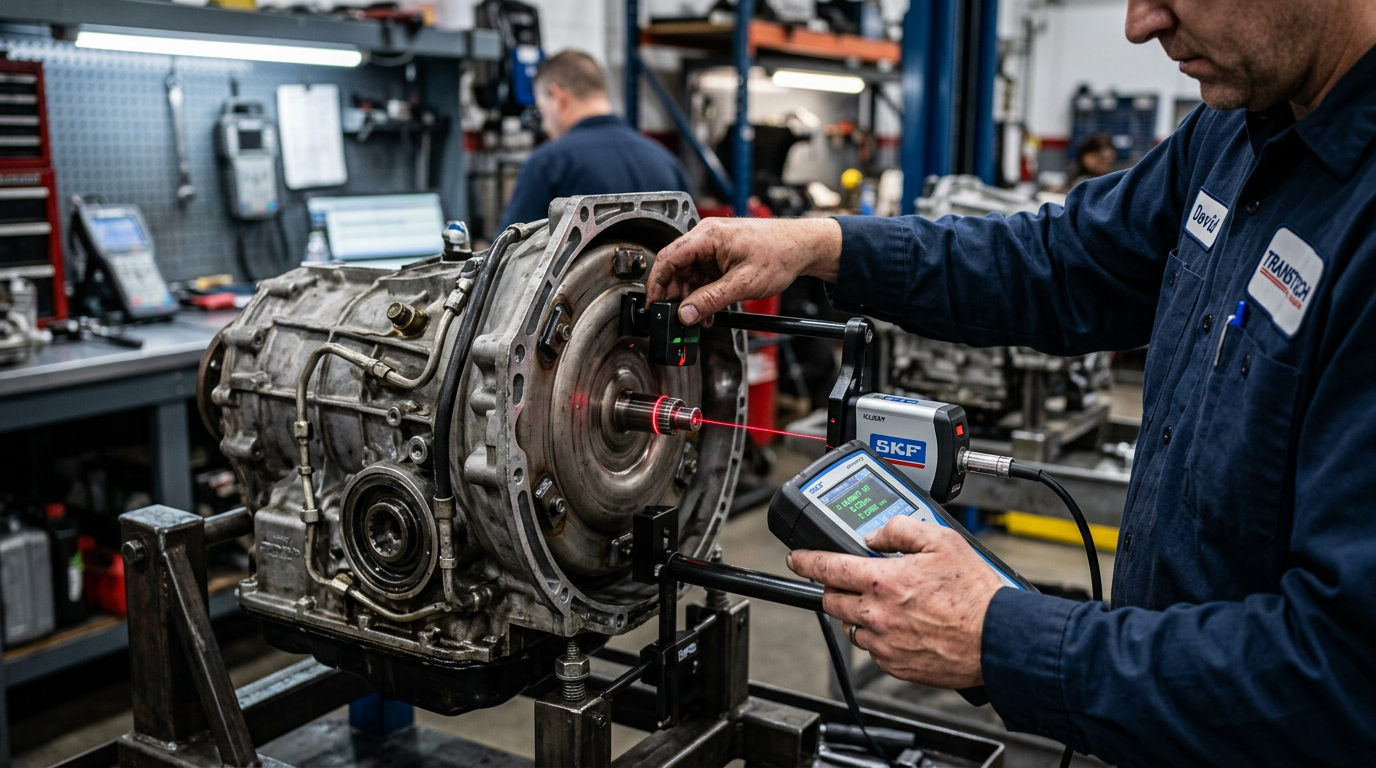
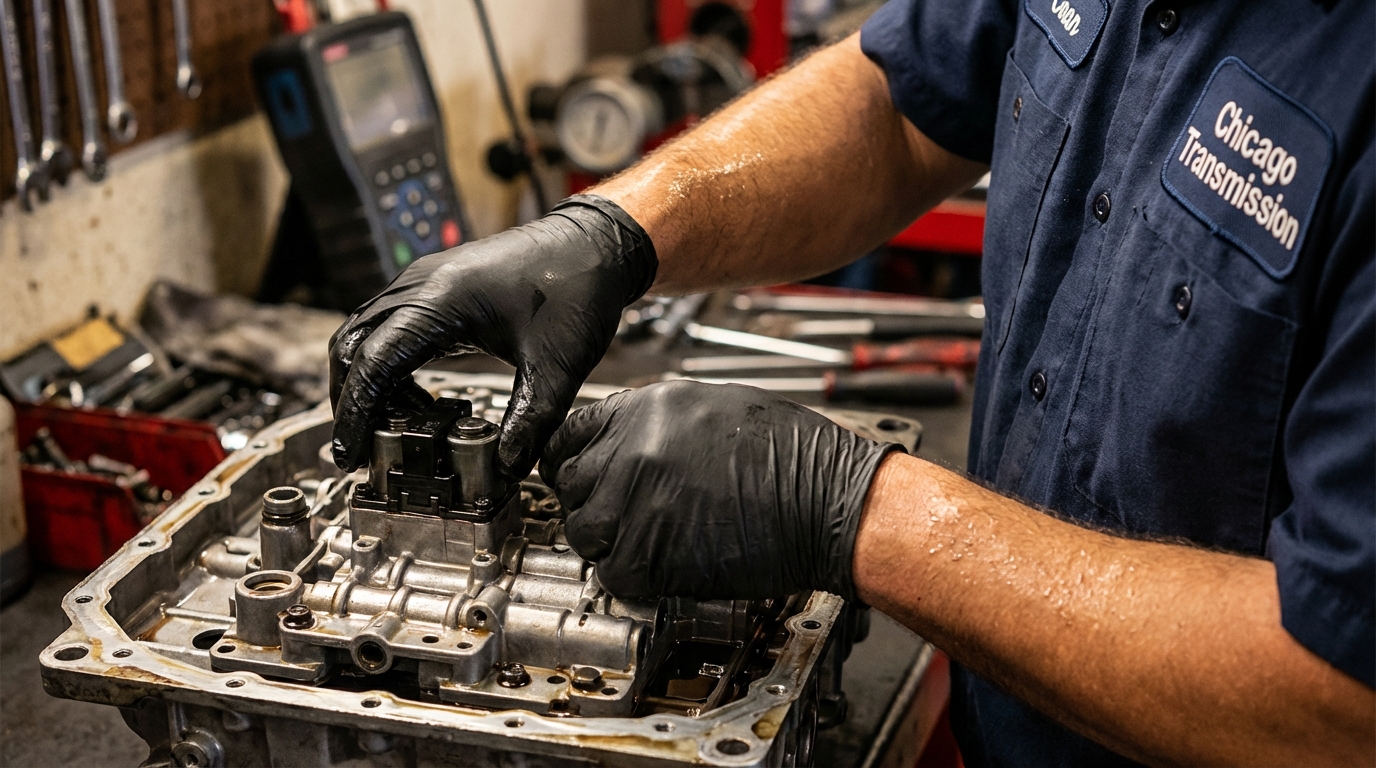
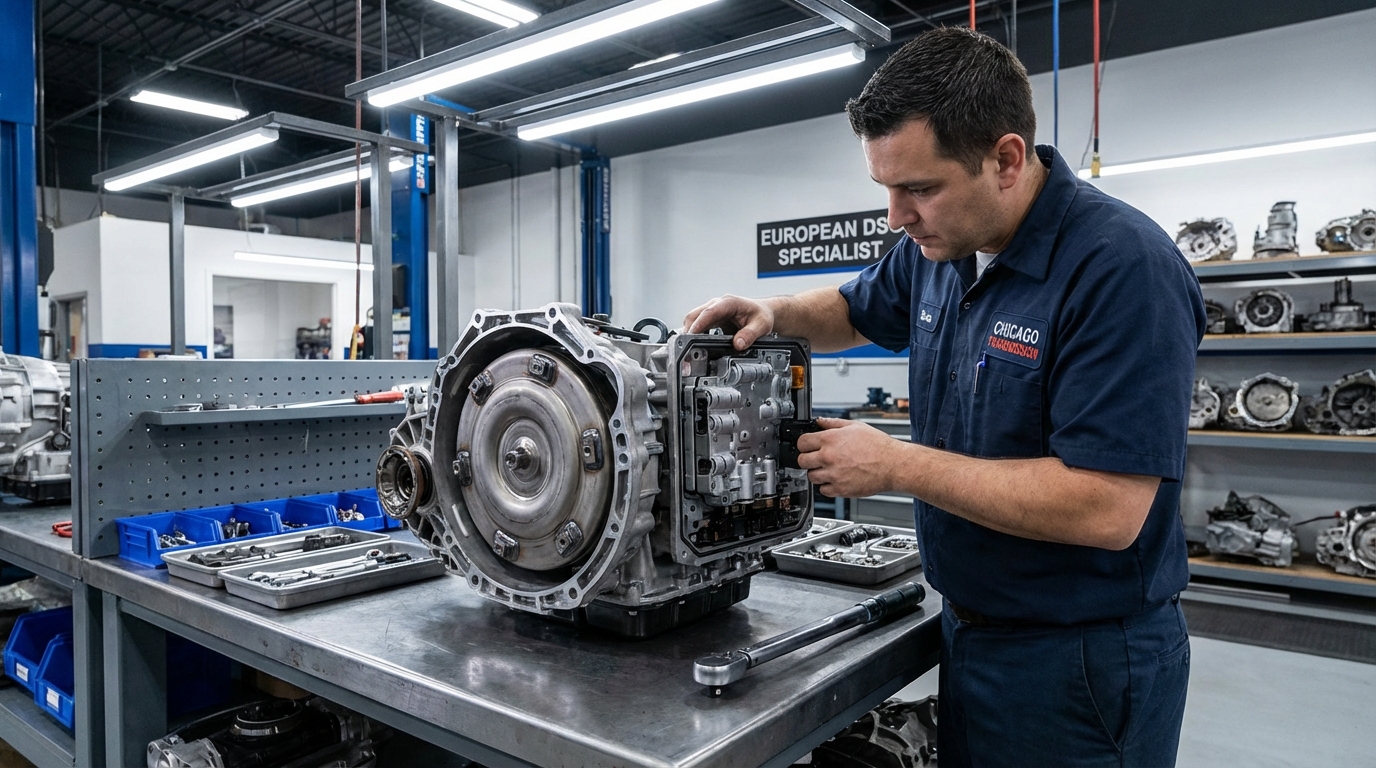
Pan-drop inspection follows if the code persists. The technician removes the pan, inspects the magnet for debris volume (fine gray powder is normal; thick metallic sludge or chunks are not), examines the solenoid and valve body, and measures solenoid resistance. Typical resistance specifications are 20-40 ohms on GM units and 4-6 ohms on Ford 6F55/10R80 solenoids. The technician also physically tests solenoid movement with a 12 V jumper.
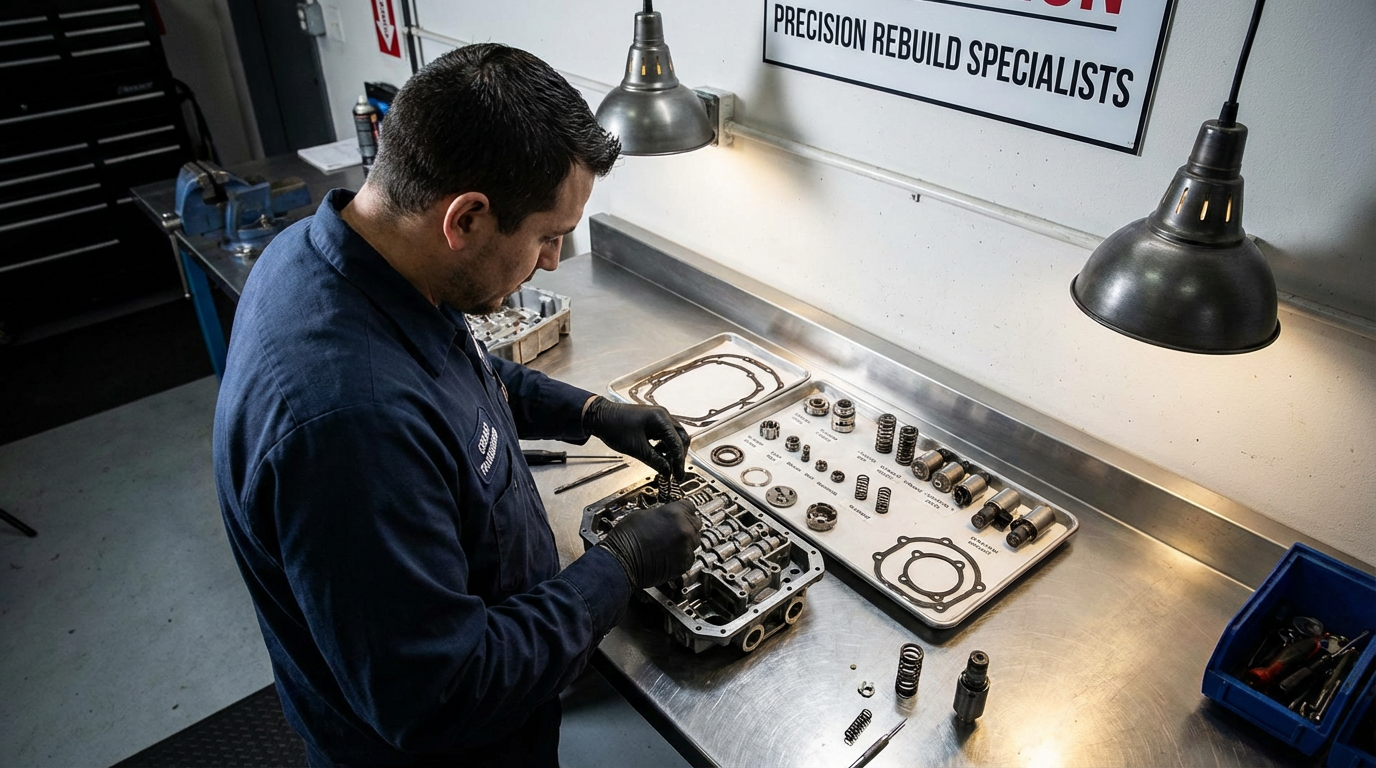
Valve-body inspection is warranted if the solenoid tests clean. The technician checks shift-valve bores for scoring and checks passages for blockage. On GM 6L80 units, TSB PIP5100A specifically directs inspection of the valve-body separator plate for debris blockage. Aftermarket correction kits (Sonnax, TransGo) are available to restore worn bores.
On Ford Explorer 6F55 transmissions (2015-2019), if the pan contains heavy metallic debris and the vehicle has lost reverse, third, and fifth gears, the direct clutch snap ring failure per TSBs SSM 46069 and SSM 50861 is the likely cause - this is a full rebuild scenario, not a solenoid repair.
Repair Cost Ranges
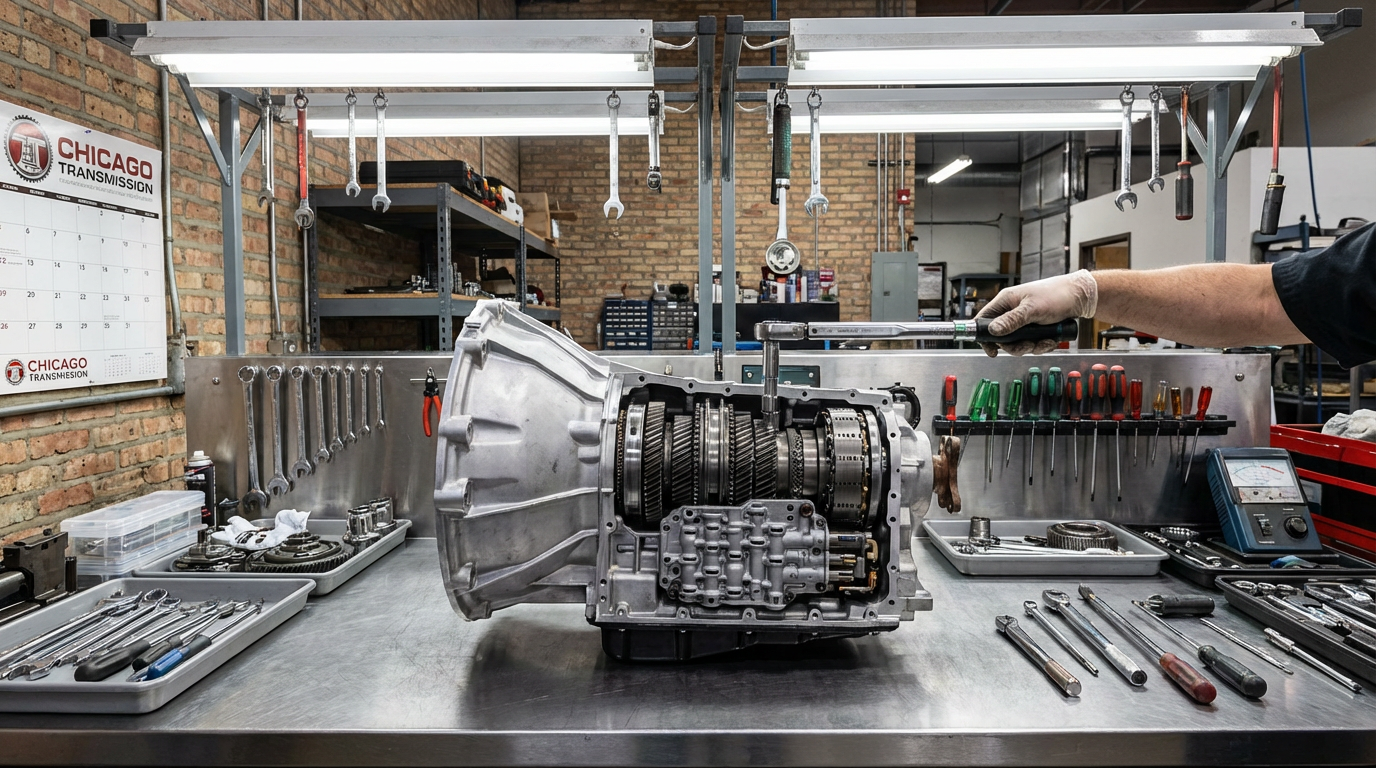
TEHCM replacement (GM 6L80/6L90). The TEHCM integrates all solenoids, the valve body, and the TCM into a single unit. OEM ACDelco is recommended when available, programming is required, and labor is 2-4 hours. On K2XX platform trucks (2014-2016), the TEHCM calibration is generation-specific and not cross-compatible with earlier GMT900 units.
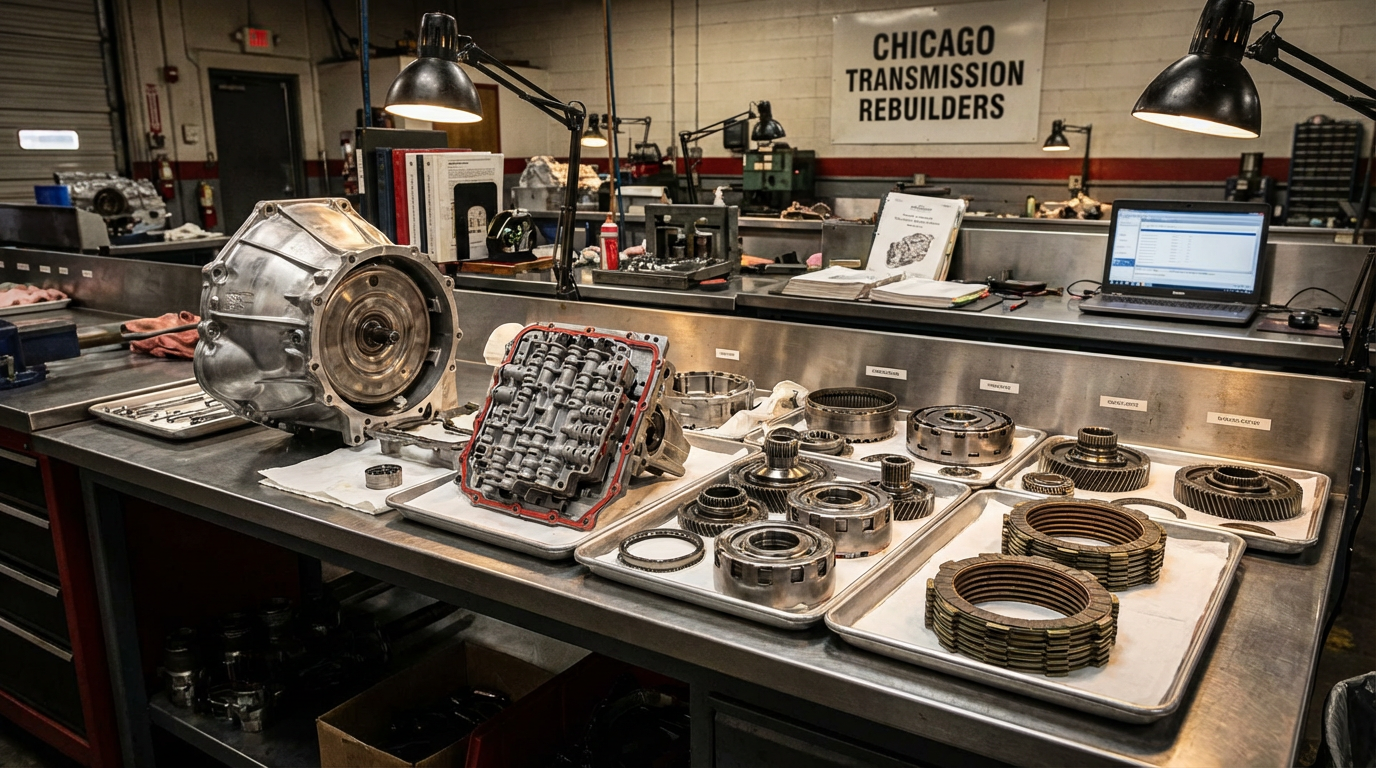
Torque converter replacement and is necessary whenever significant metallic debris is found in the pan (the GM scenario described above). The converter itself is -; the transmission must be removed for access, making labor the dominant cost component. A full cooler-line flush must be performed simultaneously to purge contaminated fluid from the cooling circuit.
Internal wiring harness replacement. The internal harness connects solenoids to the case connector and becomes brittle from heat exposure at high mileage.
TCM replacement (non-TEHCM vehicles) for a VIN-matched unit programming.
Full transmission rebuild. Ford Explorer 6F55 snap-ring failures can push costs - due to the severity of internal damage. A remanufactured transmission.
Vehicles Most Commonly Affected
GM trucks and SUVs with the 6L80/6L90 transmission lead all platforms for P0756 frequency. The Chevrolet Silverado, Tahoe, Suburban, GMC Sierra, Yukon, and Cadillac Escalade (2007-and-later) are the most commonly reported, with torque converter clutch debris as the dominant root cause. The 4L60E in pre-2007 trucks also produces P0756 from individual solenoid wear. GM's Duramax-equipped HD trucks with the 6L80 (and Allison 1000 on certain models) report the code frequently, with Duramax Forum threads documenting P0756 alongside P0751 as a signature dual-solenoid failure pattern.
Ford Explorer (2015-2022) is a particularly high-frequency platform. The 6F55 6-speed in 2015-2019 models has the documented snap-ring defect. The 10R60/10R80 10-speed in 2020-2022 models has documented valve-body sticking. Ford F-150 models with the 10R80 also report P0756, sometimes linked to the CDF clutch drum sleeve failure (Ford TSB 22-2428).
Honda Fit and Accord models produce P0756 from contaminated fluid and solenoid varnish, with cold-morning intermittent presentations being characteristic.
Jeep Wrangler and Liberty (42RLE transmission) and Jeep Grand Cherokee and Dodge Durango (545RFE/45RFE) produce P0756 from solenoid and valve-body wear. Jeep Forum threads document P0756 alongside P0758 as a common pair on the 42RLE.
Chevrolet, Ford, and Lexus are explicitly cited by CarParts.com as commonly affected makes for this code.
Chicago-Specific Factors
Cold-start fluid viscosity is the dominant Chicago-specific trigger. When temperatures drop below 10 degrees F - common from December through February - ATF thickens to the point where a marginally clogged solenoid bore cannot pass fluid. Honda Fit owners document the cold-start-only P0756 pattern: the transmission has only second and third gears when first started on a frigid morning, then returns to normal function after the fluid warms. This temperature-dependent behavior is a diagnostic clue that the solenoid is on the verge of permanent failure - warm weather merely masks the problem.
Road salt corrosion of the external transmission connector is an ongoing factor. The connector sits in the direct path of road spray, and years of salt exposure degrade pin contacts. Even a small increase in resistance at the solenoid's power pin can reduce coil current enough to prevent plunger movement in cold, viscous fluid.
Stop-and-go traffic volume in Chicago means the 2-3 shift occurs hundreds of times per commute - far more than in a highway-dominant driving environment. Each cycle fatigues the solenoid coil, wears the plunger bore, and generates microscopic friction debris. Vehicles driven primarily on congested arterials like Western, Ashland, or Cicero reach the solenoid's mechanical wear threshold at substantially lower odometer readings.
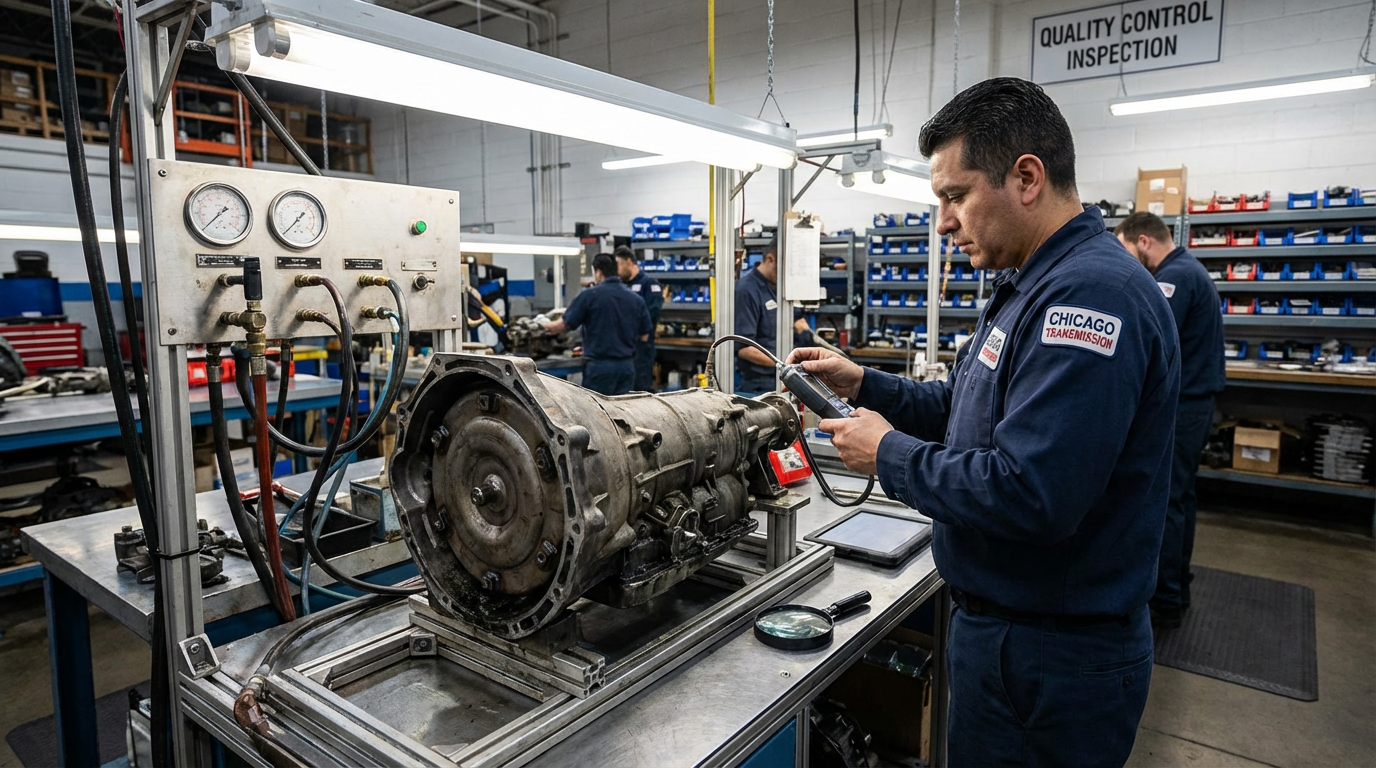
Summer heat combined with traffic-jam idling reduces cooler airflow and drives fluid temperatures above 220 degrees F, accelerating fluid oxidation and the torque converter clutch delamination that seeds debris into the system.
Potholes contribute incremental valve-body damage. Severe impacts can dislodge check balls, crack valve-body separator plates, or unseat solenoid O-ring seals - any of which produces a pressure leak that mimics a stuck-off solenoid.
Prevention Tips
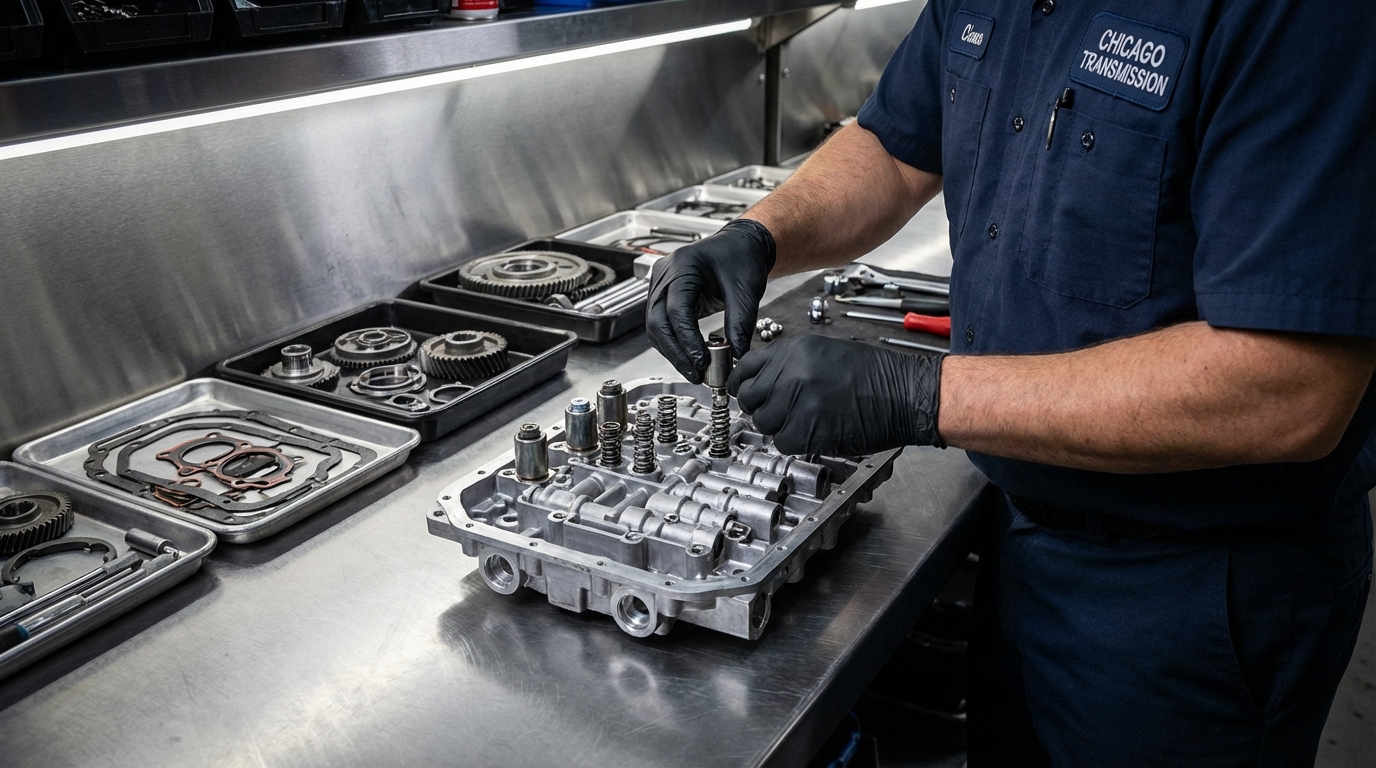
Change transmission fluid and filter every 30,000 miles - or every 25,000 miles for vehicles subjected to heavy stop-and-go, towing, or temperature extremes. On GM 6L80/6L90 trucks, where torque converter debris is the primary failure driver, some transmission specialists recommend shortening the interval to 20,000 miles and inspecting the pan magnet at each service for early signs of converter clutch material.
Clean the external transmission connector annually after salt season. Unplug the connector, inspect for green or white corrosion on pins, spray with electrical contact cleaner, dry, apply dielectric grease, and re-seat firmly.
Allow the transmission to warm up before spirited driving on cold mornings. Idle 60-90 seconds in Park, then drive gently for the first mile. Warm fluid flows through valve-body passages more readily and reduces the force needed to move solenoid plungers.
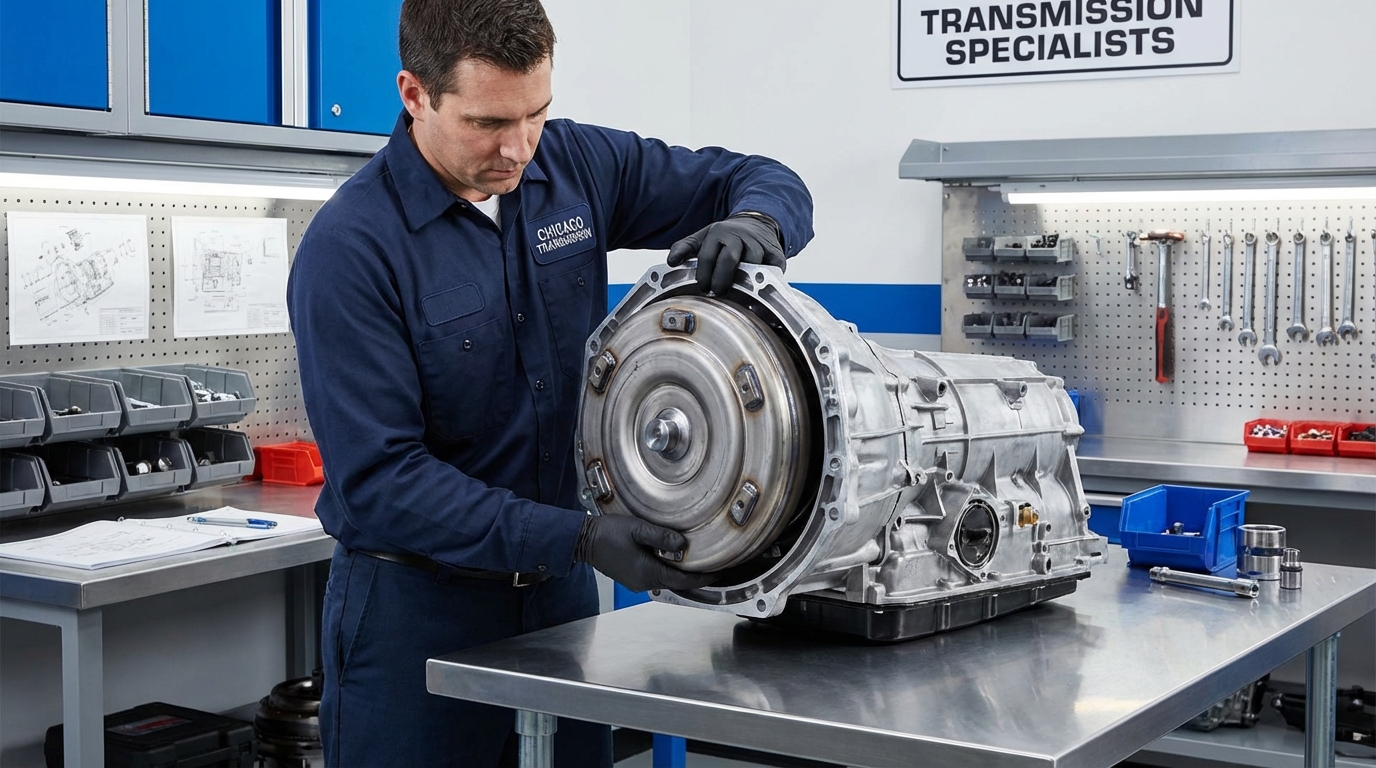
Address early symptoms immediately. If the 2-3 shift feels harsh, delayed, or flare-y in cold weather but improves after warm-up, the solenoid is already showing signs of the condition that produces P0756. A properly matched fluid service at this stage can add tens of thousands of miles before permanent failure when the internal hardware is still healthy.
Monitor for TCC shudder on GM trucks. A mild vibration at 35-55 mph on light throttle is the first sign of torque converter clutch delamination. If caught early, a converter replacement can prevent the downstream solenoid and valve-body contamination that turns a targeted repair into a rebuild.
Use the manufacturer-specified fluid. DEXRON-VI for GM, MERCON LV for Ford 6-speeds, Motorcraft ULV for Ford 10-speeds, Honda DW-1 for Honda. Incorrect fluid can alter viscosity curves and friction properties in ways that accelerate solenoid wear.
Frequently Asked Questions
What does P0756 mean in plain language?
The computer commanded one of your transmission's internal valves (shift solenoid B) to open so the transmission could shift from second to third gear, but the shift either didn't happen or happened poorly. The valve appears stuck in the closed position.
How serious is P0756?
Very serious. KBB rates P0756 as a code that should be treated immediately because delayed repair allows the problem to worsen into expensive internal transmission damage. If the transmission enters limp mode, safe driving is severely limited.
What does it typically cost to fix P0756?
Fluid service alone: quoted after diagnosis. Individual solenoid replacement: quoted after diagnosis. TEHCM replacement on GM 6-speed: quoted after diagnosis. Torque converter replacement (when debris is present): quoted after diagnosis. Valve-body work: quoted after diagnosis. Full rebuild: quoted after diagnosis. The final cost depends on the root cause and accumulated damage.
Can a fluid change really fix P0756?
Yes, in approximately 15-20% of cases. If the solenoid is sticking from varnish or light debris in degraded fluid, fresh fluid with correct friction modifiers can free the plunger. However, if the solenoid is mechanically worn, if valve-body bores are scored, or if torque converter debris has contaminated the system, a fluid change alone will not provide a lasting fix.
What is the difference between P0755 and P0756?
P0755 is a general solenoid B malfunction code without specifying the failure direction. P0756 specifically indicates the solenoid is stuck off or performing as if stuck off, providing more diagnostic direction.
What is the difference between P0756 and P0758?
P0756 is a performance/mechanical code - the solenoid coil may test fine electrically, but the valve isn't moving due to a mechanical blockage or hydraulic issue. P0758 is an electrical code - the TCM detects an open circuit, short, or abnormal resistance in the solenoid's wiring. Different root causes require different diagnostic approaches.
Why does P0756 often appear with P0751?
Because both solenoids share the same fluid supply, filter, and valve body. If contaminated fluid is the cause, it clogs both solenoids simultaneously. On GM 6L80 transmissions, this dual-solenoid pattern is a hallmark of torque converter debris contamination.
Why does P0756 appear mainly on cold mornings?
Cold ATF is thicker. Thick fluid requires more force to flow through valve-body passages and more magnetic force from the solenoid coil to move the plunger. A solenoid with marginal varnish or debris that functions in warm fluid may fail in cold, viscous fluid. This intermittent cold-start pattern is an early warning that the solenoid is approaching permanent failure.
Can I replace just the solenoid on a GM 6L80 truck?
No. On the 6L80, the solenoid is integrated into the TEHCM, which includes all solenoids, the valve body, and the transmission control module. The entire TEHCM must be replaced as a unit and programmed to your vehicle's VIN.
Which vehicles are most prone to P0756?
GM trucks with the 6L80/6L90 transmission top the list, with torque converter debris as the root cause. Ford Explorer (2015-2022) is a close second due to documented 6F55 snap-ring and 10R80 valve-body issues. Honda Fit/Accord, Jeep Wrangler (42RLE), and Dodge/Chrysler vehicles with 45RFE/545RFE transmissions are also frequently affected.
H2 sections: 12
Series tally - Articles completed (15 of 50):
| # | Code | Topic |
|---|------|-------|
| 1 | P0700 | Transmission Control System Malfunction |
| 2 | P0730 | Incorrect Gear Ratio |
| 3 | P0740 | TCC Circuit Malfunction |
| 4 | P0741 | TCC Performance / Stuck Off |
| 5 | P0715 | Input/Turbine Speed Sensor Circuit |
| 6 | P0720 | Output Speed Sensor Circuit |
| 7 | P0750 | Shift Solenoid A Malfunction |
| 8 | P0755 | Shift Solenoid B Malfunction |
| 9 | P0218 | Transmission Fluid Over-Temperature |
| 10 | P0780 | Shift Malfunction |
| 11 | P0706 | Transmission Range Sensor |
| 12 | P0613 | TCM Processor Fault |
| 13 | P0742 | TCC Circuit Stuck On |
| 14 | P0751 | Shift Solenoid A Performance / Stuck Off |
| 15 | P0756 | Shift Solenoid B Performance / Stuck Off |
Next up: P0733 - Gear 3 Incorrect Ratio
Have a Transmission Problem?
Get a Diagnosis-first inspection from Chicago transmission repair support.