P0775 is the "general malfunction" code. Its sub-codes narrow the diagnosis: P0776 (performance or stuck off), P0777 (stuck on), P0778 (electrical), and P0
SEO Metadata
| Field | Value |
|---|---|

| Title Tag | P0775 Code: Pressure Control Solenoid "B" Malfunction - Causes, Fixes & Chicago Repair Costs |
| H2 Sections | 12 |
| Schema | FAQPage, HowTo, Article |

H2 local - What Does the P0775 Code Mean?
Diagnostic trouble code P0775 is a generic OBD-II transmission code defined as "Pressure Control Solenoid 'B' Malfunction." It is set when the powertrain control module (PCM) or transmission control module (TCM) detects that the solenoid designated "B" in the pressure-control family is not regulating hydraulic line pressure within expected parameters. The fault may be electrical (open circuit, short circuit, abnormal current draw) or hydraulic (insufficient or excessive pressure at the solenoid's output despite correct electrical commands).
Unlike the shift solenoids covered earlier in this series (P0750 through P0770), which act as simple on/off or variable-duty valves that route fluid to specific clutch packs, pressure control solenoids regulate the overall force behind those fluid circuits. Think of a shift solenoid as a traffic light that opens or closes a road, and a pressure control solenoid as the water-pressure regulator that determines how fast the fluid flows down that road. Pressure Control Solenoid B works in tandem with Solenoids A and C (and sometimes D) to ensure every shift event - from a gentle 1-2 upshift at city speeds to a firm kickdown under wide-open throttle - happens with the right amount of hydraulic force. When Solenoid B malfunctions, the transmission loses its ability to modulate pressure for the gear transitions it controls, producing shifts that are either brutally harsh (too much pressure) or dangerously slippery (too little).
The "B" designation does not map to a single gear across all manufacturers. On Ford 5R55W and 5R55S transmissions (Explorer, Mountaineer, Mustang, Lincoln LS), Solenoid B is part of the integrated solenoid block and directly influences the overdrive servo circuit and the intermediate band - making P0775 a common companion to harsh 2-3 shifts and flaring overdrive engagement. On Subaru Lineartronic CVTs (TR580, TR690), the "B" pressure control solenoid governs the driven-pulley pressure circuit, which adjusts the effective gear ratio across the belt-and-pulley system; a fault here produces shudder at low speeds and ratio-hunting at cruise. On GM 6L80/6L90 transmissions, Solenoid B modulates line pressure for second- through fourth-gear apply events. On Chrysler 45RFE/545RFE/68RFE platforms, the pressure control designation sometimes overlaps with shift-solenoid nomenclature depending on the scan tool, so verifying the exact solenoid identity through the factory wiring diagram is essential before replacing parts.
For Chicago drivers, P0775 most often appears during the kind of driving the city demands: repeated stop-and-go transitions where the pressure control solenoid cycles hundreds of times per commute, heavy acceleration merging onto the Kennedy or Dan Ryan, and cold-start operations in winter when thickened fluid forces the solenoid to work harder against increased hydraulic resistance.

H2 #2 - How Pressure Control Solenoid B Works
Pressure control solenoids are variable-force electro-hydraulic actuators. Unlike simple on/off shift solenoids that are either fully open or fully closed, a pressure control solenoid receives a pulse-width-modulated (PWM) signal from the TCM - a rapid on-off electrical pulse whose duty cycle (the percentage of time the signal is "on") determines how far the solenoid's plunger opens the hydraulic valve. At zero percent duty, the valve is fully closed (or fully open, depending on the solenoid's "normally open" or "normally closed" design); at one hundred percent duty, the valve is at maximum displacement. Between those extremes, the TCM can command any intermediate pressure by varying the duty cycle, typically at a frequency of 70 to 250 Hz depending on the manufacturer.
Inside the solenoid, a wire coil wrapped around a bobbin generates a proportional magnetic field that acts on a spring-loaded steel plunger. The plunger's position regulates an orifice that meters pressurized transmission fluid from the pump to the downstream clutch-apply circuit. The precision required is remarkable: a few percent change in duty cycle translates to a few PSI change in line pressure, which in turn determines whether a shift feels smooth or jarring.
The TCM monitors Solenoid B through two feedback loops. The primary loop measures the electrical current flowing through the coil. Because the solenoid's impedance is known (typical coil resistance ranges from roughly 5 to 7 ohms on some designs to 8 to 40 ohms on others, depending on the manufacturer and solenoid type), the TCM can calculate whether the current matches the commanded duty cycle. An open coil draws zero current; a shorted coil draws excessive current; a degraded coil drifts as temperature changes. The secondary loop uses the transmission's pressure sensor (or infers pressure from the speed-sensor ratio) to verify that the commanded pressure is actually being achieved in the hydraulic circuit. When the electrical command and the hydraulic result do not match, the TCM stores P0775.
On Subaru CVTs, this feedback loop is particularly sensitive because the continuously variable ratio depends on precise pressure balance between the primary (drive) pulley and the secondary (driven) pulley. If Pressure Control Solenoid B - which governs the driven-pulley circuit - allows too little pressure, the belt slips and the ratio hunts; too much pressure, and the ratio changes abruptly, producing a shudder that feels like driving over rumble strips at low speed.
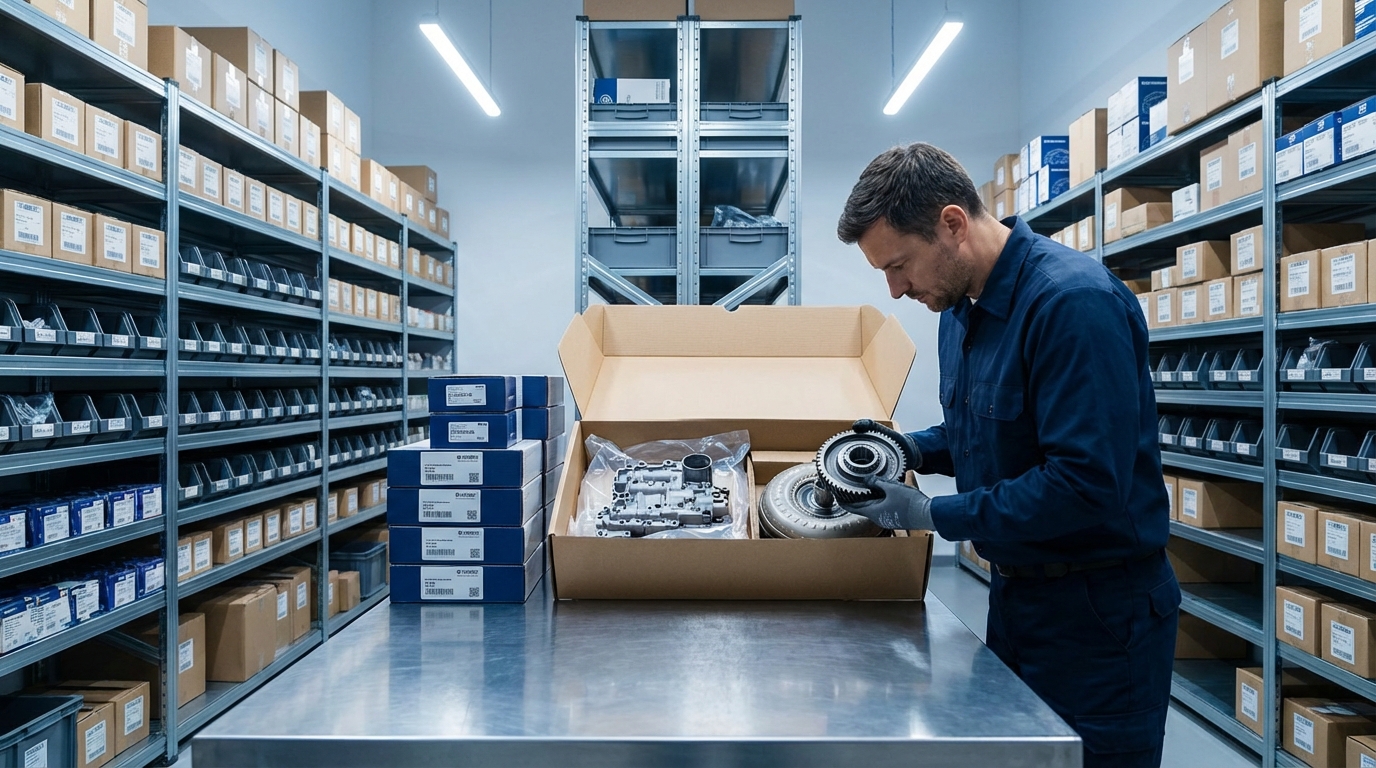
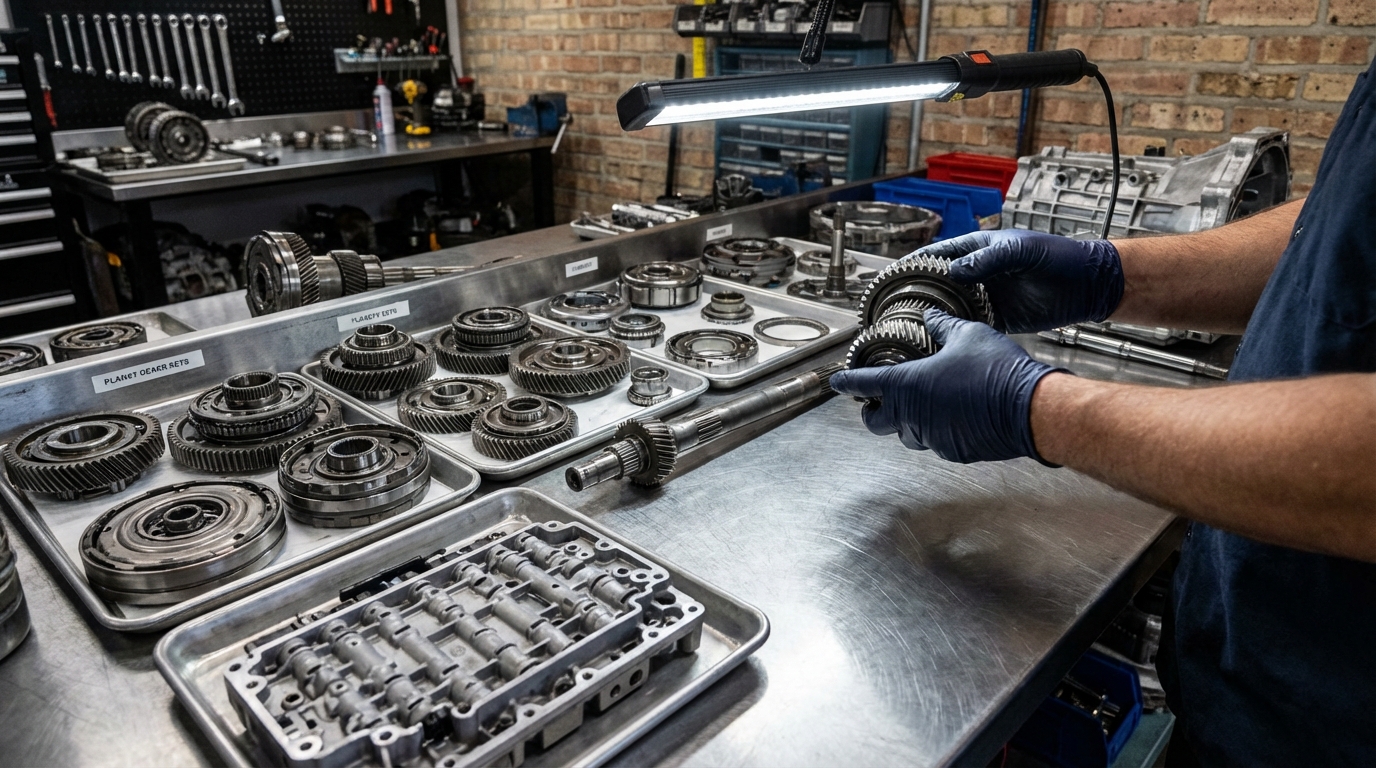
On Ford 5R55 transmissions, Solenoid B's output feeds the intermediate servo and the overdrive band circuit. The servo bore in the 5R55 is a known wear point: even a perfectly functioning solenoid cannot produce correct pressure if the bore has worn oversize, allowing fluid to bypass the piston seal. This is why replacing the solenoid pack alone frequently fails to resolve P0775 on these platforms - the underlying mechanical wear must also be addressed, as documented extensively in Explorer Forum threads where owners report persistent P0775 after multiple solenoid-pack replacements.
H2 #3 - Common Causes of P0775 (Ranked by Frequency)
Low, contaminated, or incorrect transmission fluid (25-35 percent of cases). This is the single most common trigger for P0775, and it differs from the shift-solenoid codes earlier in this series where wiring led the list. Pressure control solenoids are exquisitely sensitive to fluid condition because they modulate flow through tiny orifices. Fluid that is low by even half a quart reduces the pump's ability to generate the baseline pressure the solenoid needs to work with. Contaminated fluid - carrying friction-material debris, varnish, or metallic particles - clogs those orifices or causes the plunger to stick in a partially open position. Wrong-specification fluid (for example, using Dexron III in a Subaru CVT that requires Subaru CVT Fluid or its equivalent, or using Mercon V in a Ford that has been updated to Mercon LV) changes viscosity and friction characteristics, directly altering the pressure response the TCM expects. On Subaru CVTs, dark-brown fluid with metallic shimmer (needle-bearing debris) is a red flag for internal damage beyond what a fluid change can fix.
Defective pressure control solenoid (20-30 percent). The solenoid coil can open, short between windings, or degrade thermally so that resistance drifts out of specification at operating temperature. The plunger may stick from varnish buildup, or the valve seat may erode from fluid-borne debris. On Ford 5R55 solenoid blocks, the entire assembly (which contains multiple shift and pressure solenoids in one unit) is replaced as a module; individual solenoid replacement is not practical.
Corroded or damaged wiring and connectors (15-25 percent). The harness from the TCM to the valve body passes through a hostile environment - heat, vibration, and (on external sections) road spray and salt. Corroded pins at the transmission case connector increase circuit resistance, which the TCM interprets as an abnormal current draw. On Chrysler platforms, the 23-pin case connector is the usual suspect; on Subaru, the internal valve-body harness connectors can develop corrosion from moisture intrusion through worn case seals.
Valve-body wear or contamination (10-20 percent). The valve body contains the bores, check balls, and spool valves through which the solenoid's output pressure is routed. Worn bores allow pressure to bypass the intended circuit; stuck check balls prevent proper pressure buildup. On Ford 5R55 transmissions, the overdrive servo bore is a documented weak point - the bore wears oversize with mileage, and the servo piston O-ring can no longer seal, causing a pressure drop that mimics solenoid failure. The Explorer Forum "Solved" post on P0775 confirms this: a broken OD servo was the root cause even though the solenoid pack had been replaced. Valve-body gasket failures (reusing the old gasket during a solenoid-pack replacement) are another common oversight.
Transmission pump failure (5-10 percent). The pump is the pressure source for the entire hydraulic system. A worn pump cannot generate adequate baseline pressure, and the pressure control solenoid cannot compensate for a deficit at the source. Pump wear typically presents with multiple pressure-related codes (P0775, P0770, P0776, etc.) simultaneously and is accompanied by a whining noise that varies with engine RPM rather than vehicle speed.

Clogged filter (5-10 percent). A severely clogged filter restricts the volume of fluid reaching the pump, which reduces system pressure. This cause is particularly common on vehicles that have never had the filter replaced - the "lifetime fluid" myth means many transmissions reach 100,000 miles with an original filter that is saturated with debris.
TCM or PCM failure (less than 5 percent). A failed solenoid-driver transistor inside the control module produces the same electrical signature as a wiring or solenoid fault. Corrupted TCM firmware - from a failed reflash, a power surge during programming, or degraded flash memory - can cause the module to send incorrect duty-cycle commands or misinterpret sensor data, generating a false P0775.
H2 #4 - Symptoms Chicago Drivers Will Notice
The hallmark of P0775 is abnormal shift quality - and unlike the shift-solenoid codes (P0750-P0770) that tend to affect a single gear transition, a pressure-control fault can degrade every shift in the transmission because it alters the baseline hydraulic force behind all clutch-apply events.
The most commonly reported symptom is harsh shifting. Gear changes feel like the transmission is slamming into the next gear rather than gliding. This occurs because the solenoid is either stuck at a high-pressure setting or has failed in a way that causes the TCM to default to maximum line pressure as a protective measure. On Ford 5R55 Explorers, owners describe a "thump" on the 2-3 shift that is strong enough to spill a coffee cup.
Conversely, if the solenoid fails to generate sufficient pressure, the symptom is slipping - the engine RPM rises during a shift while the vehicle speed does not increase proportionally. The driver feels a momentary loss of power, especially under load (accelerating onto an on-ramp, climbing an incline, or towing). Persistent slipping generates friction heat that accelerates clutch-pack wear, turning a solenoid problem into an internal hard-part failure if not addressed.

Limp mode (failsafe mode) is triggered when the TCM determines that allowing normal shift operation would risk damage. The transmission locks into a single gear - usually second or third - limiting speed to roughly 25 to 40 mph and disabling the torque-converter clutch. This is especially problematic on Chicago expressways where 25 mph is dangerously slow. The check-engine light and, on some vehicles, a dedicated transmission-service message ("Transmission Service Required," "AT TEMP" on Subaru) illuminate the dashboard.
Subaru CVT owners with P0775 report a distinctive low-speed shudder - a rhythmic vibration felt through the seat and steering wheel below 20 mph that disappears at higher speeds. This occurs because the driven-pulley pressure fluctuates unevenly, causing the belt to alternate between gripping and slipping on the pulley surface.
Additional symptoms include erratic gear hunting (the transmission repeatedly shifts up and down seeking the right ratio), increased fuel consumption (inefficient pressure means the transmission cannot hold an optimal ratio or lock up the converter), transmission overheating (slipping generates friction heat, pushing fluid temperatures above 220 degrees F), and engine misfire-like symptoms (when the torque converter locks and unlocks erratically due to incorrect pressure, the engine lugs momentarily, mimicking a misfire).

Cold-weather symptoms in Chicago include all of the above, amplified. Thickened fluid at sub-20 degrees F startup means the pump must work harder to generate pressure, the solenoid plunger faces increased resistance, and the narrow orifices in the valve body restrict flow more than at operating temperature. Codes that appear only on the first cold start and clear after ten minutes of driving point to a marginally worn solenoid or slightly low fluid level that is exposed under cold-viscosity conditions.
H2 #5 - Is P0775 Serious? Can You Keep Driving?
RepairPal rates P0775 as "Urgent," and KBB advises against driving with an active code. This is more severe than many of the shift-solenoid codes covered earlier in this series, because a pressure-control fault affects the transmission globally rather than a single gear circuit.
If the transmission is in limp mode, driving is limited to short, low-speed trips to a repair shop. Do not attempt highway driving in limp mode - the fixed gear ratio is not designed for sustained high-speed use, and the disabled torque-converter clutch means the fluid is absorbing all the engine's slip energy as heat. If the transmission is slipping noticeably (engine revs without corresponding acceleration), every mile driven is causing additional clutch-pack wear that may push the eventual repair from a solenoid replacement into a full rebuild. If the fluid looks dark, smells burnt, or shows metallic debris, tow the vehicle.

If the only symptom is mildly harsh shifting and a check-engine light with no slipping or temperature warning, you have a narrow window - perhaps one to two weeks - to schedule a diagnosis. Even in this "best case," the harsh shifts are placing increased stress on transmission hard parts, shortening their service life.
For Chicago drivers, the urgency is compounded by winter cold (which magnifies every symptom), summer heat (which accelerates fluid degradation from the slipping), and the dense expressway traffic that makes limp mode a genuine safety hazard.
H2 #6 - Step-by-Step Diagnosis of P0775
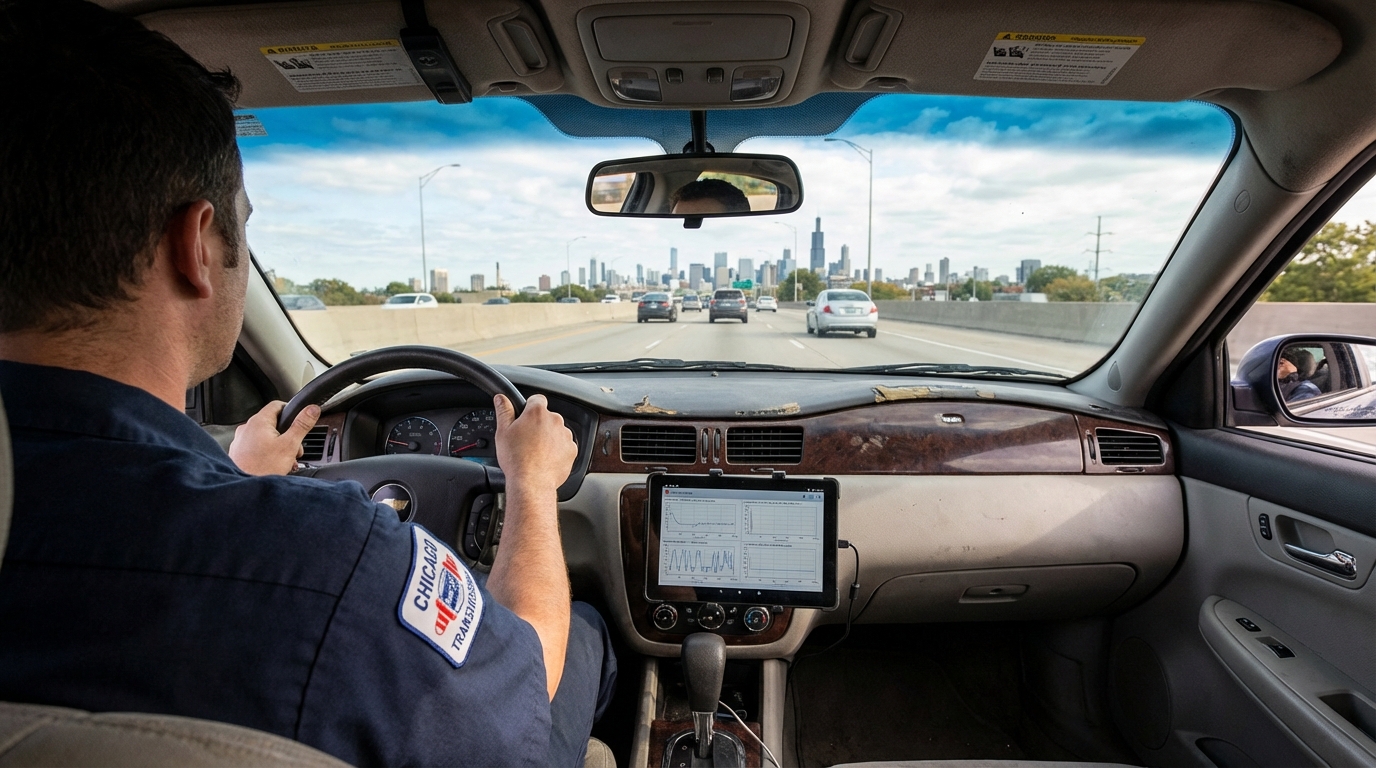
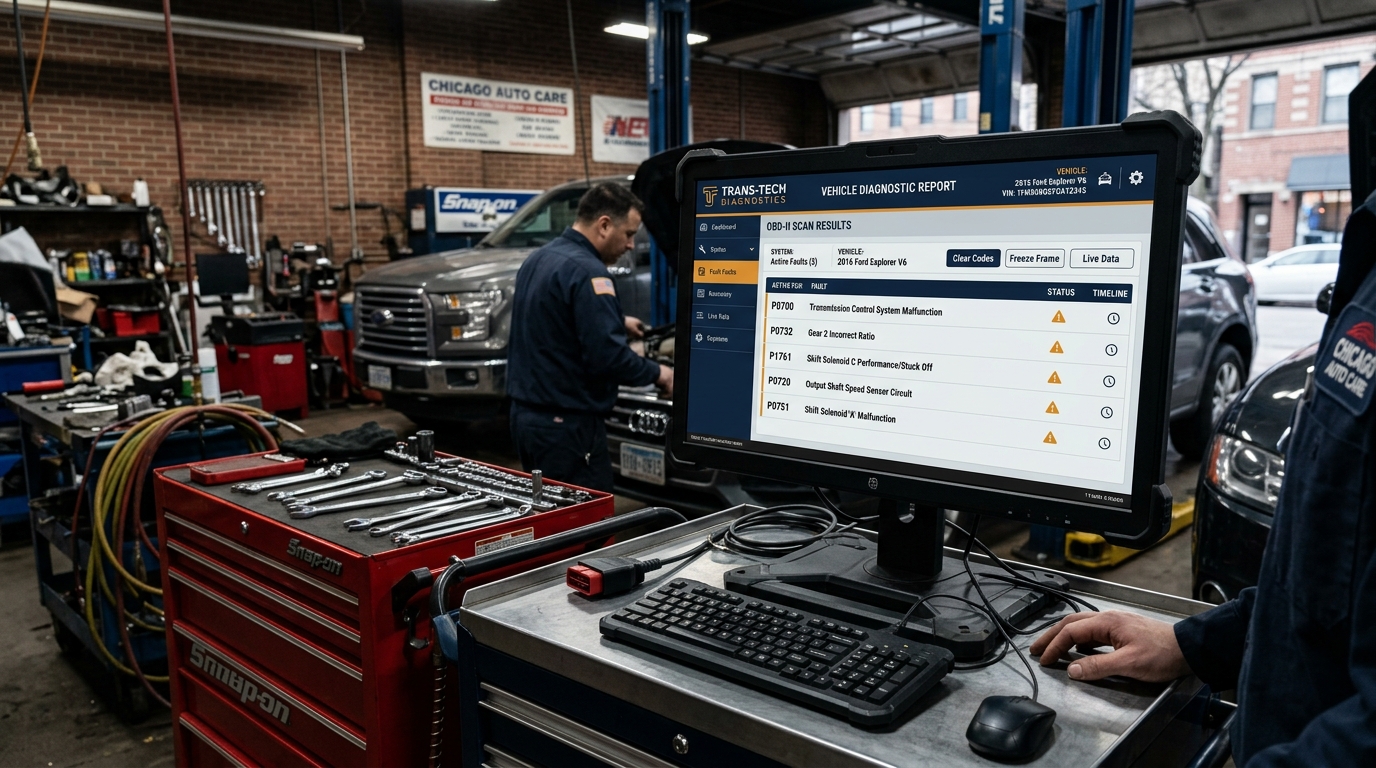
Step 1 - Full OBD-II scan with freeze-frame and live data. Use a scan tool that reads manufacturer-specific transmission codes, not just generic OBD-II. Record every code present (especially P0700, P0740, P0776-P0779, and any speed-sensor or ratio codes). Note freeze-frame parameters: vehicle speed, engine RPM, transmission fluid temperature, throttle position, commanded gear or ratio, and the PWM duty cycle commanded to Solenoid B at the moment the code set. If the code set at idle in park (as seen in some Subaru cases), the fault may be in the pressure sensor circuit rather than the solenoid itself.

Step 2 - Transmission fluid inspection. This is the critical first step for P0775 specifically. Check level (warm, engine idling, in park or per manufacturer procedure), color (healthy: pink to light red; degraded: brown to black), odor (burnt smell indicates overheated clutch material), and clarity (metallic shimmer or visible particles indicate hard-part wear). On Subaru CVTs, dark-brown fluid with needle-bearing debris means internal damage has likely progressed beyond solenoid repair. On Ford 5R55, check for the correct fluid specification (Mercon V or Mercon LV depending on model year). If fluid is low, top up and recheck before continuing - a simple low-fluid condition resolves P0775 in a meaningful percentage of cases.
Step 3 - Fluid and filter service (if fluid is degraded). Perform a drain-and-fill with the manufacturer-specified fluid and a new filter. On high-mileage vehicles (100,000+ miles) with unknown service history, perform two to three drain-and-fill cycles spaced 3,000 to 5,000 miles apart rather than a single aggressive flush. Clear codes after the service and road-test. If P0775 does not return after 50 to 100 miles of mixed driving, the fluid was the root cause.
Step 4 - Inspect and clean the transmission case connector and ground. Unplug the main transmission electrical connector. Inspect pins for corrosion, bent contacts, moisture, and partial retraction. Clean with electrical contact cleaner, dry with compressed air, and apply dielectric grease. Check all transmission ground straps - clean contact surfaces with sandpaper even if they appear visually clean, as microscopic oxide layers can add enough resistance to affect the low-impedance PWM circuit.

Step 5 - Measure solenoid resistance. With the connector unplugged, use a digital multimeter to measure resistance across the Pressure Control Solenoid B pins at the transmission-side connector. Typical specifications: Ford 5R55 variable-force solenoid 3 to 6 ohms; GM 6L80/6L90 approximately 3.5 to 7 ohms; Chrysler 1.5 to 3 ohms; Subaru CVT solenoids 5 to 15 ohms (consult the factory service manual for exact values, as the general range across all vehicles is 5 to 40 ohms). If resistance is out of range, the solenoid coil has failed. Perform a hot-resistance check (heat the area to 150 degrees F with a heat gun and recheck) to detect thermal-sensitive opens that only appear at operating temperature.
Step 6 - Bidirectional solenoid command test. Using a scan tool with bidirectional capability, command Solenoid B through a range of duty cycles (0%, 25%, 50%, 75%, 100%) while monitoring current draw. A healthy solenoid should draw current proportional to the commanded duty cycle, and you should observe a corresponding change in line pressure on the scan tool's live data or on a mechanical pressure gauge tapped into the appropriate test port. No current draw at any duty cycle indicates an open circuit. Full current draw with no pressure change indicates a stuck plunger or a hydraulic bypass (valve-body or servo-bore issue).
Step 7 - Line-pressure test. Connect a calibrated pressure gauge to the transmission's line-pressure test port (location varies by platform; consult the factory service manual). With the engine at operating temperature and the transmission in drive, compare measured pressure to the specification at idle and at stall (momentary wide-open throttle against the brakes). Low pressure across the board points to a pump issue; low pressure only in the circuit controlled by Solenoid B points to the solenoid, valve body, or servo bore. On Ford 5R55 transmissions, check the overdrive servo circuit specifically - low pressure here with a good solenoid block is diagnostic for servo-bore wear.

Step 8 - Pan drop and visual inspection (if earlier tests are inconclusive). Remove the transmission pan, inspect the filter for heavy clogging, the magnet for excessive metallic debris, and the valve-body face for scoring or warped gasket surfaces. On Ford 5R55, inspect the OD servo bore with a bore gauge or a visual inspection for scoring - if the bore diameter exceeds specification, a bore-repair sleeve kit or valve-body replacement is needed. On Subaru CVTs, inspect the valve-body solenoid area for varnish or debris and check the internal harness connectors.
Step 9 - Evaluate the transmission pump (if line pressure is low across all circuits). If the line-pressure test shows inadequate pressure system-wide (not just in Solenoid B's circuit), the pump is the suspect. Pump replacement or rebuild requires significant disassembly and is typically performed as part of a transmission rebuild.
H2 #7 - Repair Options and Chicago Cost Summary
Costs in the Chicago metropolitan area vary by vehicle, access, fluid condition, and whether programming is required. A written quote should follow diagnosis rather than a generic labor-rate assumption.

Transmission fluid and filter service: Drain-and-fill with OEM-spec fluid and new filter:. Full exchange/flush:. This resolves P0775 in an estimated 20 to 30 percent of cases where low or contaminated fluid was the root cause, and should be performed as part of the diagnostic process regardless.
Connector and ground-strap cleaning: Parts (contact cleaner, sandpaper, dielectric grease):. Labor: 0.5 to 1 hour. Total:.
Individual pressure control solenoid replacement (where applicable): Parts:. Labor: 1 to 2.5 hours (pan drop, solenoid swap, refill). Total:. This applies to transmissions where the solenoid is individually replaceable (some GM, Toyota, Subaru designs).

Solenoid pack or block replacement (Ford 5R55, Chrysler, some GM): Parts: (Ford 5R55 solenoid block -; Chrysler module -). Labor: 2 to 4 hours. Total:. On Ford, always replace the block gasket with the new pack - reusing the old gasket is a common cause of persistent codes.
Servo-bore repair (Ford 5R55 specific): Servo repair sleeve kit:. Labor: 2 to 4 hours (done during valve-body removal). Total:. This is the hidden cost that catches many Ford Explorer owners: replacing the solenoid block without addressing the worn OD servo bore results in a repeat P0775.
Valve-body rebuild or replacement: Parts (rebuild kit with springs, check balls, separator plate, gaskets):. Labor: 3 to 6 hours. Total:.

Transmission pump repair or replacement: Parts:. Labor: 4 to 8 hours (requires significant disassembly). Total:. Often bundled with a full rebuild.
Full transmission rebuild: this is the route when internal damage (worn clutch packs, damaged bearings, scored valve body) has progressed beyond solenoid-level repair. On Subaru CVTs, the rebuild option is limited - most shops recommend a remanufactured unit swap because CVT internals require specialized tooling. The final recommendation should be quoted after pan inspection, scan data, and parts availability are known.
Remanufactured transmission swap: depending on platform, warranty coverage, and whether the torque converter is included.

TCM reflash: (requires dealer-level or J2534-compatible tool with the latest calibration files).
TCM replacement: Module:. Programming:. Total:.
Pressure sensor replacement (Subaru CVT, when P0775 accompanies P0841): Parts:. Labor: 0.5 to 1 hour. Total:. This is a low-cost first step when Subaru-specific diagnostics point to the secondary pressure sensor rather than the solenoid itself.
H2 #8 - Vehicles Most Commonly Affected by P0775
Ford Explorer, Mountaineer, Mustang, and Lincoln LS (5R55W/5R55S). This is the platform most heavily represented in P0775 search results and forum discussions. The integrated solenoid block, combined with the 5R55's known servo-bore wear issue, creates a high incidence of the code after 100,000 miles. Explorer Forum threads document cases where multiple solenoid-pack replacements fail to resolve the code until the underlying servo bore or valve-body gasket is addressed.
Subaru Outback, Forester, Legacy, Impreza, and Crosstrek (TR580/TR690 Lineartronic CVT). P0775 on Subaru CVTs often accompanies P0841 (Transmission Fluid Pressure Sensor/Switch B Circuit Range/Performance) and points to either the driven-pulley pressure circuit solenoid or, in more severe cases, internal bearing failure. Subaru Outback Forum threads from 2025 document cases where dark fluid with metallic debris confirmed internal damage requiring a complete transmission swap.
GM Silverado, Sierra, Tahoe, Suburban, Escalade (6L80/6L90). These six-speed transmissions use multiple pressure control solenoids, and P0775 appears when Solenoid B - which modulates line pressure for mid-range gear transitions - fails or its circuit degrades.

Chrysler, Dodge, and Ram (45RFE, 545RFE, 68RFE). On these platforms, the pressure-control and shift-solenoid designations can overlap depending on the scan tool used. P0775 may refer to a pressure-regulation fault or may cross-reference to Shift Solenoid D depending on the manufacturer's calibration. Always verify the exact solenoid identity through the factory wiring diagram.
Toyota and Lexus (various automatic and CVT models). P0775 appears less frequently on Toyota platforms than on Ford or Subaru, but is reported on higher-mileage Camry, Corolla, and RAV4 models with conventional automatics, particularly when fluid service has been neglected.
Hyundai and Kia (A6MF/A6LF six-speed). Sonata, Optima, Tucson, and Sportage models report P0775 in conjunction with harsh shifting and torque-converter shudder, often associated with the TSB-documented valve-body issues on early A6MF units.
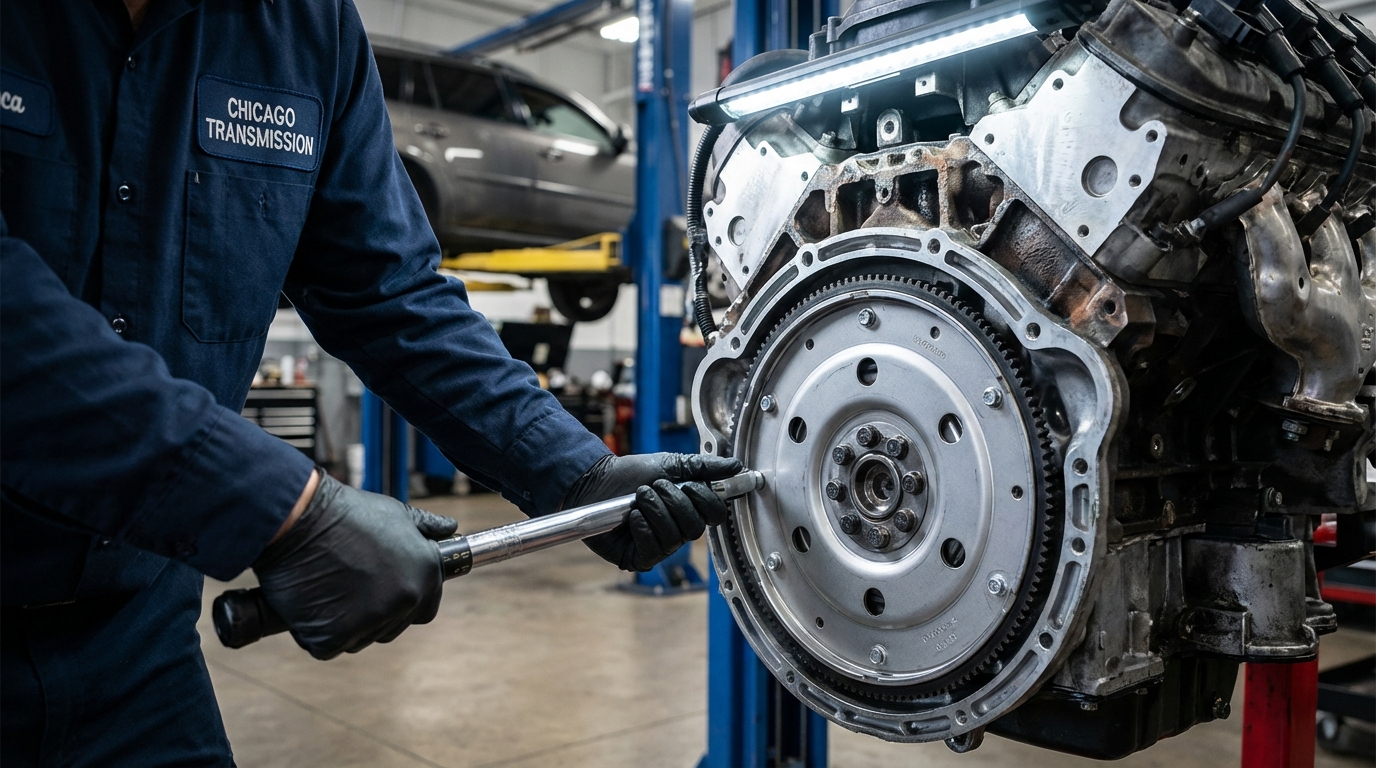
H2 #9 - P0775 vs. Related Codes: Quick-Reference Guide
P0775 (Pressure Control Solenoid B - Malfunction): general fault encompassing electrical and hydraulic failures. This is the broad "something is wrong" code. P0776 (Performance or Stuck Off): the TCM commands the solenoid to increase pressure, but pressure does not rise; suspect a stuck-closed plunger, clogged orifice, low pump output, or servo-bore bypass. P0777 (Stuck On): the solenoid delivers maximum pressure regardless of duty-cycle command; suspect a short in the driver circuit, a stuck-open plunger, or a stuck spool valve in the valve body. P0778 (Electrical): the TCM detects an open or short in the coil circuit specifically; focus on wiring, connector, and coil resistance. P0779 (Intermittent): the fault appears and disappears; look for thermal-sensitive coil failures, loose connector pins, and cold-weather viscosity effects.
If P0775 appears alongside P0770 (Shift Solenoid E) or P0776 with multiple pressure codes, the root cause is likely systemic - contaminated fluid, a pump issue, or a valve-body-wide problem - rather than an isolated Solenoid B failure. On Subaru CVTs, the combination of P0775 and P0841 specifically points to the secondary pressure circuit and warrants checking the pressure sensor before condemning the solenoid.
H2 local0 - Chicago-Specific Factors That Accelerate P0775 Failures
Road salt and connector corrosion remain the primary environmental accelerants, as with every transmission code in this series. The transmission case connector and external harness segments are exposed to chloride-laden road spray from October through April. On Ford Explorers, the solenoid-block connector sits low on the case where it collects slush; on Subaru CVTs, the case-connector seal can degrade over successive freeze-thaw cycles, allowing moisture to reach the internal harness. Annual cleaning and re-greasing of every accessible transmission connector before winter is the single most cost-effective preventive measure.
Cold-soak viscosity effects are especially impactful for pressure-control solenoids because these solenoids must modulate flow precisely - a task that becomes harder when the fluid is thick and sluggish. A marginally worn solenoid that delivers acceptable pressure at 180 degrees F may fail to generate minimum specification pressure at 10 degrees F. Freeze-frame data showing a low transmission-fluid temperature at the time the code set is a strong indicator of cold-related failure.
Stop-and-go traffic on the Kennedy, Eisenhower, Lake Shore Drive, and Dan Ryan expressways creates two problems for pressure-control solenoids. First, the constant shift cycling generates thermal stress on the solenoid coil and mechanical wear on the plunger and valve seat. Second, frequent braking and acceleration events prevent the transmission from reaching steady-state conditions where the solenoid's duty cycle is stable, instead forcing rapid and repeated pressure transitions that test the system's responsiveness.
Summer heat compounds the issue from the opposite direction. Sustained city driving in July and August with air conditioning at full load pushes transmission-fluid temperatures above 220 degrees F. At these temperatures, ATF oxidizes rapidly, forming the varnish that coats solenoid plungers and clogs orifices. The fluid's viscosity drops, which means the solenoid must open less to achieve the same pressure - but if the solenoid's calibration has drifted due to coil degradation, the TCM's correction range may be exceeded. An auxiliary transmission cooler keeps fluid in the 180 to 200 degrees F sweet spot and significantly extends solenoid life.
H2 local1 - Prevention and Maintenance Tips
Maintain the fluid aggressively. For Chicago vehicles, the severe-service interval - fluid and filter every 25,000 to 35,000 miles - is not optional, it is the baseline. Pressure control solenoids are more sensitive to fluid condition than shift solenoids because they modulate flow through smaller orifices. Use only the manufacturer-specified fluid (Subaru CVT Fluid for Subaru, Mercon V or Mercon LV for Ford depending on model year, Dexron VI or equivalent for GM, ATF+4 for Chrysler). On high-mileage vehicles with no service history, perform a series of drain-and-fill cycles rather than a single flush.
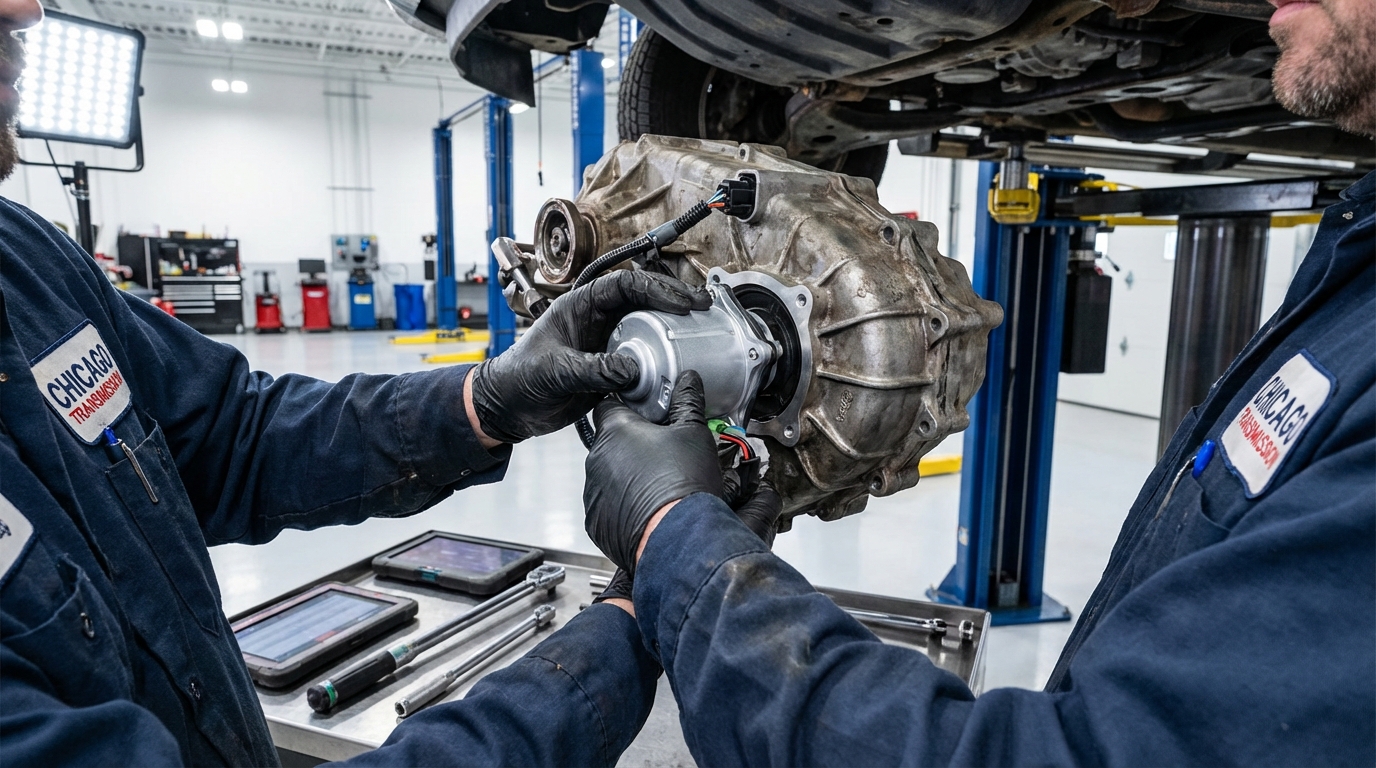
Protect the electrical connections. Before each Chicago winter, unplug the transmission case connector, clean with contact cleaner, dry thoroughly, apply dielectric grease, and reseat. Inspect external harness sections for chafed insulation, cracked loom, or corroded splice points. On Subaru, inspect the case-connector seal for cracking and replace if degraded.
Address the valve body and servo bore when replacing the solenoid. On Ford 5R55 transmissions, always inspect the overdrive servo bore and replace the servo O-ring (or install a bore-repair sleeve kit if wear is detected) when replacing the solenoid block. Always use a new valve-body-to-case gasket - never reuse the old one. This prevents the "replaced solenoid pack and still have the same code" scenario documented repeatedly in Explorer forums.
Replace the full solenoid set when one fails. If Pressure Control Solenoid B has failed at 120,000 miles, Solenoids A and C have the same mileage. The incremental parts cost of replacing all solenoids during a single pan-drop is far less than the labor cost of returning for the next failure.
Consider an auxiliary transmission cooler. For any Chicago vehicle used for towing, hauling, or commuting more than 30 minutes each way in stop-and-go traffic, an add-on cooler with a thermostat bypass is a worthwhile investment that extends the life of both the fluid and the solenoids.
Keep TCM software current. Manufacturers release calibration updates that refine shift-pressure tables. A reflash and can improve shift quality while also resetting adaptive-pressure values that may have drifted due to worn solenoids.
H2 local2 - Frequently Asked Questions
What does P0775 mean in plain language? Your transmission's computer detected a problem with the pressure-regulating solenoid labeled "B." This solenoid controls how hard or soft the transmission shifts. When it fails, shifts become harsh, slippery, or erratic, and the transmission may enter limp mode.
How serious is P0775? Serious. RepairPal classifies it as "Urgent." Unlike a shift-solenoid code that affects one gear, a pressure-control fault degrades every shift and can cause slipping that rapidly destroys clutch packs. Diagnose it within days, not weeks.
Can a transmission fluid change fix P0775? Yes, in an estimated 20 to 30 percent of cases - those where low or contaminated fluid was the direct cause. A fluid and filter service should always be the first repair step because it is relatively inexpensive and is a prerequisite for accurate further diagnosis. If the code does not return after 50 to 100 miles of mixed driving, the fluid was the culprit.
Why does my P0775 code only appear when it is cold? Cold fluid is thicker and harder for the solenoid to push through. A marginally worn solenoid or slightly low fluid level that works at 180 degrees F may fail at 10 degrees F. Using full-synthetic ATF rated for cold climates, ensuring the fluid is at the correct level, and cleaning the connector and ground strap can eliminate the winter-only pattern.
What is the difference between P0775 and P0778? P0775 is the general "Pressure Control Solenoid B - Malfunction" code that encompasses electrical and hydraulic failures. P0778 specifically means "Pressure Control Solenoid B - Electrical," narrowing the diagnosis to an open or short in the coil circuit. If you have P0778, focus on wiring, connector, and coil-resistance testing before investigating hydraulic causes.
Why did replacing the solenoid pack not fix my P0775 (Ford Explorer)? On Ford 5R55W/5R55S transmissions, the overdrive servo bore is a known wear point. If the bore has worn oversize, the servo piston seal cannot maintain pressure regardless of the solenoid's output. You may need a servo-bore repair sleeve kit, a new servo, and a new valve-body gasket in addition to the solenoid block. Also verify that you did not reuse the old block gasket.
Can I fix P0775 myself? A fluid-and-filter service and connector cleaning are solidly DIY-accessible. Measuring solenoid resistance requires a multimeter and the factory pin-out chart. Replacing a solenoid or solenoid block (pan drop, swap, refill) is intermediate-level and achievable with a service manual. Valve-body, servo-bore, or pump work is professional territory. The KBB guide and CarParts.com both recommend professional diagnosis for P0775 due to the transmission's complexity.
How long does the repair take? Fluid and filter service: 1 to 2 hours. Connector cleaning: 0.5 to 1 hour. Solenoid or solenoid-pack replacement: 2 to 4 hours. Valve-body rebuild: 4 to 8 hours. Transmission pump repair: 6 to 10 hours. Full rebuild or remanufactured swap: 1 to 2 days in a busy Chicago shop.
Which vehicles get P0775 most often? Ford Explorer, Mountaineer, Mustang, and Lincoln LS with 5R55W/5R55S transmissions; Subaru Outback, Forester, and Legacy with Lineartronic CVTs (TR580/TR690); GM trucks and SUVs with 6L80/6L90; and Chrysler/Dodge/Ram trucks with 45RFE/545RFE/68RFE.
Final Takeaway
P0775 marks a meaningful step up in severity from the shift-solenoid codes earlier in this series. A pressure-control solenoid fault affects the entire transmission's shift behavior, not just one gear, and the risk of cascading damage from slipping clutch packs makes prompt diagnosis essential. The good news is that a significant share of cases trace back to fluid condition - the cheapest possible fix. For Chicago vehicles, the combination of salt corrosion, extreme temperature swings, and heavy stop-and-go traffic makes aggressive fluid maintenance and annual connector care not just recommended but necessary. On Ford 5R55 platforms specifically, be prepared to address the servo bore and valve-body gasket alongside the solenoid block - it is the most common reason for repeat P0775 failures.
Series Progress: 26 of 50 articles completed (52%). P0775 - Done.
Have a Transmission Problem?
Get a free computer diagnostic from Chicago transmission repair support.