A well-maintained automatic transmission typically lasts 150,000 - 200,000 miles. Some last longer. Some fail at 80,000. The difference almost always comes down to maintenance history, operating conditions, and whether early warning signs were addressed before they became major failures. Here's what the data looks like.
Average Transmission Lifespan by Type
Traditional Automatic Transmissions
Most automatic transmissions - the 4-speed, 5-speed, 6-speed, and 8/9/10-speed automatics found in the majority of vehicles - are designed to last the life of the vehicle with proper maintenance. Industry data suggests:
- With regular fluid changes (every 30,000 - 50,000 miles): 150,000 - 250,000+ miles
- With neglected fluid (never changed or changed too rarely): 80,000 - 120,000 miles before significant problems
- Vehicles used for towing or heavy loads: Deduct 20 - 30% from any estimate unless an auxiliary cooler is installed
CVTs (Continuously Variable Transmissions)
CVTs have a different failure pattern. The steel belt or push-chain and the variator pulleys wear over time, and CVT fluid degrades faster than conventional ATF. CVT lifespan:
- With fluid changes every 25,000 - 30,000 miles: 120,000 - 180,000 miles
- With neglected fluid: 60,000 - 100,000 miles - CVTs fail dramatically faster without maintenance
- Nissan Jatco CVTs: Known for shorter life - 80,000 - 120,000 miles even with maintenance on some applications
Dual-Clutch Transmissions (DCT)
DCTs (like Ford's PowerShift, VW/Audi DSG, Porsche PDK) use wet or dry clutch packs instead of torque converters. Wet DCTs are generally durable; dry DCTs (Ford PowerShift, some Fiesta/Focus) have a troubled history with premature clutch wear.
- Wet DCT (VW DSG, Audi S-Tronic): 150,000 - 200,000 miles with correct fluid changes
- Dry DCT (Ford PowerShift 6DCT250): Often 60,000 - 100,000 miles before clutch replacement - a known defect on 2011 - 2016 Focus and Fiesta
What Kills Transmissions Early
Neglected Fluid - local Cause of Early Failure
This is the single biggest factor. Transmission fluid degrades over time, losing its friction modifiers and oxidation inhibitors. Old fluid causes increased clutch wear, solenoid varnishing, and valve body deposits. A transmission that's had fluid changed every 40,000 miles will last twice as long as one that's never had it changed - everything else equal.
Towing Beyond the Vehicle's Rating
Towing generates sustained high transmission temperature. Every 20 degrees F above the normal operating range cuts fluid and clutch life by roughly half. Chicago traffic - especially stop-and-go towing on I-90/94 in summer - is particularly hard on transmissions.
Driving on a Slipping Transmission
Slipping clutch packs generate heat. Heat degrades fluid and burns friction material. A solenoid repair ignored for 3 months becomes a rebuild. We hear this story regularly.
Low Fluid Level
Transmission fluid is both lubricant and hydraulic fluid. Low fluid reduces hydraulic pressure, causing clutch slippage - which generates heat, which further degrades the fluid. A small leak that goes unfixed creates a cascade.
Signs Your Transmission Is Aging
- Slightly delayed engagement (1 - 2 seconds after selecting Drive)
- Shift quality that's slightly less smooth than it used to be
- TCC shudder that appeared after 100,000 miles
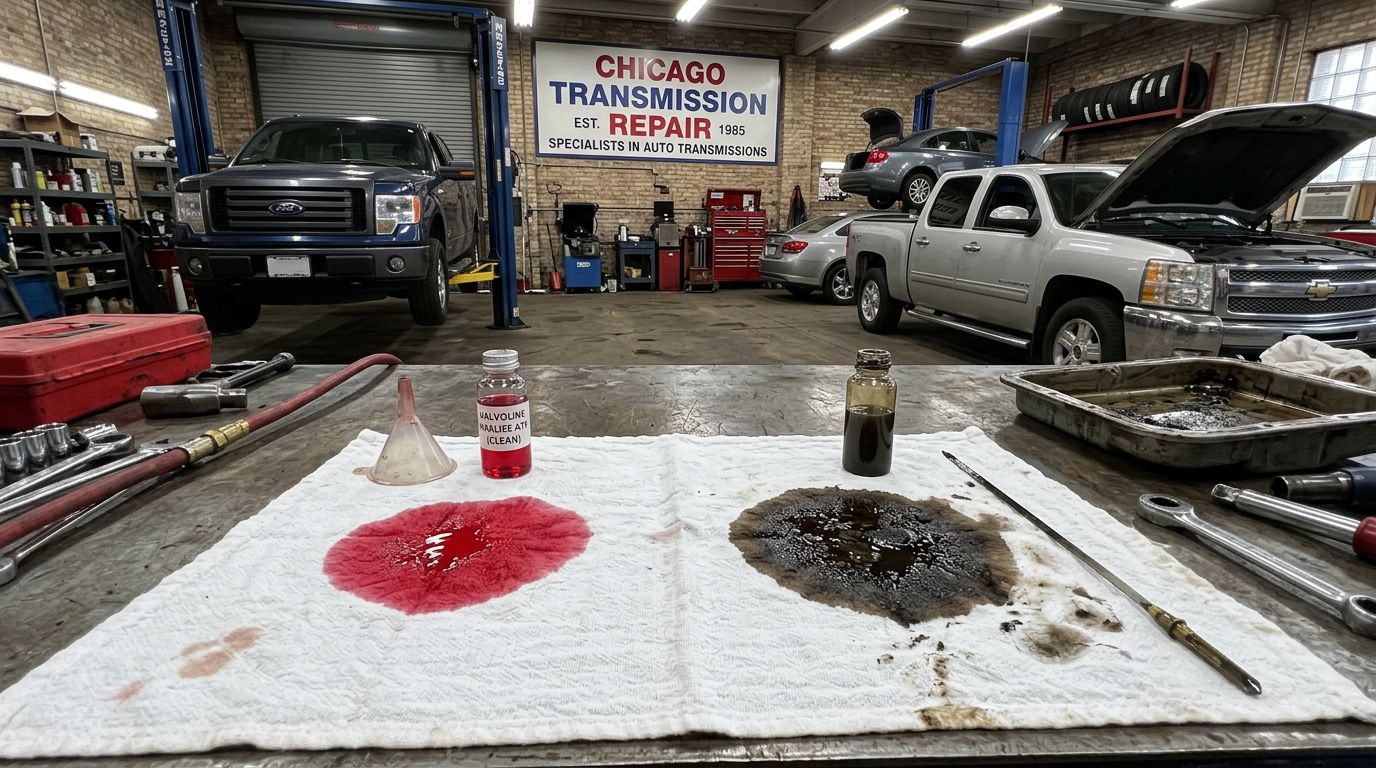
- Fluid that's darker than it used to be (check the dipstick color)
These are early warnings, not death sentences. A fluid service at this stage often adds 50,000+ miles to a transmission's life.
The Maintenance That Extends Transmission Life
- Fluid changes every 30,000 - 50,000 miles - with OEM-specified fluid, not generic ATF
- Fix leaks immediately - don't let low fluid become the new normal
- Address early symptoms - a fluid change now prevents a rebuild later
- Install an auxiliary cooler if you tow and it extends transmission life dramatically
- Free annual diagnostic if the vehicle is over 100,000 miles - catches solenoid wear before it causes clutch damage
Diagnostic appointment at Chicago Transmission, shop options near Southwest Chicago. Call (312) 626-8759 - Mon-Fri 8:00 AM-5:30 PM | Sat 8:00 AM-1:00 PM | Sun Closed.