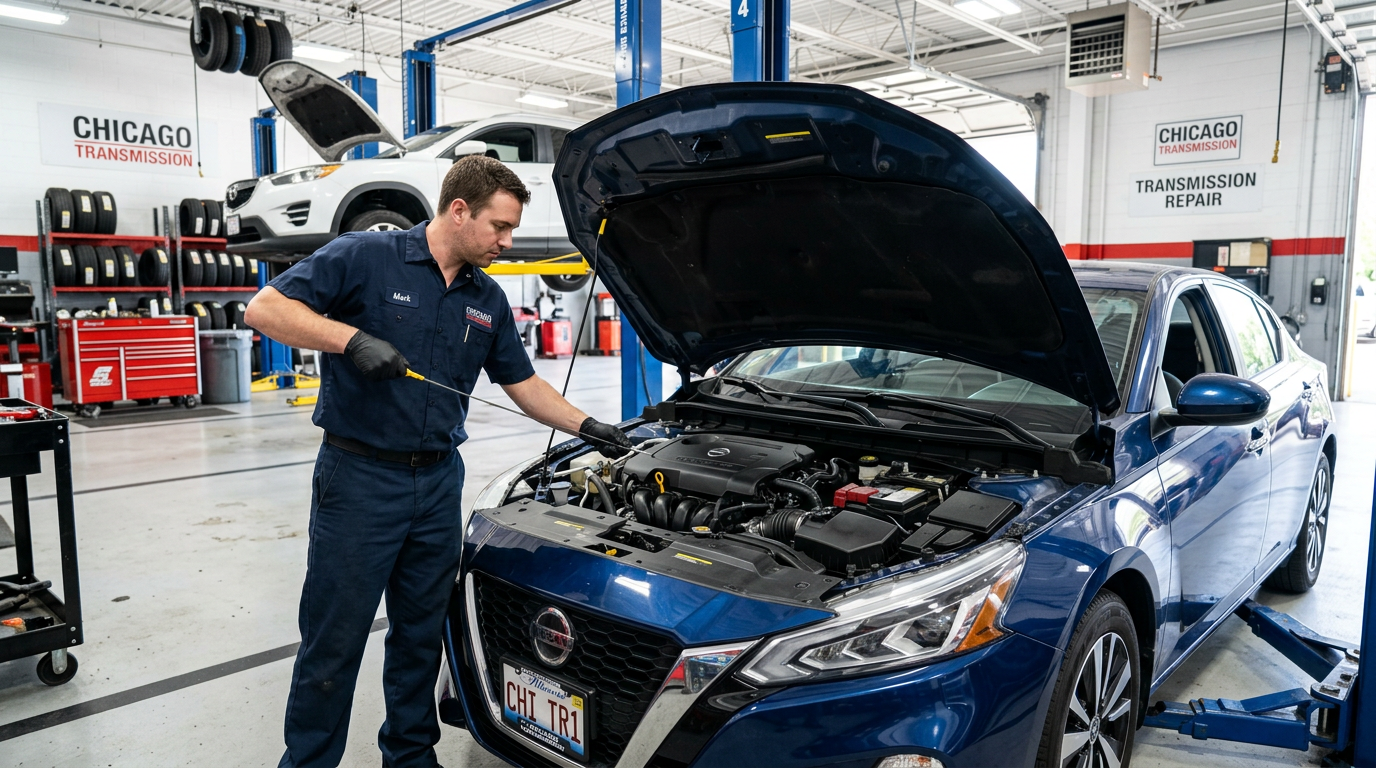
The 2019 Nissan Altima is the fifth generation of a car that has been selling in enormous numbers since 1992 - and like every Altima since 2007, it uses a Jatco CVT (Continuously Variable Transmission). Nissan's CVT reputation is complicated: when maintained properly, the CVT can last 150,000+ miles. When neglected or driven hard, it fails early and repairs are expensive. Here's what 2019 Altima owners in Chicago need to know.
The CVT in the 2019 Nissan Altima: Jatco CVT8
The 2019 Altima uses the Jatco CVT8, which Nissan has continuously refined over the previous CVT generations. Compared to the CVT7 in earlier Altimas, the CVT8 has a wider ratio spread and improved cooling. It's meaningfully better than what was in 2015 - 2017 models. However, the fundamental design - a steel push-belt running between two variable-diameter pulleys - is still subject to the same wear modes.
Nissan's CVT Warranty Extension
Nissan issued a warranty extension for CVT failures on many of their CVT-equipped vehicles. The coverage depends on model year and region. For the 2019 Altima specifically: check with Nissan's consumer affairs line or a Nissan dealer to confirm whether your VIN is covered by any outstanding campaign or extended warranty. If it is, the dealer repair is your first stop - at no cost to you.
If the warranty extension doesn't apply (coverage ended, mileage exceeded, or VIN not included), you're looking at out-of-pocket repair costs.
Common 2019 Nissan Altima CVT Problems
Shudder or Vibration Under Acceleration
CVT shudder in the Altima typically occurs at low speed under moderate throttle - particularly when pulling away from a stop or on slight uphill grades. This is usually belt/pulley surface wear or degraded CVT fluid that can no longer properly lubricate the contact patch. Early-stage shudder often responds to a CVT fluid exchange with Nissan NS-3 fluid.
Jerking or Hesitation When Engaging Drive
A forward jerk or shudder when shifting from Park to Drive - especially noticeable when the car is cold - indicates degraded fluid or early pulley wear. This can progress to delayed engagement over time.
Loss of Power or Failure to Accelerate
When the CVT belt slips significantly on the pulleys, the engine revs but the car doesn't accelerate proportionally. This is a critical symptom - belt slip at this level rapidly escalates to belt failure. If you experience this, stop driving immediately. Continued driving with a slipping belt can cause the belt to catastrophically fail inside the transmission, turning what might be a belt replacement into a full CVT replacement.
Whining Noise from Transmission
A high-pitched whining that increases with vehicle speed indicates bearing wear or pulley surface damage. The noise comes from the transmission and changes pitch with vehicle speed, not engine speed - this helps distinguish it from accessory belt noise.
Repair Cost for 2019 Nissan Altima CVT in Chicago
- CVT fluid exchange (NS-3 only): quoted after diagnosis, access check, and parts availability.
- CVT solenoid or sensor replacement: quoted after diagnosis, access check, and parts availability.
- CVT belt and pulley service: quoted after diagnosis, access check, and parts availability.
- Full CVT rebuild: quoted after diagnosis, access check, and parts availability.
- Remanufactured CVT unit (Jatco reman): quoted after diagnosis, access check, and parts availability.
The Maintenance Imperative for CVT Longevity
Nissan's manual says the CVT is "lifetime filled" and doesn't require service. This is demonstrably false in practice. Our shop has rebuilt dozens of Altima CVTs that failed at 80,000 - 100,000 miles with no service history. The same design, maintained with fluid changes every 25,000 - 30,000 miles, routinely runs 150,000+ miles without major failure. The fluid service is the most cost-effective maintenance a Nissan Altima owner can do.