The torque converter is the fluid coupling between your engine and your automatic transmission. It does something a manual clutch does mechanically - it lets the engine run while the car is stopped, and then smoothly transfers power as you accelerate. Understanding what it does helps explain why it fails and what those failures feel like.
The Basic Job: Fluid Coupling
In a car with a manual transmission, a friction clutch connects and disconnects the engine from the gearbox. In an automatic, the torque converter does the same job - but using fluid dynamics instead of mechanical friction.
Think of two fans facing each other. If you spin one fan (the pump), the moving air will spin the other fan (the turbine). The torque converter works the same way, but with oil instead of air. The engine spins the pump wheel; the oil picks up kinetic energy and drives the turbine wheel; the turbine is connected to the transmission input shaft. No mechanical connection required - the fluid does the work.
This is why automatic transmissions feel smooth from a stop: there's no clutch to slip or grab. The fluid coupling inherently provides a smooth transition from zero to full power transfer.
The Three Components Inside
Pump (Impeller)
The outer housing of the torque converter is bolted directly to the engine's flexplate and rotates at engine speed. The pump vanes inside this housing fling transmission fluid outward by centrifugal force, creating a high-velocity fluid circuit.
Turbine
The turbine sits inside the housing but is not connected to it - it's connected to the transmission input shaft. The fluid flowing from the pump hits the turbine vanes and spins them, transferring power to the transmission. At idle with the car stopped, the turbine barely moves. As engine speed increases, more fluid momentum builds up and eventually the turbine spins close to pump speed.
Stator
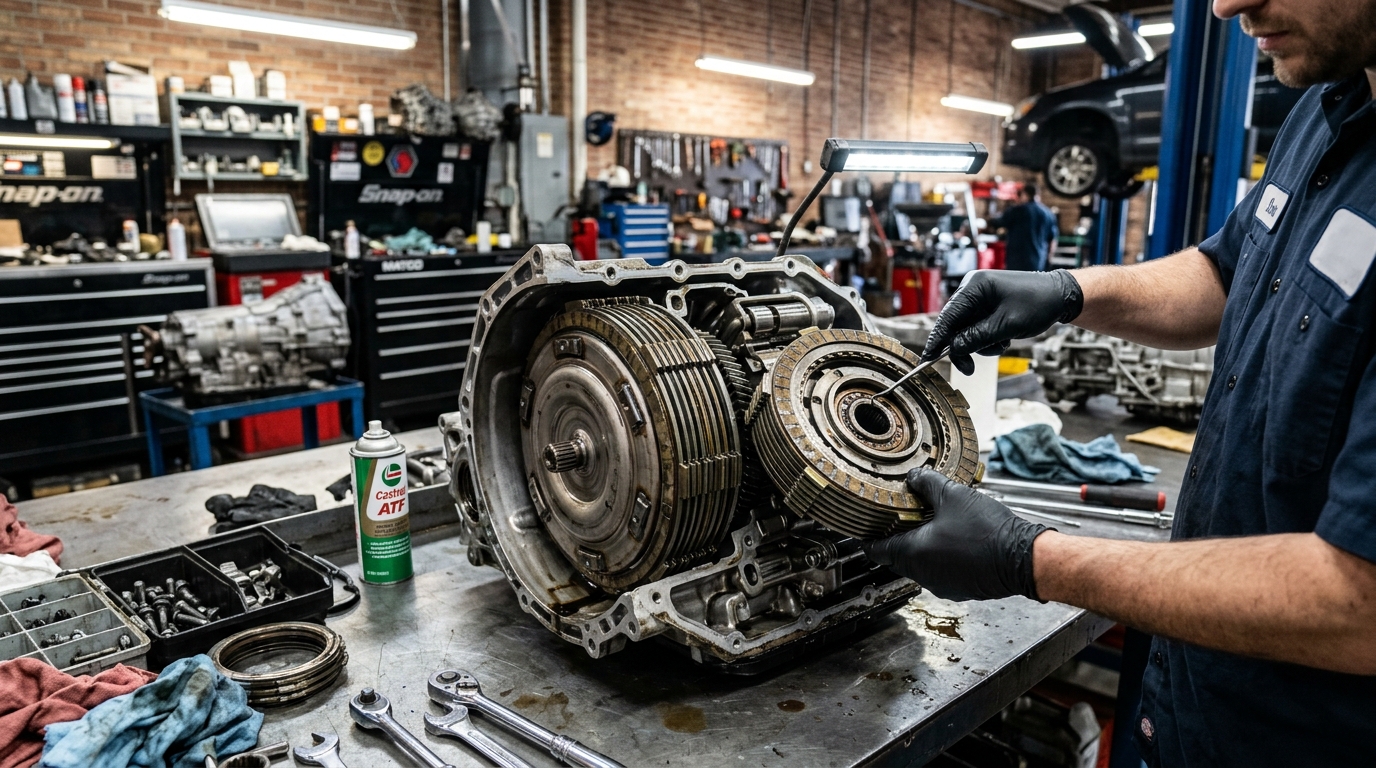
The stator sits between the pump and turbine and is the key to torque multiplication. Its angled vanes redirect fluid returning from the turbine back into the pump in the same direction it's already moving - like a booster. This recycling effect multiplies torque during acceleration: at low speeds, the torque converter can multiply engine torque by 1.5 - 2.5x, which is why automatics can accelerate smoothly from a stop without a clutch.
The stator is mounted on a one-way clutch. At higher speeds (when pump and turbine speeds are nearly matched), the stator spins freely and stops redirecting fluid - at this point the converter is operating as a simple fluid coupling without torque multiplication.
The Torque Converter Clutch (TCC)
There's a problem with pure fluid couplings: they always slip slightly, which wastes energy as heat and reduces fuel economy. Modern torque converters solve this with a mechanical lockup clutch - the Torque Converter Clutch (TCC).
At highway cruising speeds, the TCM commands the TCC to engage, mechanically locking the turbine to the converter housing. Now the engine and transmission turn together with no slip - just like a manual in top gear with the clutch fully engaged. This is why modern automatics match manual transmission fuel economy on the highway.
The TCC is what most torque converter repairs involve. Its friction disc wears over time, causing shudder (the characteristic vibration at 40 - 55 mph) when it can no longer engage cleanly.
Why Torque Converters Fail
- TCC friction wear: The most common failure. The TCC friction disc wears thin and can no longer lock up cleanly - instead it slips intermittently, producing shudder.
- Stator one-way clutch failure: The stator's one-way clutch seizes or fails to hold. You'll notice poor acceleration from a stop and reduced low-speed torque.
- Fluid contamination: Metal debris from a failing transmission damages converter internals.
- Overheating: Sustained TCC slippage generates heat that degrades the friction material and the fluid inside the converter.
When You Need a Torque Converter vs Just a Fluid Change
TCC shudder in its early stages often responds to a fluid exchange with OEM-spec fluid plus a friction modifier additive. If the friction disc still has usable material, the right fluid restores enough friction characteristics to eliminate the shudder. If the disc is worn through, no fluid will fix it and converter replacement is required.
Diagnosis determines which applies - see our torque converter replacement cost guide for Chicago pricing. Diagnostic appointment at Chicago Transmission, shop options near Southwest Chicago. Call (312) 626-8759.