The Toyota Camry has earned a reputation for reliability - and it's mostly deserved. But every generation has its characteristic transmission weak points, and knowing which generation you have helps set realistic expectations for repairs. Here's the breakdown by model year.
2002 - 2006 Camry: U241E 4-Speed (4-Cyl) / A750E 5-Speed (V6)
These are generally robust units with few systemic problems. Most issues on this generation are fluid-related:
- Delayed engagement from Park: Usually direct clutch wear - more common above 180,000 miles
- Slipping between gears: Forward clutch pack wear, accelerated by neglected fluid
- O/D light flashing: Shift solenoid failure - often P0750 or P0755
The key maintenance item for this generation: Toyota T-IV fluid. Using a universal ATF accelerates clutch wear. If fluid hasn't been changed in 60,000+ miles, a fluid exchange is the first step for most complaints.
2007 - 2011 Camry: U250E 6-Speed (4-Cyl) / U660E 6-Speed (V6)
The 5th-generation Camry introduced 6-speed automatics across the lineup. The U660E V6 is the most common transmission on the road today and has a well-documented weak point:
TCC Shudder (U660E)
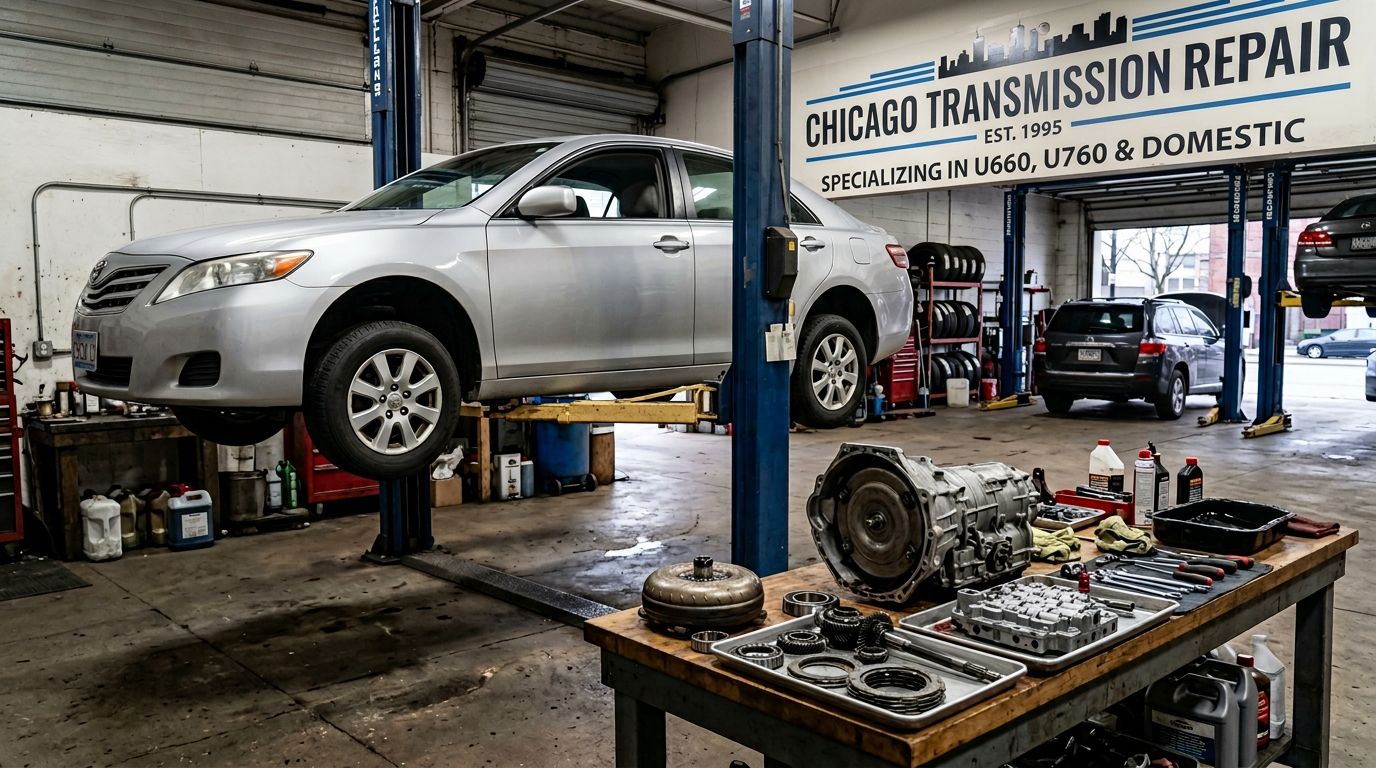
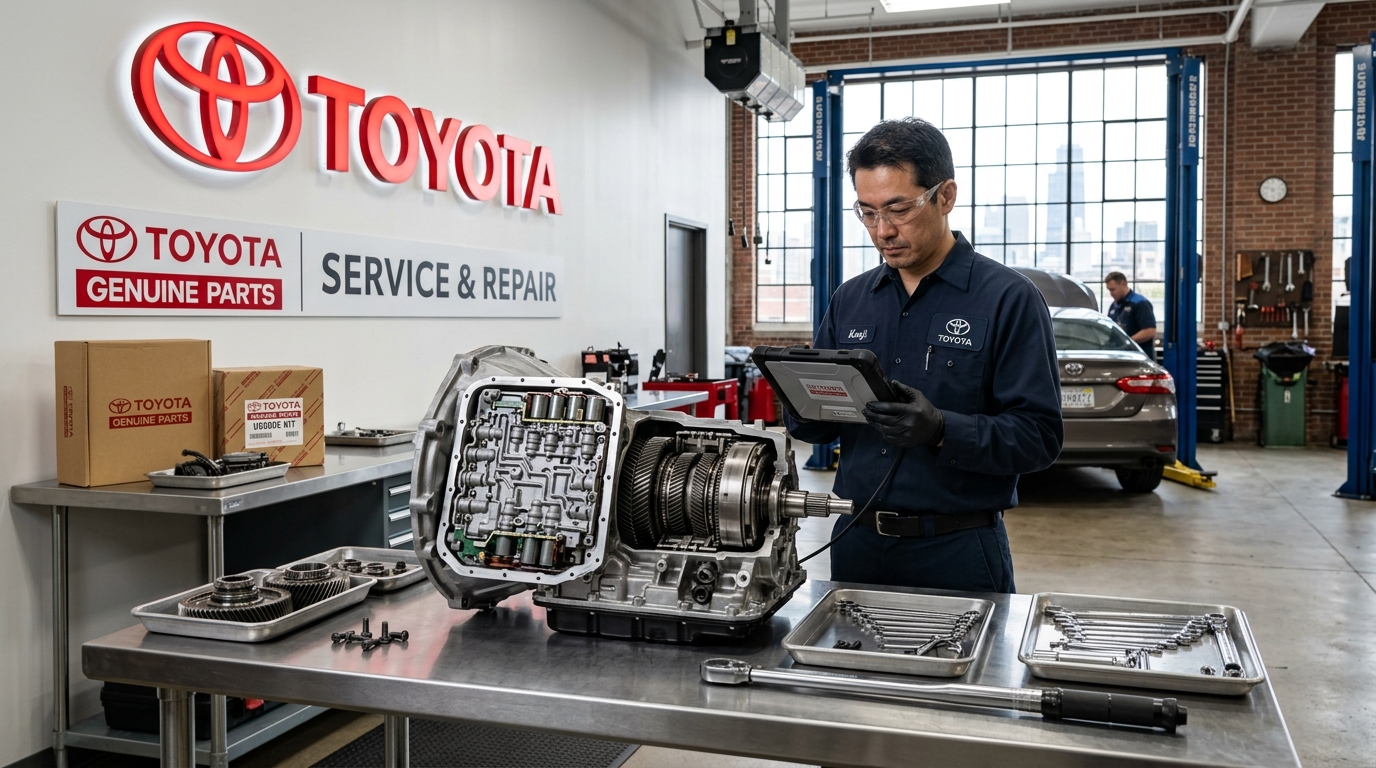
The 2007 - 2011 Camry V6 with the U660E is the most common Toyota shudder complaint we see in Chicago. Toyota issued multiple TSBs (including TSB 0155-11) addressing shudder at highway cruise speed. The fix involves a fluid exchange using Toyota ATF WS fluid plus Toyota's friction modifier additive (Part #00289-ATF0W). This resolves shudder in the majority of cases where the TCC friction material is not yet worn through.
Harsh Cold Shifts
Both U250E and U660E shift more firmly than expected during Chicago winters. This is partially normal behavior (cold fluid is more viscous), but it's exacerbated by degraded fluid that has absorbed moisture. A fluid exchange typically reduces the severity significantly.
2012 - 2017 Camry: U660E (All Engines)
The 6th-generation Camry used variants of the U660E across all engine options. The same TCC shudder and cold-shift issues apply, and this generation benefits from the same TSB fluid service fix.
One additional item specific to 2012 - 2014 models: some owners report a brief hesitation or delayed downshift when merging at highway speed. This is a TCM calibration behavior - a software update from Toyota (available through dealers) addresses it on most affected vehicles.
2018 - 2022 Camry: 8-Speed Direct-Shift Automatic
The 2018+ Camry introduced Toyota's Direct-Shift 8-speed - a fundamentally different design where the gears can engage from a stop without TCC slippage. This generation is too new to have the high-mileage pattern data of older units, but known issues include:
- Firm 1-2 upshift under light throttle: More pronounced than the U660E; Toyota acknowledged this and issued calibration updates
- Occasional rough engagement from Park to Drive: Reported on early 2018 - 2019 production; often resolved with fluid change and software update
Fluid spec for 2018+ Camry: Toyota ATF WS. The 8-speed is a sealed unit on some trims (no dipstick) - service requires a dealer or equipped independent shop.
Hybrid Camry: e-CVT
Hybrid Camry models use Toyota's e-CVT (electrically controlled CVT combined with the HV motor). This system rarely has mechanical failures before 200,000 miles; most hybrid drivetrain issues are HV battery or inverter-related rather than transmission mechanical failures.
Chicago Repair Costs
- Fluid exchange + friction modifier (shudder fix): quoted after diagnosis, access check, and parts availability.
- Shift solenoid replacement (P0750, P0755, P0760): quoted after diagnosis, access check, and parts availability.
- Torque converter replacement: quoted after diagnosis, access check, and parts availability.
- Full U660E rebuild: quoted after diagnosis, access check, and parts availability.
Call (312) 626-8759 - shop options near Southwest Chicago. Diagnostic appointment, Mon-Fri 8:00 AM-5:30 PM | Sat 8:00 AM-1:00 PM | Sun Closed.